
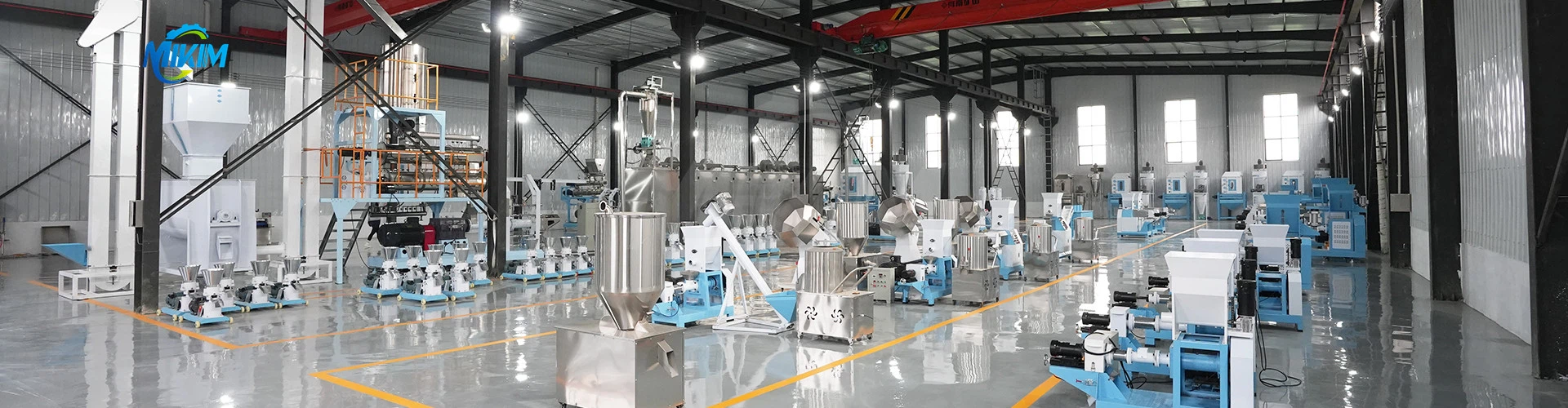
Before choosing equipment, you must first clarify your needs, including production scale, feed type and production process. Different needs will directly affect the choice of equipment, so you need to have a clear understanding of your own needs.
Equipment performance is a key factor affecting the quality of feed production. Attention should be paid to indicators such as equipment processing accuracy, production efficiency and energy consumption, while considering the equipment failure rate and maintenance costs.
Evaluate the scale of the farm and choose equipment with matching processing capacity. Small farmers may only need simple crushers and mixers, while large-scale breeding companies need complete sets of equipment with high automation and large production capacity.

| Model | Capacity | Power | Dimension | Weight |
| 125 | 80-100kg/h | 3kw | 110*35*70 cm | 95 kg |
| 150 | 120-150kg/h | 4kw | 115*35*80cm | 100 kg |
| 210 | 200-300kg/h | 7.5kw | 115*45*95cm | 300 kg |
| 260 | 500-600kg/h | 15kw | 138*46*100cm | 350 kg |
| 300 | 700-800kg/h | 22kw | 130*53*105cm | 600 kg |
| 360 | 900-1000kg/h | 22kw | 160*67*150cm | 800 kg |
| 400 | 1200-1500kg/h | 30kw | 160*68*145cm | 1200 kg |
Equipment quality directly affects the service life and operational stability of the equipment. Equipment produced by manufacturers with good reputation and credibility should be selected, and attention should be paid to the materials and manufacturing processes of the equipment to ensure that the equipment is wear-resistant, corrosion-resistant and easy to clean and maintain.
Modern feed equipment usually has an intelligent control system that can realize automatic feeding, feed monitoring, etc., to improve production efficiency. Therefore, when choosing equipment, you can pay attention to its intelligence level.
Choosing equipment suitable for your own breeding occasion can better meet your needs and improve work efficiency.