
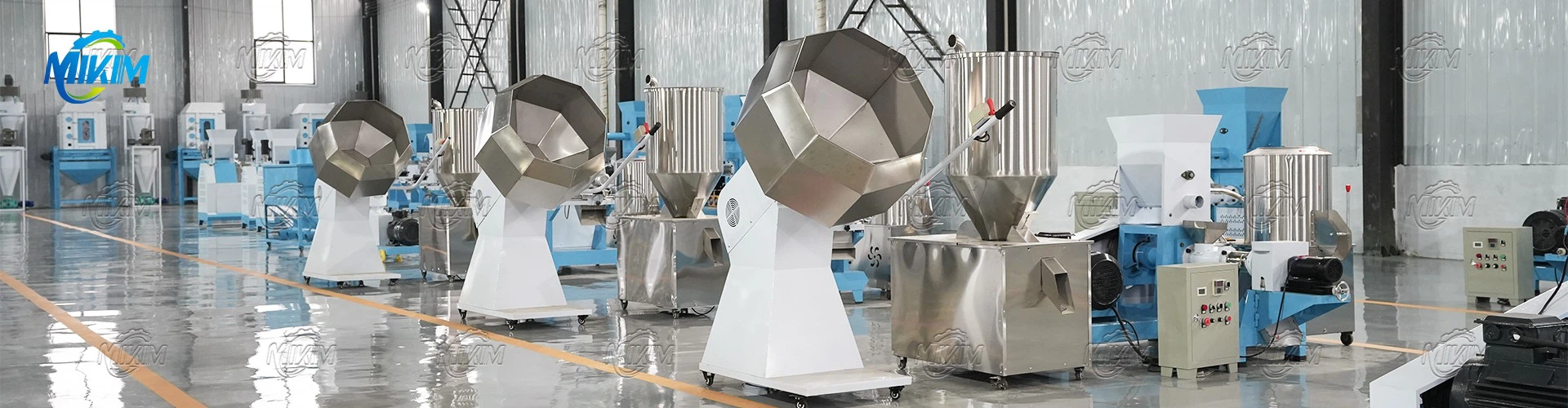
Animal feed pellet machine test videos
A finished cattle feed pellet machine, built to order, running on a corn, soybean meal and grass meal mix in the days before it was crated. This is the acceptance stage most first-time importers never get to see: the die is brought up to working temperature, the feed rate is set, and the first pellets come off the die while the machine is still on our floor. Slight surface cracking in the opening minutes is normal until the die warms through, and the operator points this out rather than editing it away. Watch the pellet surface and the amount of fines returning to the feeder - those two things tell you more about die condition than any capacity figure.
✓ Die warm-up behaviour and the first pellets off the die
✓ Pellet surface quality and fines returning to the feeder
✓ Machine condition at acceptance, before crating
This unit was built for a specific buyer and test-run on poultry feed before the order was accepted - not a stock machine pulled from the line for filming. Two details make the footage worth watching: it is dated, so you can judge how recent the build is, and the feed type matches what the buyer actually produces rather than a convenient test formula. For a first-time importer this is the most concrete assurance available. A certificate proves that a quality system exists somewhere; a dated recording of the ordered machine running proves that the unit in front of you works. Ask any supplier whether they can produce this for your order, and treat hesitation as an answer in itself.
✓ The unit running on the buyer's own feed formulation
✓ Recording date, to judge how current the build is
✓ That pre-delivery testing is standard, not a special request
This is the smallest complete feed line we run, and it is the one most farm-scale buyers should start by looking at. Crushing, mixing, pelleting and cooling operate as one linked sequence rather than four separate machines, which is the point where a farm stops buying equipment and starts operating a plant. Watch the material flow between stages: if the crusher outruns the mixer or the cooler cannot keep pace with the die, the line never reaches its rated output no matter what the pellet mill is capable of. That balance between stages is what a line quotation is really buying, and it is the first thing to interrogate when comparing two prices.
✓ All four stages running as one linked sequence
✓ Material flow and buffering between stages
✓ Footprint and layout a line of this size needs
Floating fish feed and aquatic feed extrusion videos
Five videos covering the full aquafeed range: from a 120 kg/h diesel unit for a single farm up to a one-tonne-per-hour wet-type machine for commercial production, plus shrimp feed.
A diesel drive is not a downgrade - it is the right answer for a site without reliable three-phase power, which describes a large share of fish farms in Africa, Southeast Asia and parts of Latin America. This unit is tested at 120 to 150 kg/h, and that capacity band exists for a reason: it is the size a single farm or small cooperative can feed with its own labour, without a dedicated electrical installation. Watch how the extruder is brought up to temperature, how the floating pellets come off the cutter, and what the pellet looks like once dried. If your site has unstable grid power, compare this against the electric version instead of dismissing it.
✓ Start-up sequence and how quickly output stabilises
✓ Pellet expansion and cut length coming off the die
✓ Whether a diesel drive fits your site's power situation
The important part of this clip is the phrase before packing. This is a customer's own unit, already built to their order, running at 200 kg/h in our workshop in the days before it was crated. That sequence is what makes the footage useful: the machine on screen is not a demo unit kept for filming, it is the same physical machine the buyer paid for, and the video was their proof of condition prior to shipment. If you are negotiating with several suppliers, ask each one whether they film your specific unit before it ships or only show generic footage. The difference is the difference between a promise and a record.
✓ Machine condition immediately before it was packed
✓ Actual output achieved on the buyer's own unit
✓ That pre-shipment filming is a standard step
Pellet diameter drives almost every other decision in aquafeed: a 4 mm pellet suits fingerlings and small species, and producing it consistently is harder than producing a larger pellet because the die holes are smaller and block more readily. This unit runs at 300 to 500 kg/h on a 4 mm die, which puts it in the middle of the farm-to-commercial transition. If you are moving up from a small extruder, the question is rarely whether the machine can hit the tonnage - it is whether it can hold a small pellet size without constant die cleaning. Watch the cut consistency and how the operator manages the die during the run.
✓ 4 mm pellet cut consistency at sustained output
✓ How the die is managed during the run
✓ Where this sits between farm-scale and commercial units
This is the top of the single-machine range on this page, and the wet-type process is why. At one tonne per hour and above, the constraint stops being the extruder and becomes how consistently you can prepare the slurry going in - moisture control, grinding fineness and feed rate all have to hold steady or pellet quality drifts. The video shows the machine running at that output, which is the number to hold a supplier to if you are planning a commercial aquafeed operation. Smaller farms rarely need this. Buyers scaling up from a 200 kg/h unit to a commercial line usually do, and this is the reference point for that conversation.
✓ Machine scale and footprint at one-tonne-per-hour output
✓ Pellet consistency at sustained high throughput
✓ Whether your raw material prep can support this rate
Shrimp feed is a harder pelleting problem than poultry feed. The pellet has to hold together in water long enough to be eaten, which shifts the emphasis from raw throughput to die compression, binder dispersion and pellet durability. This clip shows a shrimp feed mill running and the finished pellets it produces - the check most buyers skip, because they compare capacity figures and never look at what actually comes out of the die. If your operation is aquafeed rather than livestock feed, compare the pellet appearance here against the floating fish feed clips before settling on a die specification. Water stability, not tonnage, is what decides whether shrimp feed performs.
✓ Finished shrimp pellet uniformity and surface
✓ Die and cutter setup for a water-stable pellet
✓ How this output differs from floating fish feed
Pet food extrusion videos
Three videos spanning small single units for home or workshop production up to a 40–300 kg/h complete pet food line.
Pet food shape is a marketing decision as much as a production one - triangular kibble, star, bone and ring shapes all come from the same extruder with a different die plate and cutter setting. This trial run shows a pet food extruder producing triangular kibble in our workshop, which is the stage where a buyer finds out whether the shape they want is actually achievable at their target output. Shape complexity costs throughput: the more intricate the profile, the slower the run. If you are planning a retail product where appearance matters, ask for a shape trial before ordering rather than after the machine arrives.
✓ Triangular kibble formation and cut quality
✓ How die plate and cutter set the final shape
✓ Output trade-off when running a shaped profile
Not every buyer is building a factory. This clip shows a small pet food extruder running in a home or workshop setting, which is the entry point for breeders, kennels and small brands testing a formula before scaling. The value here is honesty about scale: a machine this size produces enough for a household or a small local customer base, not for distribution. Watch how much manual handling the process involves at this size - filling, drying and packing are all done by hand, and that labour is the real constraint on output, not the extruder itself. If you plan to sell rather than feed your own animals, start by looking at the line videos instead.
✓ Realistic output for a home or workshop setup
✓ How much of the process is still manual
✓ Where the scale ceiling sits before you need a line
A pet food line at 40 to 300 kg/h covers the whole range from a small regional brand to a mid-size manufacturer, and the same equipment set scales across it. The stages are crusher, mixer, extruder, dryer, flavour coating drum, cooling and packing - and the dryer is usually the stage buyers underestimate. Wet extruded kibble comes out at high moisture, and if the dryer cannot match the extruder's output the line runs below rating no matter how capable the extruder is. Watch how the drying and coating stages are laid out here; that layout, more than the extruder specification, is what determines whether the line holds its rated capacity shift after shift.
✓ Full stage sequence including dryer and coating drum
✓ Relative size of drying equipment versus extruder
✓ How the line scales across the 40–300 kg/h band
Complete feed and fish feed production line videos
Two full-process demonstrations. If you are planning a plant rather than buying a machine, start here.
If you are planning a plant rather than buying a machine, this is the video to start with. It follows a fish feed line through the whole process in sequence - crushing, mixing, extrusion, drying, cooling and packing - so you can see how each stage feeds the next and where the bottlenecks actually sit. Buyers evaluating a turnkey quote usually focus on the extruder and underestimate everything around it: dryer capacity, conveying between stages, cooling time before packing. Watching the line run end to end is the fastest way to understand why two quotes for the same nominal output can differ by a wide margin, and which stage you should be asking harder questions about.
✓ Full stage sequence and how material moves between them
✓ Relative footprint of dryer, cooler and conveying
✓ Which stage is likely to constrain your target output
An extruded aquatic feed line is not simply a fish feed line with a different die. Extrusion changes the process upstream as well: raw material has to be ground finer and conditioned more precisely, and the downstream drying and cooling have to handle a lighter, more porous pellet that is harder to dry evenly. This factory test shows the line running as a unit before it was accepted, which is the point where integration problems surface - conveyors that cannot keep up, controls that do not talk to each other, cooling that runs ahead of drying. Any of those would have been far more expensive to fix after installation on the buyer's site.
✓ Line integration tested before shipping, not after arrival
✓ How extrusion affects upstream grinding and conditioning
✓ Control and conveying between stages
Assembly, operation and maintenance tutorials
Four how-to videos filmed by the technicians who build these machines. They double as the reference clips our after-sales team sends when a customer needs to replace a part.
This is not a product animation. It is one of our technicians putting a single-screw extruder together on the workshop bench, part by part - barrel, screw, cutter head and drive coupling - in the order the assembly actually happens. Buyers who have never imported machinery often worry about what arrives in the crate and whether the machine can be put back together after maintenance. This video answers both: it shows the component count, how the parts mate, and how much of the assembly is straightforward enough for your own team to repeat on site. It is also the clip our after-sales team sends when a customer needs to replace a screw or re-seat the cutter assembly.
✓ How the screw and barrel fit, and the order they go back in
✓ Whether assembly is within reach of your own maintenance staff
✓ Build quality at component level, not behind a painted panel
Most extruder problems in the first month of operation are operator errors, not machine faults: starting with a cold die, feeding too fast, or running material at the wrong moisture. This walkthrough covers the correct operating sequence on a small floating fish feed extruder - preheating, setting the feed rate against the die temperature, and what to do when output starts to drop mid-run. It is written for the person who will actually stand in front of the machine, not for an engineer. If you are training staff to run a new unit, this is the clip to watch together before commissioning, which is exactly why we recorded it.
✓ Correct preheat and start-up sequence
✓ How feed rate is matched to die temperature
✓ What a drop in output mid-run usually means
The control cabinet is the part of an imported machine that fails first, and the part almost no supplier shows you. Here our electrician walks through the cabinet on a single-screw extruder as it is wired: terminal layout, contactor and overload protection, the main drive circuit and the auxiliary circuits for the feeder. Nothing is hidden behind a cover. If you are comparing three suppliers and want to know who actually builds their own panels rather than buying a generic box, this is a more useful thirty seconds than any specification sheet. It doubles as a wiring reference for your own electrician during installation.
✓ Component layout inside the cabinet
✓ Whether overload and phase protection are fitted as standard
✓ How the cabinet is labelled for on-site installation
Floating feed is not simply feed that has been extruded - the pellet floats because the extrusion process creates a porous, expanded structure, and whether it floats long enough depends on how the material was prepared and how the die was set. This clip follows the full process from raw material through grinding, mixing, extrusion and drying to a finished floating pellet. Watch the expansion at the die and the change in the pellet after drying; those two moments explain why two producers using similar machines get feed with very different water stability. If you are setting up aquafeed production for the first time, this is the process to understand before choosing a machine.
✓ The stages from raw material to finished floating pellet
✓ Pellet expansion at the die and shrinkage after drying
✓ Why water stability varies between producers
Biomass wood pellet machine videos
Ring die and flat die machines are often compared on price when the real difference is geometry. On a flat die mill the rollers press material down through a horizontal die and pellets drop out underneath; on a ring die mill the die is a rotating vertical ring and material is pressed outward through it. That larger working area is why ring die machines hold throughput on continuous duty, and why commercial biomass plants standardise on them. This clip shows a ring die mill running on sawdust for fuel pellet production. If you are moving up from a flat die machine because your order book has outgrown it, this is the configuration to compare against.
✓ Ring die geometry and how material is pressed outward
✓ Pellet density and surface on sawdust feedstock
✓ Machine build for continuous commercial duty
Briquette and charcoal machine videos
Five videos covering the briquette range across straw, sawdust, wood chips and charcoal powder - the widest material span of any category on this page.
The single biggest question about briquette machines is material flexibility, and the honest answer is that it depends on the press and the die rather than on the marketing claim. This clip shows a briquette press working across straw, sawdust and wood chips - three materials with very different fibre structure, bulk density and flow behaviour. Watching the same machine handle all three tells you more about real versatility than a specification table, because you can see where the operator has to adjust feed rate or die pressure between materials. If your supply of raw material varies seasonally, this flexibility matters more than peak output on any one material.
✓ Three different materials through the same press
✓ Where the operator adjusts between materials
✓ Briquette density and surface on each feedstock
This is the entry point into briquetting: a compact press that turns sawdust and wood dust into fuel briquettes or BBQ charcoal feedstock, at a scale a small workshop or farm can run. The economics of small-scale briquetting depend less on the machine than on what you are feeding it - free sawdust from a nearby mill changes the calculation completely compared with buying material in. Watch the output rate and how much manual handling the process needs at this size; that labour requirement is the number that decides whether a small operation is viable, and it is the number suppliers rarely mention.
✓ Realistic output for a workshop-scale press
✓ Manual handling needed per shift
✓ Briquette form for fuel versus charcoal feedstock
Charcoal extrusion is a different process from briquetting: instead of pressing loose biomass, it shapes carbonised powder into rods with a binder, which is how most BBQ and shisha charcoal is formed before drying. This clip shows a charcoal rod extruder in factory stock, which is useful for a different reason than a test run - it tells you what a finished unit looks like when it is ready to ship, including the frame, the auger and the die head. If you are comparing quotes and one supplier's machine looks substantially lighter in build than another's at a similar price, that difference is worth asking about before you order.
✓ Finished unit build before shipment
✓ Auger and die head configuration for charcoal rods
✓ How this differs from a biomass briquetting press
Briquette quality is decided before the material ever reaches the press. Moisture content, particle size and the absence of contaminants like sand or stones determine whether you get a dense, stable briquette or one that crumbles in the yard. This walkthrough follows the full sequence on a sawdust press - preparing and drying the material, feeding the press, and checking the finished briquette. If you are new to briquetting and have been quoted a machine without being asked about your material's moisture content, that is a warning sign: the press cannot fix a feedstock problem, and no amount of pressure compensates for material that is too wet.
✓ Material preparation before it enters the press
✓ Feeding method and how density is judged
✓ Why moisture content decides briquette quality
Waste-to-energy briquetting is where briquette machines earn their keep in industrial settings: agricultural residue, processing waste and offcuts that would otherwise be burned or landfilled get densified into a fuel that can substitute for coal in boilers. The technical requirement is different from household briquettes - consistent calorific value and low ash matter more than appearance, and the machine has to tolerate a feedstock whose composition shifts from batch to batch. This clip shows a briquette machine running on that kind of material. If your project is a waste-handling operation rather than a fuel producer, the questions to ask are about ash content and moisture tolerance, not output tonnage alone.
✓ Machine behaviour on mixed or variable feedstock
✓ Briquette form suited to boiler feed
✓ Build robustness for industrial duty
Shipping and Delivery
A machine that runs perfectly in our workshop can still arrive damaged if it is packed badly, and that risk sits entirely with the buyer once the container leaves. This clip follows a stainless steel granule production line through packing for a specific customer order: how the stainless surfaces are wrapped, how frame sections are braced against container movement, how smaller components are boxed and marked against the packing list, and how the set is loaded. If you have been quoted by several suppliers at similar prices, the difference often shows up here rather than in the machine itself - and this is the stage where cheap suppliers cut corners you only discover on arrival.
✓ Protective wrapping and bracing on stainless surfaces
✓ How components are marked against the packing list
✓ Real container loading, not a staged photo
factory
This is our machining workshop, not a showroom - the room where the screws and dies that go into every machine we ship are actually cut. Both are wear parts: the screw and the die decide how consistently a pellet mill holds output and how long it runs between rebuilds, which is why buying them in from an outside supplier is a risk most assemblers quietly accept. What the clip shows is the sequence as it happens - cutting, turning, milling, drilling and precision machining on our own equipment, followed by inspection before anything goes to assembly. If you are comparing suppliers and want to know who genuinely machines their own components rather than reselling bought-in parts, this sixteen seconds answers that faster than any brochure claim. It is also the reason we can supply replacement screws and dies to your original dimensions years after your order.
✓ Cutting, turning, milling and drilling on our own machines
✓ Die and screw inspection before they reach assembly
✓ Why these two wear parts decide pellet consistency and service life
Questions buyers ask after watching these videos
Built in our own facility using precision CNC technology, then assembled, wired and tested in the same workshop you see in the videos. Machines run 24 hours before QC sign-off, and every exported unit is filmed for the buyer's written approval before it is crated.
Yes. We deliver complete EPC projects: raw material analysis, 3D plant layout and process flowchart, equipment manufacturing, 24-hour trial run and QC inspection, then export packaging and installation support. The line videos on this page show that process end to end.
Each card states the capacity of the machine in that specific recording, taken from the order it was built for. Ask for the test report and the serial number of the unit in the video - we keep both on file for every shipment.
Yes, at no cost. Send 5–10 kg of your feedstock and we run it on the closest matching machine, then return a performance report and pellet samples along with the test video. This removes the technical risk before you commit to an order.
ISO 9001:2015 for our quality management system, plus CE documentation covering feed and pet food production lines, briquette machines, wood crushing machines, dryers and extruders. Full certificate documents are available on request.
Standard practice on every export order. Your unit is run, filmed and sent to you for written approval before the container is loaded - the same step shown in the pre-shipment test videos above.
Send us your raw material - we will film the test
Tell us the material, the target capacity and the pellet size. We run it on the closest machine in our workshop and send back the video with the measured output, before you place any order.
Send 5–10 kg of material. You get a performance report, pellet samples and the test video - no commitment attached.
Request a Test Run