
-
Customer Location: Yaoundé, Cameroon
- Target Species: African Catfish (Clarias gariepinus) and Nile Tilapia
- The Problem: Rising prices of imported commercial feed (accounting for 70% of farm OPEX).
- The Solution: MIKIM DGP-Series Dry-Type Floating Fish Feed Extruder.
- Key Result: Successful transition to 100% self-produced, high-buoyancy feed using local ingredients.
1. The Challenge: The Economic Bottleneck of Aquaculture in Cameroon
Fish farming is a booming industry in Cameroon, yet many farmers struggle with the high volatility of imported feed prices. Our customer, a medium-scale farm owner, faced a common dilemma: the cost of commercial bagged feed was eroding his profit margins, making it difficult to compete in the local market.
Primary Challenges Identified:
- Supply Chain Instability: Frequent delays in imported feed delivery.
- Nutritional Inconsistency: Lack of control over protein levels for different growth stages.
- High Feed Waste: Sinking feeds were causing water pollution and poor Feed Conversion Ratios (FCR).
2. The Solution: MIKIM Dry-Type Fish Feed Extruder
After consulting with MIKIM's technical team, the customer selected the Dry-Type Floating Fish Feed Making Machine. This model was chosen specifically for the African market because it does not require a steam boiler, significantly lowering the initial investment and simplifying maintenance.
Technical Specifications of the Installed Unit:
| Feature | Technical Detail |
| Model | DGP Series (Dry-Type Extrusion) |
| Output Capacity | Customized (ranges from 100kg/h to 350kg/h) |
| Pellet Diameter | 1.0mm – 9.0mm (Interchangeable dies) |
| Expansion Rate | High (Floating time > 24 hours) |
| Power Supply | 380V/50Hz (Customized for local grid) |
MIKIM 350kg/h dry-type floating fish feed pellet extruder machine feedback form Cameroon Customer
I am interested in this product
3. Data-Driven Results: The ROI of Self-Production
The most significant impact of the MIKIM machine was on the farm's bottom line. By sourcing raw materials locally, the customer achieved the following:
Cost Comparison (Per Ton of Feed)
- Commercial Feed Price: ~$1,200 - $1,400 USD/Ton
- Self-Produced Feed Cost: ~$750 - $850 USD/Ton (including raw materials, electricity, and labor)
- Savings: Approx. 35% - 45% per ton.
- Return on Investment (ROI): Based on the farm's monthly consumption of 5 tons, the machine is projected to pay for itself within 7 months.
4. Technical Expertise: Optimized Local Formula
One reason for this project's success was the customization of the feed formula using Cameroonian raw materials. MIKIM's nutritionists suggested the following localized blend:
| Ingredient | Percentage | Nutritional Role |
| Maize/Corn Flour | 25% | Energy & Starch (for expansion) |
| Soybean Meal | 30% | Primary Plant Protein |
| Local Fish Meal | 15% | Essential Animal Protein |
| Rice/Wheat Bran | 20% | Fiber & Bulk |
| Cassava Flour | 8% | Natural Binder (Locally abundant) |
| Vitamin/Mineral Premix | 2% | Growth & Immunity |
Result: The pellets achieved a 99.5% floating rate, allowing the farmer to monitor fish health and minimize uneaten waste.
Floating Fish Feed Pellet Buoyancy Test by Our Customer in Cameroon


5. Overcoming Operational Challenges
Transitioning to self-production often involves a learning curve. During the first week of installation in Cameroon, the customer faced a challenge with pellet uniformity.
MIKIM's Professional Support:
- Remote Troubleshooting: Through video calls, MIKIM engineers identified that the raw material moisture content was too high (above 25%).
- Adjustment: We guided the customer to adjust the moisture to 15-20% and fine-tune the cutter speed.
- Outcome: The farm now produces perfectly uniform, smooth-surface pellets consistently.
6. Why MIKIM is the Preferred Choice for Africa
MIKIM doesn't just sell machines; we provide aquaculture empowerment.
- Wear-Resistant Parts: Our screws and sleeves are made of high-strength alloy, doubling the service life compared to standard models.
- Global Logistics Experience: Deep expertise in shipping to Douala and Kribi ports, handling all documentation.
- Comprehensive Service: We provide the machine, the formula, the spare parts, and the technical training.
7. FAQ
Q1: Is the dry type floating fish food pellet making machine easy to operate for beginners?
Yes. The machine features a user-friendly control cabinet. MIKIM provides full video tutorials and an operation manual. Most customers become proficient within 2 days of testing.
Q2: Can I produce feed for both Tilapia and Catfish?
Absolutely. By simply changing the die (mold) and adjusting the protein ratio in your formula, you can produce 1mm-2mm pellets for fingerlings and 4mm-8mm pellets for adult fish.
Q3: How do I get spare parts in Cameroon?
MIKIM includes a set of "wear parts" (screws, dies, heating rings) with every shipment. For long-term needs, we offer express international shipping via DHL/FedEx.
Q4: Does a dry type floating fish food pellet extruder machine Require an Additional Boiler?
A: No. A dry type floating fish food pellet maker machine does not require an external boiler or steam system. It generates the heat needed for extrusion through mechanical friction, pressure, and, in some models, electric heating. This simplifies installation, reduces initial investment, and lowers maintenance costs. In contrast, wet Type Floating fish feed extruder machines require an external steam boiler to supply steam during the extrusion process.
Q5: What Is the Price of a Dry Type floating Fish Feed pellet making machine in the Philippines?
A: Our dry type floating fish food extruder machines typically start at around USD 1,500, with prices varying according to the model, output capacity, motor power, and optional configurations. Please contact us for the latest pricing and a customized quotation.
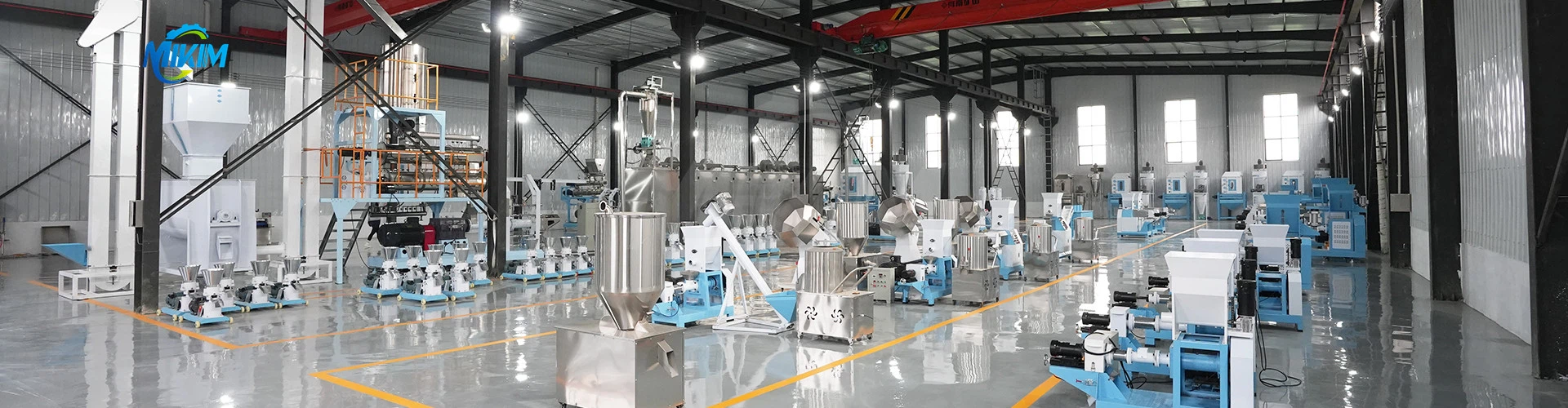
Our Factory


