

Key Technical Highlights:
- System Power: Industrial standard 90kW - 110kW main motor for high-torque stability.
- Floating Performance: Achieving a >98% floating rate through precise steam conditioning (85°C-95°C) and SME control.
- Process Optimization: Integration of dual-shaft differential conditioning and post-extrusion oil coating for premium pellet quality.
- Goal: To provide a professional roadmap for farm owners and feed manufacturers to achieve FCR ratios of 1.2-1.5 while minimizing machine wear.
1. Industrial Technical Specifications (1000kg/h Grade)
The following parameters are the baseline for a standard 1-ton-per-hour industrial twin-screw line. Parameters deviating significantly from these ranges may indicate insufficient torque or thermal capacity.
| Component | Engineering Standard (1000kg/h) |
| Main Motor Power | 90kW - 110kW (High-torque configuration) |
| Screw Diameter | Φ95mm - Φ115mm |
| L/D Ratio | 18:1 to 21:1 |
| Conditioner Type | Dual-Shaft Differential (Stainless Steel 304) |
| SME (Specific Mechanical Energy) | 15 - 35 Wh/kg |
| Steam Pressure | 0.4 - 0.8 MPa |
| Screw Service Life | 1,500 - 3,000 Hours (Application dependent) |
2. Advantages of Wet-Type Twin-Screw Floating Fish Feed Extruder Machines
At a production scale of 1000kg/h, Wet-type Twin screw floating fish food pellet maker machine provides critical process advantages:
- Positive Displacement: Intermeshing screws prevent extrusion surging, ensuring a stable flow even with high-moisture or "sticky" raw materials.
- Controlled Shear: The modular screw configuration allows for precise adjustment of the mixing, kneading, and shearing zones.
- Optimized Fat Management: Twin-screw extruders can handle up to 8% internal fat while maintaining high expansion ratios for floating feed.(Note: Total fat content up to 15-20% is achieved via post-extrusion coating).
What Are the Key Advantages of a Twin screw floating fish feed pellet making machine?
Learn more about formula adaptability, precise pellet control, water stability, and efficient commercial feed production.
3. The 7-Step Industrial Testing Protocol
1000kg/h Wet-type Twin-Screw floating fish feed extruder test in our factory
I am interested in this product
Step 1: Particle Size Verification (Micronization)
Raw materials must be pulverized to 60-80 mesh. Inadequate grinding leads to die-hole blockage and uneven expansion, causing pressure fluctuations in the barrel.
Step 2: Differential Steam Conditioning
We utilize a dual-shaft differential conditioner to achieve a retention time of 90-120 seconds. This ensures a pre-gelatinization rate of >30%, significantly reducing the mechanical load (amps) on the main motor and extending screw life.
Step 3: SME and Torque Monitoring via PLC
During the test, we monitor the Specific Mechanical Energy (SME). For floating aquafeed, the moisture at the extruder inlet is typically maintained at 22-26%.
Observation: If torque exceeds 85% of motor capacity, steam injection in the barrel jackets is adjusted to reduce internal friction.
Step 4: Die Head and Cutter Calibration
The die plate must be preheated to prevent a "cold plug." We synchronize the inverter-controlled cutter to maintain a pellet length-to-diameter ratio of 1:1 or 1.2:1.
Step 5: Post-Extrusion Oil Coating (Essential Section)
For commercial 1000 kg/h lines, pellets transition from the extruder to a Vacuum or Drum Coater. This stage adds supplemental oils and heat-sensitive vitamins that cannot survive the high temperatures of the extruder barrel.
Step 6: Thermal Dehydration (Drying)
Pellets enter a multi-layer circulation dryer. For 1000kg/h production, the dryer must be rated to remove approximately 150-180kg of moisture per hour to reach a final safe storage moisture of 8-10%.
Step 7: Buoyancy and Stability Analysis
Pellets are sampled for density testing. High-quality floating feed must achieve a floating rate of ≥98% with a water stability time exceeding 12 hours without structural collapse.

Our Wet-type Twin screw floating fish food extruder machine ensures that 99% of pellets remain afloat for over 24 hours, even with high-protein formulations.
4. Safety & Operational Warnings
Before commencing any testing or maintenance on the 1000kg/h extrusion line, all operators must adhere to the following safety standards:
- High-Temperature Hazard: The extruder barrel and steam pipes can reach temperatures over 150°C. Avoid direct contact and always wear heat-resistant PPE.
- High-Pressure Discharge: During start-up or in the event of a blockage, "blowouts" may occur at the die head. Never stand directly in front of the die while the machine is running.
- LOTO (Lock-Out Tag-Out): Before adjusting the cutter blades or cleaning the screw, the power supply must be disconnected and locked to prevent accidental startup.
- Steam Safety: Ensure all steam valves are inspected for leaks. Sudden release of high-pressure steam can cause severe invisible burns.
- Emergency Stop: Familiarize yourself with the location of the E-Stop button on the PLC cabinet before powering the main motor.
5. Technical Troubleshooting for Commissioning
| Problem | Root Cause Analysis | Corrective Action |
| Pellet "Surging" | Uneven feeding or steam pressure flux | Calibrate screw feeder; stabilize boiler output |
| Instantaneous Overloading | Cold start or excessive dry material | Pre-heat barrel to 100°C; check conditioning moisture |
| Sinking Pellets | Insufficient starch or low SME | Increase screw speed or add high-gelatin starch (cassava) |
| Tailings on Pellets | Cutter blade misalignment | Adjust blade-to-die clearance (0.05-0.1mm) |
6. Mechanical Build Quality: What to Check in a 1000kg/h Wet-type Twin-Screw floating fish feed extruder
A professional 1000kg/h extruder is identified by its secondary components, not just its output:
- Gearbox: Must be a high-torque, independent reduction gearbox with an integrated oil cooling/lubrication system.
- Screw Material: Screws must be fabricated from High-Chrome Alloy (Cr12MoV) or vacuum-quenched 38CrMoAl.
- Safety Interlocks: The PLC must include an automatic "Pressure Relief" or "Emergency Stop" sequence if barrel pressure exceeds 6 MPa.
7. Customer Case
Nigerian Customer Receives Integrated Grinding and Mixing Machine + 500kg/h Fish Feed Extruder


7. FAQ
Q1. What Makes Floating Fish Feed Pellets Float on Water?
Floating fish feed pellets float mainly because the extrusion process creates a porous, low-density structure, rather than because a special floating ingredient is simply added to the formula.
A starch-rich formulation is commonly used to support expansion during extrusion. During processing, heat, moisture, pressure, and mechanical shear gelatinize the starch. When the extruded material leaves the die, the sudden pressure drop causes moisture to vaporize and the feed to expand, creating small air spaces inside the pellet.
Therefore, the key factors affecting floating performance are the following:
- Starch content and formulation
- Raw material moisture
- Steam or water addition
- Extrusion temperature and pressure
- Screw speed and configuration
- Die-hole size and design
- Feed rate and residence time
In short: Floating feed is produced primarily through controlled extrusion and expansion, not by adding a single ingredient that makes the pellets float.
Q2. What Is the Feed Conversion Ratio (FCR) of Floating Fish Feed?
The feed conversion ratio (FCR) is the amount of feed required to produce one unit of fish weight gain. It is calculated as:
FCR = Feed Consumed ÷ Weight Gain
For example, if fish consume 1.2 kg of feed and gain 1 kg of body weight, the FCR is 1.2.
However, there is no single FCR for all floating fish feed or grain-based feed. FCR depends on the fish species, feed formulation, feed quality, feeding rate, water temperature, fish size, stocking density, and farm management.
Floating feed can help improve feed management because farmers can observe the pellets on the water surface and adjust feeding when uneaten feed remains. However, floating ability itself does not guarantee a lower FCR.
For an accurate FCR evaluation, compare feeds under the same species, growth stage, feeding program, and farming conditions.
Q3. How can a wet-type twin-screw floating fish feed pellet making machine Blockages Be Prevented During Production?
Occasional blockages in a Wet-type Twin-Screw floating fish feed extruder can usually be reduced by controlling raw material moisture, maintaining a consistent feed rate, preventing foreign materials from entering the machine, and keeping the die and extrusion chamber clean.
The main preventive measures include:
- Control raw material moisture: Excessively wet or unevenly moistened material can make extrusion unstable.
- Maintain consistent feeding: Avoid sudden increases in feed rate that overload the extrusion chamber.
- Grind raw materials properly: Oversized particles or poorly ground materials can interfere with smooth feeding and extrusion.
- Remove foreign materials: Stones, metal pieces, ropes, and other contaminants should be removed before materials enter the extruder.
- Check the die regularly: Accumulated feed residue or partially blocked die holes can increase extrusion pressure.
- Clean the extrusion chamber: Remove residual material after production, especially when processing sticky or high-protein formulas.
- Monitor motor load and extrusion pressure: A sudden increase can indicate excessive feeding, unsuitable moisture, or developing blockage.
If a blockage occurs, do not continue forcing material through the extruder. Stop the machine according to the manufacturer's operating procedure, isolate the power supply, and inspect the feeding section, screw chamber, and die after the equipment has safely stopped.
Q4. How Do You Replace the Blades on a Wet-type twin-screw floating fish feed pellet extruder machine?
Replacing the Wet-type Twin-Screw floating fish feed extruder cutting blade (knife) involves safely stopping and isolating the machine, removing the existing cutter assembly, installing the new blade, and adjusting the cutting position before restarting.
A general replacement procedure is:
- Stop the extruder completely and disconnect the power supply according to the manufacturer's lockout and safety procedure.
- Make sure the die and cutter assembly are no longer moving or under pressure.
- Remove any residual feed material around the cutting area.
- Loosen and remove the worn cutting blade or cutter assembly using the appropriate tools.
- Inspect the blade holder, shaft, fasteners, and mounting surface for wear or damage.
- Install the new blade securely in the correct position.
- Adjust the blade-to-die clearance according to the extruder manufacturer's specifications.
- Manually check that the cutter can rotate freely without contacting the die improperly.
- Reinstall all guards and safety covers.
10. Run the machine at low speed first and check whether the pellets are being cut evenly.
Important: The exact blade replacement method varies by extruder model and cutter design. Always follow the machine manufacturer's service manual for the correct blade type, mounting method, clearance, and tightening requirements.
A properly adjusted cutting blade should produce consistent pellet lengths without excessive powder, deformation, or damage to the die surface.
Q5. Does a Wet-type Twin-screw floating fish feed pellet maker machine Need a Steam Boiler?
Yes. A Wet-type twin-screw floating fish machine generally requires a steam source, and a steam boiler is commonly used to provide the required steam. Steam helps control moisture and temperature during conditioning and extrusion, promoting starch gelatinization and improving pellet quality.
For a 1000kg/h Wet-type Twin screw floating fish feed production machine, the required steam capacity depends on the machine configuration, feed formula, raw material moisture, and operating conditions. A 0.5 t/h steam boiler may be suitable for some 1000kg/h extruder configurations, but it should be confirmed according to the actual steam consumption of the specific machine.
Steam is mainly used to:
- Increase and stabilize feed moisture
- Improve starch gelatinization
- Provide more consistent extrusion conditions
- Improve pellet expansion and structure
- Help maintain stable pellet quality
Therefore, when selecting a steam boiler for a 1000kg/h wet-type fish feed extruder, do not determine the boiler capacity from the extruder output alone. The manufacturer's recommended steam consumption and the actual feed formula should be used to select the appropriate boiler.
Q6. What Is the Difference Between a Wet-Type and Dry-Type floating fish food extruder machine?
The main difference is how moisture and heat are supplied during extrusion. A wet-type fish feed pellet extruder machine uses steam and/or water to condition the feed material, while a dry-type extruder mainly generates heat through mechanical friction and does not normally require an external steam boiler.
- A Wet-type Floating fish feed extruder machine is suitable for applications requiring better moisture and temperature control and can handle a wider range of feed formulations. It is commonly used for commercial aquafeed production where stable pellet quality and continuous production are important.
- A dry-type fish feed pellet extruder machine has a simpler setup and is often preferred for small- and medium-scale fish feed production where a steam system is not available.
In simple terms:
Wet-type fish feed pellet extruder machine: steam/water conditioning → better process control → suitable for larger-scale production
Dry-type floating Fish Feed pellet making machine: mechanical heating → simpler setup → suitable for smaller-scale production
The appropriate type should be selected based on production capacity, feed formula, target pellet size, available utilities, and required pellet characteristics.
Conclusion
The successful operation of a 1000 kg/h Wet-type Twin-Screw floating fish feed extruder is a science of balancing mechanical shear with thermal conditioning. At Mikim, our testing protocols ensure that your production line is optimized for your specific local ingredients and target species.
Contact the MIKIM Engineering Team for detailed CAD layouts and customized extrusion parameters tailored to your production requirements.
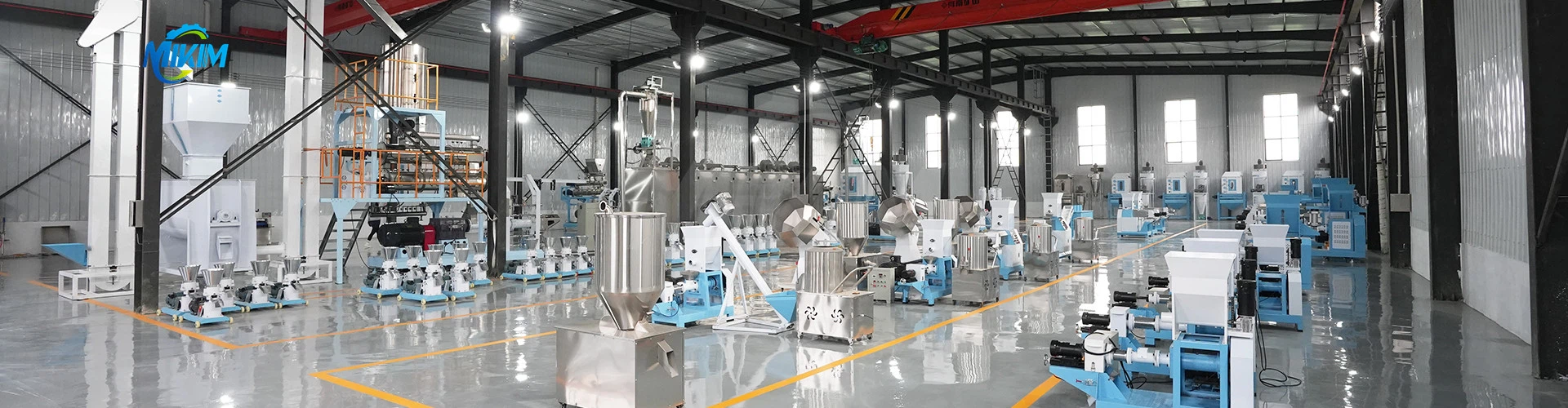
Our Factory

Packaging and Shipping
Our machines are first wrapped with stretch film, securely packed in wooden crates, and then loaded into containers for safe international shipping.

Certificate of Quality Compliance
