
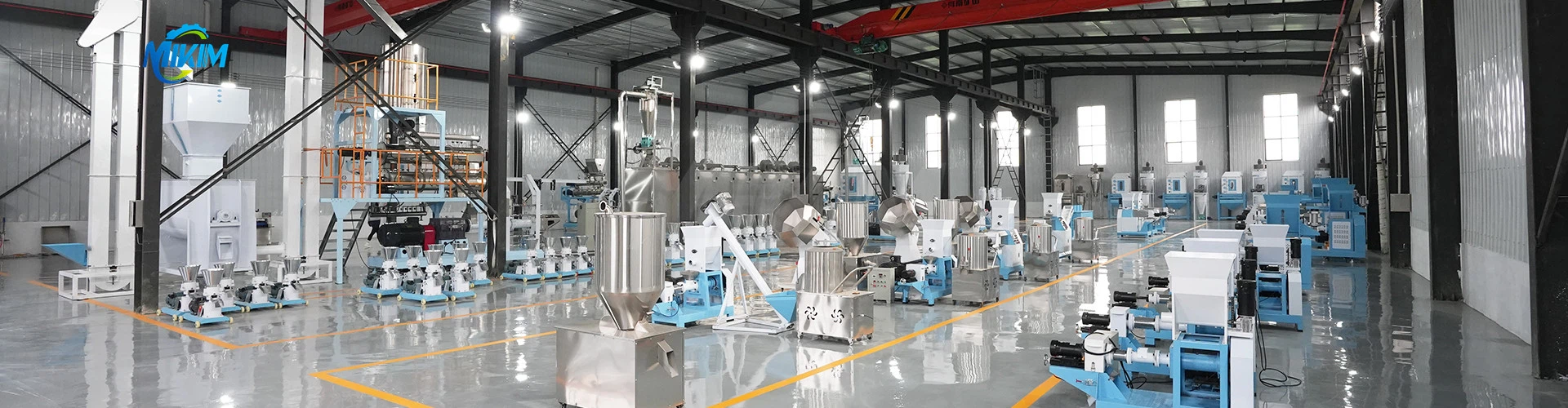

According to customer requirements, MIKIM engineers successfully conducted a comprehensive performance test on a 1-2 T/H (Ton Per Hour) Animal Feed Pellet Production Line specifically customized for African agricultural markets. This test goes beyond mechanical stability-it validates how local ingredients like Nigerian maize, Zambian soybean meal, and West African cassava by-products behave under industrial extrusion.
As Africa's poultry industry shifts toward self-sufficiency, this production line provides a robust solution to bypass high import costs and feed quality instability.
Technical Specifications & Regional Compatibility
Below is the verified performance matrix from our recent factory test:
| Feature | Specification / Test Result | African Regional Context |
| Capacity (Pellet) | 1.0 – 1.5 Tons / Hour | Optimized for SMMEs and commercial farms. |
| Capacity (Mash) | 1.5 – 2.0 Tons / Hour | High-speed mixing for immediate use. |
| Pellet Durability (PDI) | > 98% | Ensures minimal dust during long-distance transport. |
| Material Versatility | Maize, Cassava, Soya, Fish Meal | Engineered for high-fiber local ingredients. |
| Power Standards | 380V-440V / 50Hz (Customized) | Compatible with Nigeria, Kenya, Ghana, etc. |
| Moisture Content | 12% - 14% (Pre-conditioning) | Critical for mold prevention in humid coastal zones. |

Climate-Resilient Engineering: Built for the African Environment
A "standard" machine often fails in extreme climates. Our 1-2 T/H Agricultural Poultry Feed Production Line is specifically engineered to address the unique operational pain points of the African continent:
1. High-Temperature & Arid Zones (e.g., Ethiopia, Northern Nigeria)
In regions where ambient temperatures exceed 40°C, equipment overheating is a major risk.
The Solution: We utilize Class F insulated motors and independent oil-cooling systems for the gearboxes. Our electrical cabinets feature enhanced ventilation and Schneider/Siemens surge protection to handle grid instability.
2. High-Humidity Coastal Zones (e.g., Lagos, Accra, Mombasa)
Humidity levels of 70-90% can lead to rapid feed spoilage and equipment corrosion.
The Solution: The core Conditioner and all feed-contact parts are made of Grade 304 Stainless Steel. This prevents rust and ensures the steam-to-feed ratio is precisely calibrated to prevent clumping and bacterial growth.
Get a Customized Production Line Solution
Optimizing Local Raw Materials: From Cassava to Maize
- Maize & Soya: The primary energy and protein sources, processed with a CV (Coefficient of Variation) of ≤ 5%.
- Cassava & Sunflower Meal: OurHigh-Efficiency Hammer Mill features reinforced tungsten carbide beaters, capable of grinding dried cassava chips into fine flour suitable for pelletizing up to 20% of the total ration.
- Cottonseed & Fish Meal: Precision mixing ensures these high-density additives are uniformly distributed, preventing "nutrient hot spots."
Complete Line Overview: The Production Process
- Hammer Mill: Crushes maize and cassava to a precise 0.8-3mm particle size.
- Horizontal Mixer: Achieves high mixing uniformity for vitamins and premixes.
- Ring Die Pellet Mill: The heart of the plant, producing 2-5mm pellets for chicks, broilers, or layers.
- Counterflow Cooler: Reduces pellet temperature to within +3°C of ambient, essential for a long shelf life.
- Automatic Packing: Precision weighing for 10kg, 25kg, or 50kg bags.

Why African Poultry Farms are Investing in Local Milling
Moving from "Purchasing Feed" to "Producing Feed" offers a significant Return on Investment (ROI):
- Import Substitution: Hedge against fluctuating exchange rates and high import duties.
- Freshness & Palatability: Local production eliminates long-term storage degradation, preserving the essential oils and vitamins that heat usually destroys.
- Operational Flexibility: Adjust your formulation based on the growth stage of your flock (Broiler Starter vs. Layer Finisher) and the seasonal availability of ingredients.
FAQ:
Q: What is the land requirement for a 1-2T/H Cattle Feed Complete Production Line in Kenya or Uganda?
A: A standard semi-automatic line requires approximately 150-200 square meters. We provide customized foundation drawings to help optimize your existing warehouse space.
Q: Can this Pellet machine production line operate on a generator?
A: Yes. We customize the motor starting systems (Star-Delta or Soft Starter) to reduce the initial current surge, making it compatible with industrial diesel generators.
Q: Is technical support available in Africa?
A: We provide comprehensive installation videos, 24/7 online technical support, and can dispatch engineers for on-site commissioning and staff training in countries like Nigeria, Tanzania, and Zambia.
Q: How can I reduce poultry feed costs by using local African raw materials like cassava or sunflower cake?
A:Our 1-2 T/H Efficient Pellet Feed Production Line is specifically designed for alternative feedstock processing. To reduce reliance on expensive imported maize, you can substitute up to 20-25% with dried cassava chips or sorghum. Our high-performance hammer mill ensures these fibrous materials are ground to a uniform <3mm particle size. When using sunflower or cottonseed cake, our precision mixer ensures a CV (Coefficient of Variation) <5%, preventing nutrient imbalances and optimizing the Feed Conversion Ratio (FCR) for your flock.
Q: What are the recommended pellet diameters for different poultry growth stages (Chick, Broiler, Layer)?
A:Pellet size is critical for feed intake efficiency. Our production line offers customizable ring dies for various stages:
- Chicks (0-2 weeks): 2.0mm pellets or crumbled feed.
- Broiler Growers: 3.0mm - 3.5mm pellets.
- Broiler Finishers & Layers: 4.0mm - 5.0mm pellets.
By switching the Ring Die, you can produce the entire range of feed on a single 1-2 T/H New Poultry Pellet Feed Production Line, ensuring your birds receive the right physical form of nutrients for their age.
Q: What is the expected lifespan of the Ring Die and Rollers in an African production environment?
A:In high-intensity industrial use, the lifespan of wear parts depends on the abrasiveness of the material. Our high-chromium alloy steel dies typically last for 800-1,200 tons of production. To maximize longevity in hot African climates, we recommend regular lubrication of the roller bearings every 4-8 hours and ensuring the raw material is free of sand or metal contaminants by using a magnetic separator (included in our full production line).
Q: How does the counterflow cooling system prevent mold and spoilage in high-humidity areas like Lagos or Mombasa?
A:In humid coastal regions, moisture is the enemy of shelf life. Our Counterflow Cooler uses ambient air to gradually reduce pellet temperature to within +3°C to +5°C of the room temperature while stripping away excess surface moisture. This process ensures the final moisture content is stable at 12-13%, which is the "safety zone" to prevent fungal growth and mycotoxin development during storage in humid warehouses.
Q: What technical support and spare parts availability can MIKIM provide for customers in Nigeria, Kenya, or Zambia?
A:We understand that downtime is costly. MIKIM provides a "Quick-Wear Parts Package" with every 1-2 T/H line (including extra dies, rollers, and beaters). We offer:
- Remote Digital Support: Real-time troubleshooting via WhatsApp/Zoom.
- Local Logistics: We work with established shipping partners to ensure fast delivery of spare parts to major African hubs.
- On-site Commissioning: For 1-2 T/H Livestock feed complete equipments, we can dispatch engineers to your site for installation and to train your local staff on preventive maintenance and formulation adjustment.
Contact Us for a Custom Quotation
Are you looking to scale your poultry business? Contact MIKIM today for a tailored 1-2 T/H poultry feed production line quote.
WhatsApp: +86 199 1372 6062
Email: info@mikimz.com
Company Profile
A Return Order Story: When an African Client Came Back for More
The factory test report above already proved the 1–2 T/H poultry feed production line can handle African reality - Nigerian corn, Zambian soybean meal, and West African cassava, run under 40 ℃-plus heat and high humidity on 304 stainless steel - and it closed by asking whether you are ready to scale your poultry business. One African client answered that question. After MIKIM validated the line in the workshop, the same African client took that exact configuration into real production, ran it on local raw materials day after day, and then returned for a second capital investment: a dedicated 2t/h feed pellet production plant built on the same proven setup.
What counts as a return order? In our export records, a return order is when a customer who validated their first test line later purchases again - usually scaling up to a dedicated production plant rather than repeating a pilot setup.
This was a major capacity expansion built on a large-scale repeat order: the same African client returned to invest in a dedicated 2t/h feed pellet production plant, moving beyond the original 1–2 T/H test line into full production. It is a second capital investment in a complete plant, not a one-off spare-parts top-up.
The Mini Case: First Line, Then the Follow-Up
Where It Started - The 1–2 T/H Test Line
The relationship began with a 1–2 T/H poultry feed production line: a feed hammer mill, mixer, a ring die pellet mill, cooler, and packing. It was tuned for African power (380–440V/50Hz) and local inputs such as Nigerian corn, Zambian soybean meal, and West African cassava. Pellet durability index stayed above 98% - a result that follows ASABE S269.5, as detailed by K-State Extension - confirming the line could meet real farm-feed demand.
What the Client Came Back For - A 2 T/H Feed Pellet Production Plant
After the test line proved reliable, the same African client returned to order a 2t/h feed pellet production plant. This was not a replacement but an upgrade - a dedicated full plant built on the same validated configuration, scaled for higher daily output.
What Changed in the Second Order
| Aspect | First Line (Test) | Second Order (Plant) |
|---|---|---|
| Capacity | 1–2 T/H | 2 T/H dedicated |
| Configuration | Pilot test setup | Full production plant |
| Raw material fit | Local corn, soya, cassava | Same local inputs, higher volume |
| Automation | Standard | Scaled for continuous runs |
| Adaptation | 380–440V/50Hz, tropical | Same specs, production-grade |
How the 2 T/H Plant Fits Their Growth
Rising flock size and growing local feed demand make a dedicated 2 T/H plant worthwhile once the first line proves reliable. FAO feed-industry good practices guide safe local feed manufacturing, and the plant is built to those local-safety expectations. The upgrade scales from a 1–2 t/h test line to a 2t/h feed pellet production plant, protecting the gains already earned from the first line while removing the bottleneck of pilot-scale output.

Quotation for the 2 t/h Feed Pellet Production Line

Electrical Control Panel
 2 t/h Feed Pellet Production Line Before Shipment

Loading Feed Production Line Equipment

Feed Pellet Production Line Shipment

Equipment Loading Before Delivery
Talk to Us About Scaling Your Feed Line
If you already run a test line and need to grow, you do not have to start the selection from scratch. Tell us your current model and target capacity, and we will propose an upgrade path based on a configuration we have already validated in the field. Request a quotation to begin the conversation.
The questions below focus on this particular return order - how a validated test line becomes a dedicated production plant - rather than the generic product specs covered in the test report above.