
content
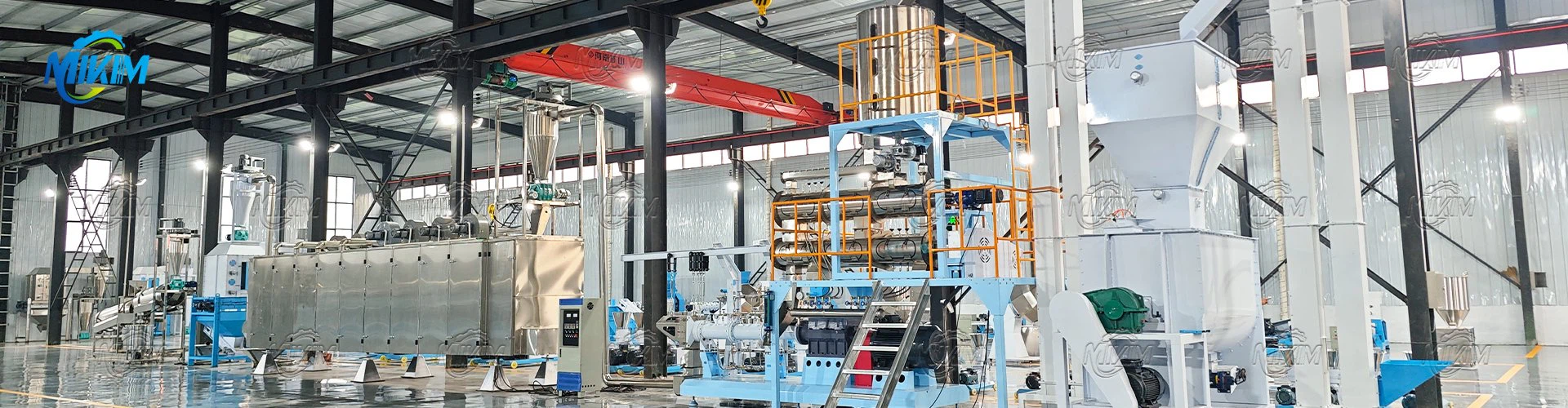
The core of dry-process pet food production is "efficient maturation and shaping centered around a fish feed pellet mill extruder," requiring precise parameter control at every stage. In the raw material pretreatment stage, besides routine screening and crushing, moisture control is crucial-the moisture content must be strictly controlled between 10% and 15%, which is fundamental to ensuring the normal operation of the extruder. If the moisture content is too high, the raw materials are prone to sticking and clogging the die head in the Fish Feed Extrusion Process; if the moisture content is too low, sufficient frictional heat cannot be generated, leading to incomplete maturation. Therefore, a moisture meter is needed for real-time monitoring to ensure the raw materials meet the standards.
The mixing stage uses a twin-shaft paddle mixer, with a mixing time controlled at 5-10 minutes, achieving a mixing uniformity of over 95%. Uneven mixing will result in some pellets losing nutrients. While the extrusion action of the floating fish feed extruder machine can assist in mixing, it cannot compensate for pre-mixing defects. Entering the core extrusion stage, the parameter control of the small pet feed extruder machine directly determines the quality of the finished product: the temperature in the feeding section is controlled at 80-100℃, allowing the raw materials to gradually heat up; the temperature in the extrusion section (core maturation zone) is 120-140℃ to ensure full starch gelatinization; the screw speed is 300-600 r/min, allowing the raw materials to remain in the chamber for 10-20 seconds, achieving "short-time high-temperature" maturation, which improves digestibility and reduces the loss of heat-sensitive nutrients.
The extruded granules must immediately enter a mesh belt dryer and be dried in a hot air environment at 80-100℃ for 15-20 minutes to reduce the moisture content to below 12%, which is crucial for extending shelf life. The dried high-temperature granules (above 60℃) must be rapidly cooled to room temperature to prevent residual heat from causing moisture and mold growth. Finally, after screening and grading to remove broken and oversized particles, they are packaged in sealed bags, completing the production process. Throughout the entire process, the performance of the extruder directly determines the production efficiency and the quality of the finished product. The small fish feed pellet extruder can achieve a production capacity of 100-1000 kg per hour, with a raw material utilization rate of over 98%, making it the core support for the efficient mass production of the dry process.
Related equipment


about Us
Customer visit

Certificate of Honor

FAQ
1. What is the price of the pet food processing machine?
The price ranges from approximately $1,500-$55,000
2. Do you provide maintenance services for your customers?
Yes, we offer comprehensive after-sales maintenance services to our customers.
If you would like to learn more about MIKIM machinery, please contact us. We offer one-stop service and welcome your inquiries!!!