
content
I. High-Efficiency Mass Production: Extruders Raise the Upper Limit of Fish Feed Production Efficiency
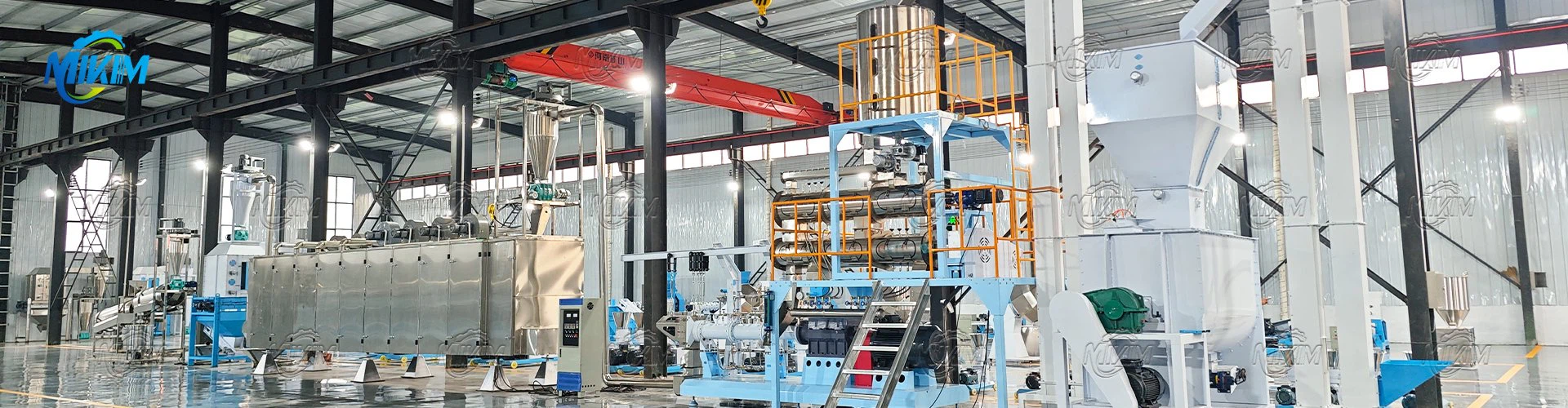
Large-scale aquaculture demands enormous amounts of fish feed. Traditional floating fish feed pellet making machines suffer from low production efficiency and limited capacity, making it difficult to meet large-scale production needs. Extruders, however, employ continuous production processes, enabling integrated continuous operation from raw material input, extrusion molding, cooling and drying to packaging, without interrupting the production process and significantly improving production efficiency. Depending on the equipment specifications, a single small fish food pellet making machine can achieve a daily production capacity of 5-50 tons, far exceeding the 1-5 tons/day of traditional production equipment, representing a capacity increase of 400%-900%. Simultaneously, extruders have a high degree of automation, capable of being equipped with a PLC control system to achieve precise control of parameters such as feed rate, temperature, pressure, and particle size, reducing manual operation, lowering labor costs, and avoiding production efficiency declines caused by human error. For example, after introducing extruders, a medium-sized aquatic feed company increased its production efficiency from 3 tons/day to 20 tons/day, reduced labor costs by 60%, and shortened the production cycle by 70%, significantly enhancing the company's production capacity advantage.


II. Cost Optimization: Extruders Reduce the Overall Cost of Fish Feed Production
The overall cost of fish feed production includes raw material costs, energy costs, labor costs, and loss costs. Through process optimization, extruders can reduce costs in multiple ways, improving profitability. Regarding raw material costs, extrusion technology allows for the rational utilization of various inexpensive raw materials, such as wheat bran, rice bran, and distiller's grains. After extrusion modification, these can be transformed into high-quality fish feed ingredients, replacing some expensive fishmeal and soybean meal, reducing raw material costs by 10%-20%. Regarding energy costs, extruders adopt integrated heating and energy-saving designs. Compared to traditional small fish feed maker machines (which involve separate crushing, mixing, and drying processes), energy consumption can be reduced by 30%-40%, lowering the energy cost per ton of fish feed from around 80 yuan to below 50 yuan. Regarding loss costs, extruded fish feed pellets are uniform and stable, with a breakage rate controlled below 5%, while traditional pelleted feed can have a breakage rate of 15%-20%, significantly reducing feed loss. Furthermore, extruders have a long service life and low maintenance costs. Under normal maintenance, their service life can reach 8-10 years, compared to the 3-5 years of traditional equipment, further reducing long-term investment costs.


III. Product Diversity: Extruders Adapt to Different Fish Feed Production Needs
Different fish species and growth stages have significantly different requirements for the specifications, nutrition, and form of fish feed. Traditional fish feed production equipment struggles to produce diversified products. However, the small electric fish feed extruder, with its flexible process adjustment capabilities, can adapt to the production needs of various fish feeds. By changing the die head, the extruder can produce fish feed pellets of different sizes (0.2-10mm) and shapes (cylindrical, spherical, flake), meeting the feeding needs of fish fry, juveniles, and adults at different growth stages. By adjusting the raw material formula and extrusion parameters, it can produce various types of fish feed, such as high-protein feed, high-energy feed, floating feed, sinking feed, and slow-sinking feed, suitable for different fish species such as carp, grass carp, tilapia, and salmon. For example, for carnivorous fish such as salmon, extruders can produce high-protein floating feed, ensuring the feed floats in water for a long time, making it easy for salmon to consume. For bottom-dwelling fish such as carp, sinking feed can be produced to meet their feeding habits. This diversified production capacity helps companies expand their product categories, cover a wider range of market demands, and enhance their market competitiveness.


IV. Environmental Protection and Energy Saving: Extruders Align with the Development Trend of Green Aquaculture
With increasingly stringent environmental policies, green aquaculture has become the mainstream trend in the industry, and the environmental performance of small fish feed making machines has become a key focus for companies. Extruders employ a closed-loop process during production, effectively reducing the diffusion of raw material dust and lowering environmental pollution. Simultaneously, the high temperature and pressure during extrusion ensure thorough gelatinization of the raw materials, reducing feed loss in water, lowering water pollution, and contributing to green aquaculture. Furthermore, the energy-saving design of extruders significantly reduces energy consumption, decreasing the consumption of coal and electricity, lowering carbon emissions, and complying with the national "dual carbon" policy requirements. Compared to traditional production equipment, the small fish feed pellet machine reduces dust emissions by over 80%, water pollutant emissions by over 30%, and energy consumption by 30%-40% during the production process. This not only meets environmental protection requirements but also helps companies reduce environmental governance costs. For example, after introducing the extruder, a certain aquatic feed company successfully passed environmental inspections, reduced its environmental governance costs by 150,000 yuan annually, and simultaneously enhanced its brand image, gaining greater customer recognition.
about Us
Customer visit

Certificate of Honor

FAQ
1. What is the price of the floating fish food production machine?
The price ranges from approximately $1,500-$55,000
2. Do you provide maintenance services for your customers?
Yes, we offer comprehensive after-sales maintenance services to our customers.
If you would like to learn more about MIKIM machinery, please contact us. We offer one-stop service and welcome your inquiries!!!