
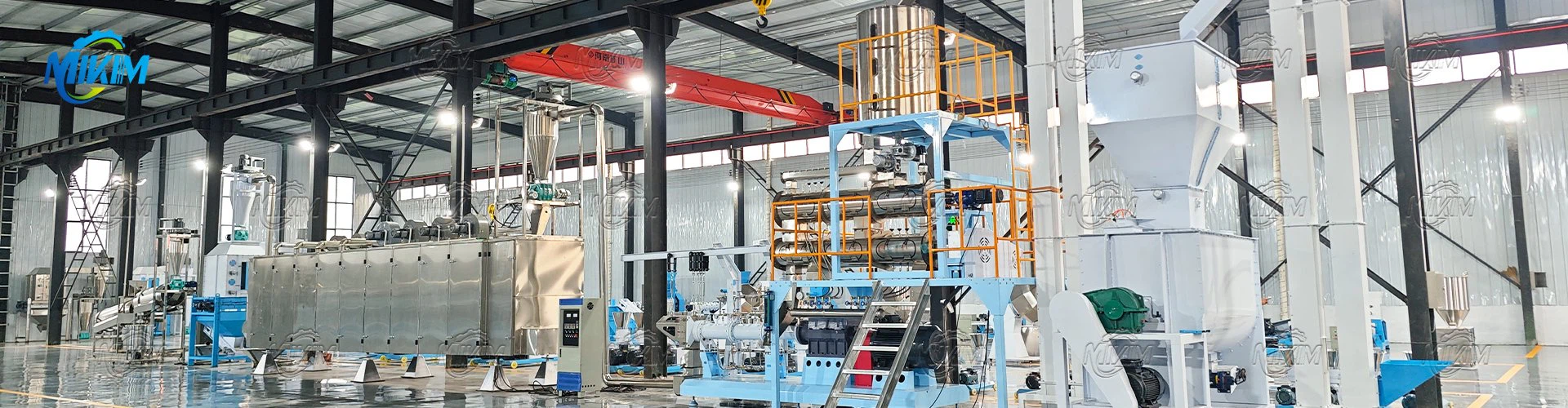
What Is Extrusion Technology in Floating Fish Feed Production?
Extrusion is a thermal-mechanical process in which feed ingredients are cooked and shaped under high temperature, high pressure, and shear force. In a floating fish feed machine, the rotating screw conveys the moistened mixture forward while the barrel is heated, typically to 80-140 degrees Celsius. When the cooked material is forced through the die and rapidly depressurized, it expands into a stable pellet. This process changes the physical and chemical structure of the feed: starch gelatinizes, protein denatures, and anti-nutritional factors are broken down.
Benefit 1: Higher Starch Gelatinization
Compared with ordinary grinding and mixing, extrusion increases feed gelatinization by 30-50 percent. Gelatinized starch binds the pellet together and makes carbohydrates easier for fish to digest, which is the foundation of floating feed quality.
Benefit 2: Better Protein Utilization
During extrusion, protein molecules in fishmeal and soybean meal are moderately denatured, and their spatial structure is opened up so that digestive enzymes can act more easily. As a result, protein utilization can rise by 15-20 percent, supporting faster growth and a lower feed cost per kilogram of fish.
Benefit 3: Higher Vitamin Retention
Because extrusion uses controlled heating and rapid cooling, heat-sensitive vitamins survive better than in long traditional drying processes. Vitamin retention can reach over 85 percent, compared with about 60 percent in conventional drying, which helps keep the feed nutritionally balanced.
Benefit 4: Stable Pellet Shape and Hardness
The die design and pressure control allow the machine to produce pellets of different sizes for different fish, for example 0.5 mm pellets for fry and 2-5 mm pellets for adult fish. The gelatinized colloidal structure keeps Shore hardness in a suitable range of about 30-50, so pellets are firm enough to resist breakage but soft enough for fish to chew.
Benefit 5: Long Water Stability
Extruded pellets typically remain intact for 2-4 hours in water, compared with less than 1 hour for traditional pelleted feed. This longer stability gives fish enough time to consume the feed, reduces feed waste and water pollution, and can raise feed utilization by 10-15 percent.
Choosing the Right Machine Parameters
When selecting an automatic floating fish feed machine, check the temperature control range, the screw speed adjustment, and the die options. The barrel temperature should cover the range needed for the target recipe, and the cutter speed should match the desired pellet length. Ask the supplier to run a trial with your own formula so that the parameter settings are confirmed with real materials.
FAQ
1. Why is barrel temperature important in a floating fish feed machine?
The barrel temperature, typically 80-140 degrees Celsius, drives starch gelatinization; too low a temperature gives soft, unstable pellets, while too high a temperature can damage heat-sensitive nutrients.
2. How much does extrusion improve gelatinization?
According to the article's figures, extrusion can increase feed gelatinization by 30-50 percent compared with conventional processing.
3. Do extruded pellets stay longer in water?
Yes. Extruded fish feed pellets can remain intact for 2-4 hours, while traditional pelleted feed often falls apart in less than 1 hour.
4. What pellet sizes can an automatic floating fish feed machine produce?
With suitable dies, the machine can produce about 0.5 mm pellets for fry and 2-5 mm pellets for adult fish.
5. Does extrusion damage vitamins?
The controlled heating and fast cooling of extrusion limit vitamin loss; retention can exceed 85 percent, higher than the roughly 60 percent typical of traditional drying.
6. Can the same machine make sinking feed too?
Floating and sinking feeds need different expansion levels; check with the supplier whether the machine's screw configuration and die design support the target feed type.