
content
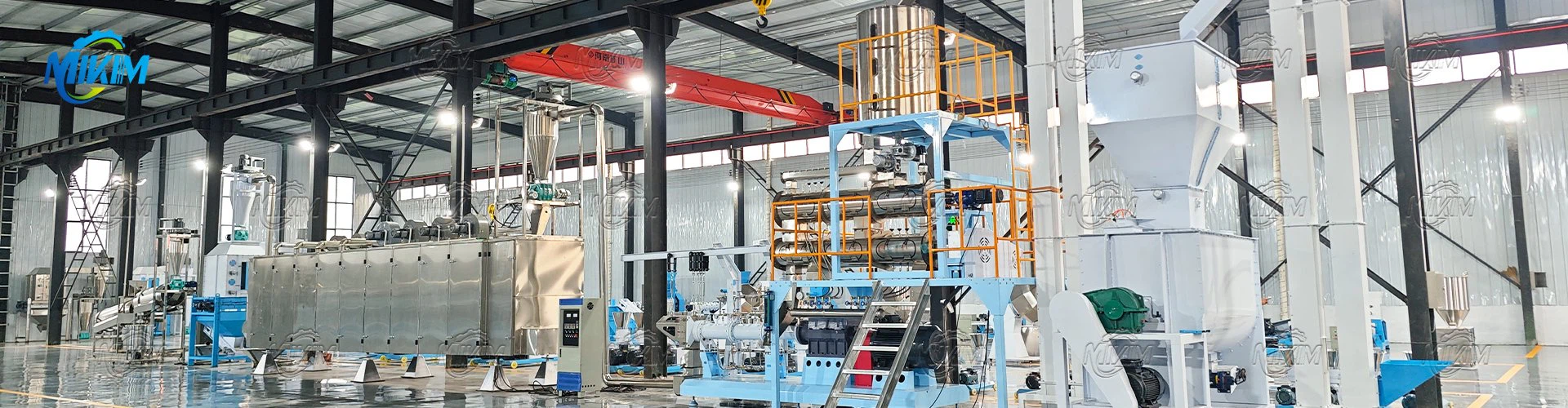
In extruded feed production, identifying die hole blockage in automatic fish food making equipment requires attention to signals related to the extrusion effect. Besides the usual decrease in output and pressure spikes, the most distinctive signal is abnormal pellet buoyancy-fish feed that should normally float 100% will produce a large number of sinking pellets after blockage. This is because partial die hole blockage leads to uneven raw material discharge, causing some raw material to remain in the extrusion chamber for too long and become overcooked, while others remain for too short a time and are not fully extruded. Simultaneously, scorched spots (overcooked) or a rough, dull surface (undercooked) will appear on the pellet surface, and a small amount of abnormal steam leakage from the die outlet, accompanied by a burnt smell.
Emergency handling of die hole blockage in extruded feed production requires a combination of blockage removal and extrusion system protection. Because the die head of the floating fish feed extruder is tightly connected to the extrusion chamber, the heating system must be turned off before disassembly, and the equipment must be allowed to cool to below 50℃ to avoid burns. When cleaning the die head, first use a special scraper to remove the raw material adhering to the surface, then use a wire brush with a matching aperture to unclog the die holes. For stubborn charred blockages caused by over-cooking, the die head can be soaked in a 5% citric acid solution for 60 minutes to soften it before cleaning, avoiding hard scraping that could damage the die head. After cleaning, a no-load test run is required. Adjust the extrusion parameters to slightly lower than normal values (temperature reduced by 10℃, pressure reduced by 0.5MPa), feed slowly, observe the output and extrusion effect, and restore normal parameters only after confirming there are no abnormalities. For example, after cleaning the die head of the fish feed extruder, first set the temperature to 120℃ and the pressure to 3.5MPa, feed a small amount of material, and after the buoyancy of the pellets returns to normal, adjust back to the normal parameters of 130℃ and 4MPa.
Optimize parameters and maintain the equipment of the small pet food making machine to prevent blockages. The core of puffing parameter adjustment is the matching of "temperature-pressure-speed": Excessive temperature (above 160℃) will cause the raw material to over-gelatinize and stick together, while insufficient temperature will result in poor flowability. It needs to be precisely controlled between 120-140℃ according to the raw material formula; the pressure should be stable at 3-5MPa, with fluctuations not exceeding 0.5MPa, which can be controlled by adjusting the feed speed and die orifice diameter; the screw speed should be 300-350r/min to ensure the raw material stays in the puffing chamber for a moderate time (20-30 seconds). For the maintenance of the floating fish feed pellet extruder machine, disassemble the die and screw weekly to clean residual puffed raw material and check the screw thread wear (replace if wear exceeds 2mm) to avoid uneven material feeding due to screw thread wear; calibrate the temperature controller and pressure gauge monthly to ensure accurate parameter display, thus preventing blockages from both equipment and parameter perspectives.
Related equipment


about Us
Customer visit

Certificate of Honor

FAQ
1. What is the price of the dog food manufacturing equipment?
The price ranges from approximately $1,500-$55,000
2. Do you provide maintenance services for your customers?
Yes, we offer comprehensive after-sales maintenance services to our customers.
If you would like to learn more about MIKIM machinery, please contact us. We offer one-stop service and welcome your inquiries!!!