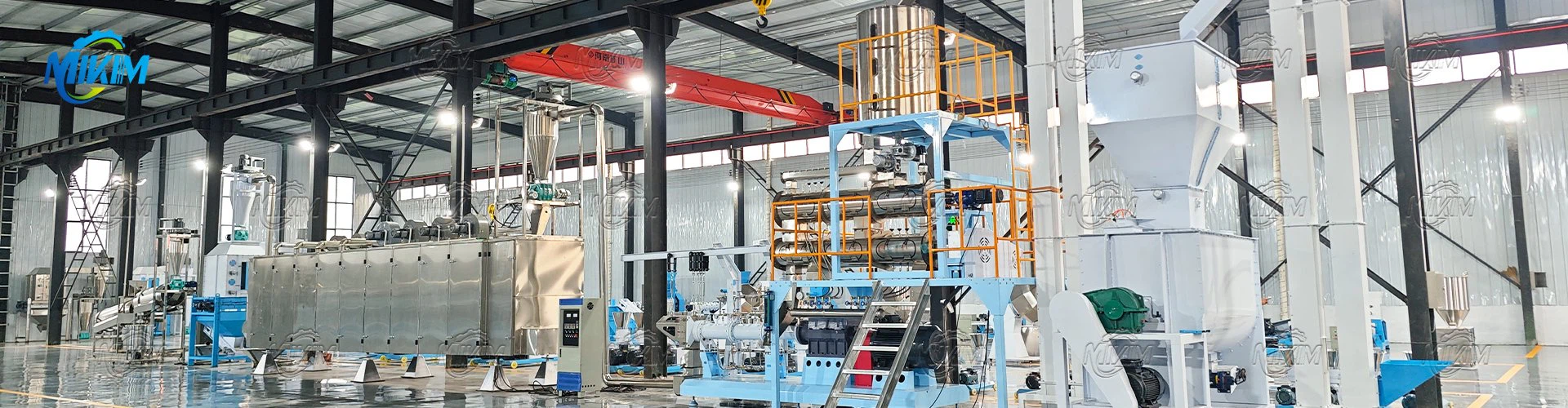

A Twin screw floating fish feed making machine can produce sinking pellets by precisely controlling the expansion process. While the machine is famous for "floating" feed, it is a versatile extrusion system. To produce sinking feed, the operator must increase the pellet density to >1.0 g/cm³ by reducing the Specific Mechanical Energy (SME), increasing moisture (up to 25-30%), and lowering the barrel temperature to suppress expansion at the die exit.
1. The Physics of Sinking vs. Floating Feed
The behavior of a pellet in water is determined by its internal porosity.
- Floating Feed: High expansion creates air pockets inside the starch-protein matrix, lowering the density.
- Sinking Feed: Minimal expansion creates a dense, compact structure.
- The Twin screw floating fish feed pellet extruder machine Advantage: Unlike single-screw machines, the twin-screw provides enough torque to handle the denser, higher-moisture doughs required for premium sinking feed (like shrimp or trout feed).
2. 4 Critical Adjustments to Switch from Floating to Sinking
If you want to produce sinking feed on your current line, focus on these technical parameters:
A. Formulation Modification
Sinking feeds typically require lower starch (10-15%) and higher protein/mineral content. Minerals like calcium carbonate can act as weighting agents to ensure the pellet sinks rapidly.
B. Moisture Control
Increasing the moisture content in the conditioner and barrel (up to 28%) helps "lubricate" the material, reducing the friction-induced expansion that causes pellets to float.
C. Temperature Zoning
To make pellets sink, you must cool the final zones of the extruder barrel (down to 80°C - 100°C). This prevents the "flash evaporation" of steam as the pellet exits the die, which is what usually causes the "puffing" effect.
D. Screw Speed & Configuration
Reducing the screw RPM lowers the SME (Specific Mechanical Energy). Lower energy input means less expansion. In some cases, operators remove "shear locks" (kneading blocks) from the screw assembly to further reduce puffing.
3. Comparison: Floating vs. Sinking Production Settings
| Technical Variable | Floating Feed Settings | Sinking Feed Settings |
| Starch Content | 20% - 30% (High) | 10% - 15% (Low) |
| Barrel Temperature | 120°C - 160°C (High) | 80°C - 110°C (Lower) |
| Moisture Content | 18% - 22% | 25% - 30% |
| Expansion Ratio | 1.5 - 2.0x | 1.0 - 1.1x |
| Internal Structure | Porous / Air-filled | Dense / Compact |
4. Why Use a Twin screw floating fish feed pellet making machine for Sinking Feed?
Industry experts prefer twin-screw systems for sinking feed because of uniformity.
- Problem with Single-Screw: In sinking feed production, single-screw machines often produce "half-floaters" (some sink, some float) due to inconsistent pressure.
- Twin-Screw Solution: The intermeshing screws ensure that every single pellet has the exact same density, ensuring a 100% sinking rate-which is critical for bottom-feeders like Shrimp and Crab.
☆Click to learn more about the twin-screw floating fish food extruder machine.
5. FAQ:
Q: How do I make my fish feed sink instead of float?
A: To make your feed sink, you need to increase its density. The most effective ways are: 1. Increase moisture in the extruder. 2. Decrease the temperature of the final barrel zones. 3. Reduce the screw speed. 4. Decrease the amount of starch in your recipe.
Q: Why are my sinking fish feed pellets floating?
A: This is usually caused by "over-expansion." Even if you have a sinking formula, if the barrel temperature is too high (over 120°C), the moisture will turn to steam at the die exit and "puff" the pellet, making it light enough to float.
Q: Can I produce shrimp feed on a floating fish feed machine?
A: Yes. Shrimp feed must sink and have high water stability. A twin-screw machine is ideal for this because it can handle the high moisture and protein levels needed for shrimp while compressing the pellet enough to ensure it sinks.
Q: Does sinking feed require a different die plate?
A: Not necessarily. While a thicker die plate (longer hole length) can help compress the pellet and increase density, most sinking behavior is achieved through adjusting moisture, temperature, and recipe.
Q: Will sinking pellets fall apart faster in water?
A: If processed correctly in a Twin screw floating fish feed production machine, sinking pellets actually have better water stability than floating ones because they are more compressed and have higher starch gelatinization at higher moisture levels.
Conclusion: The Value of Versatility
The ability of a Twin screw fish feed extruder machine to produce sinking pellets makes it a highly profitable asset. It allows a single factory to serve multiple markets-from surface-feeding Tilapia to bottom-feeding Shrimp-with only minor adjustments to the production process.
Company Profile