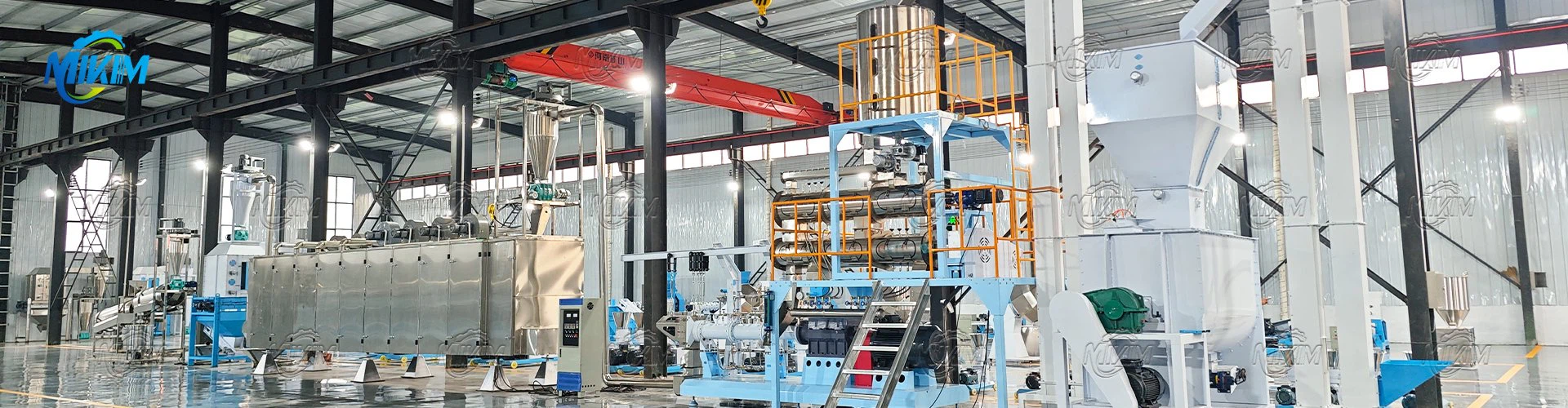

Yes, a Twin screw fish feed making machine is the industry standard for processing high-fat (up to 15-18%) and high-moisture formulations. Unlike single-screw machines that rely on friction and often "slip" when lubricants (fats) are added, twin-screw extruders use intermeshing positive displacement. This ensures stable material flow, uniform starch gelatinization, and consistent pellet expansion even in complex, nutrient-dense aquatic recipes.
1. The "Slippage" Challenge: Why Fat is the Enemy of Single-Screws
In aquafeed production, increasing lipids (fats) improves energy density for species like salmon and trout. However:
- The Problem: In a single-screw barrel, fat acts as a lubricant. When fat levels exceed 6-8%, the material loses friction against the barrel wall, causing the screw to spin without moving the dough forward (Slippage).
- The Twin screw fish feed extruder machine Solution: The dual screws intermesh, mechanically forcing the oily dough toward the die. This "pumping" action is independent of friction, allowing for high-fat injection without losing extrusion pressure.
2. Handling High Moisture for Enhanced Digestibility
High moisture (20-30%) is often introduced via steam conditioning to improve Starch Gelatinization.
- Better Texture: Twin-screw extruders handle wet, sticky materials without backflow.
- Self-Wiping: The screws continuously clean each other, preventing "dead zones" where wet feed could ferment or clunk.
- Uniform Expansion: Higher moisture allows for a more controlled "flash-off" at the die, resulting in a smoother pellet skin and better buoyancy.
3. Technical Performance: Twin-Screw vs. Single-Screw
| Feature | Twin-Screw Performance | Single-Screw Limitation |
| Max Fat Content | 12% - 18% (In-barrel) | 5% - 8% Max |
| Mixing Intensity | High (Homogeneous) | Low (Risk of oil pockets) |
| Moisture Range | 15% - 35% | 15% - 22% |
| Expansion Control | Precise (Uniform density) | Unstable in high-fat recipes |
| Self-Cleaning | Excellent | Poor (Requires manual teardown) |
4. Strategic Advantages for Commercial Manufacturers
- Energy Density: Produce "High-Energy" feeds that reduce the growing cycle of fish.
- Reduced Dust: Higher fat/moisture integration leads to more durable pellets with fewer fines, improving water quality.
- Recipe Versatility: Switch from floating tilapia feed (high starch) to sinking shrimp feed (high protein/moisture) on the same machine.
5. FAQ:
Q: What is the maximum oil content I can add directly into a Twin screw floating fish feed production machine?
A: Most industrial twin-screw extruders can handle 12% to 15% oil added within the barrel. For higher levels (up to 20% or more), a vacuum coater is typically used after the drying stage to infuse oil into the porous pellets.
Q: Why does my floating feed sink when I increase the fat content?
A: Fat reduces the mechanical energy (SME) transferred to the dough, which can hinder expansion. To fix this, you need to increase the screw speed or adjust the screw configuration to provide more shearing force to "cook" the starch despite the lubrication.
Q: Can I process semi-moist fish feed with this machine?
A: Yes. Twin screw floating fish feed pellet making machines are ideal for semi-moist formulations. However, you will need a specialized cooling and packaging system to prevent mold growth due to the higher water activity in the final product.
Q: Does high moisture affect the lifespan of the extruder screws?
A: Actually, proper moisture levels can extend screw life by reducing abrasive wear. However, you must use high-quality stainless or alloy steel screws to prevent corrosion from the steam and acidic additives often found in moist formulas.
Q: Will high-fat pellets stay stable in water?
A: Yes, provided there is enough starch gelatinization. The twin-screw's ability to mix fat into the protein-starch matrix ensures that the oil doesn't "leak" out, maintaining water stability for up to 12-24 hours.
Conclusion: Why Twin-Screw is Non-Negotiable for Premium Feed
If your production goals involve High-Energy (High-Fat) or High-Digestibility (High-Moisture) feeds, the Twin screw floating fish feed pellet extruder machine is the only viable technology. It eliminates the operational risks of material slippage and inconsistent expansion, providing a stable platform for nutritional innovation.
Company Profile