
content
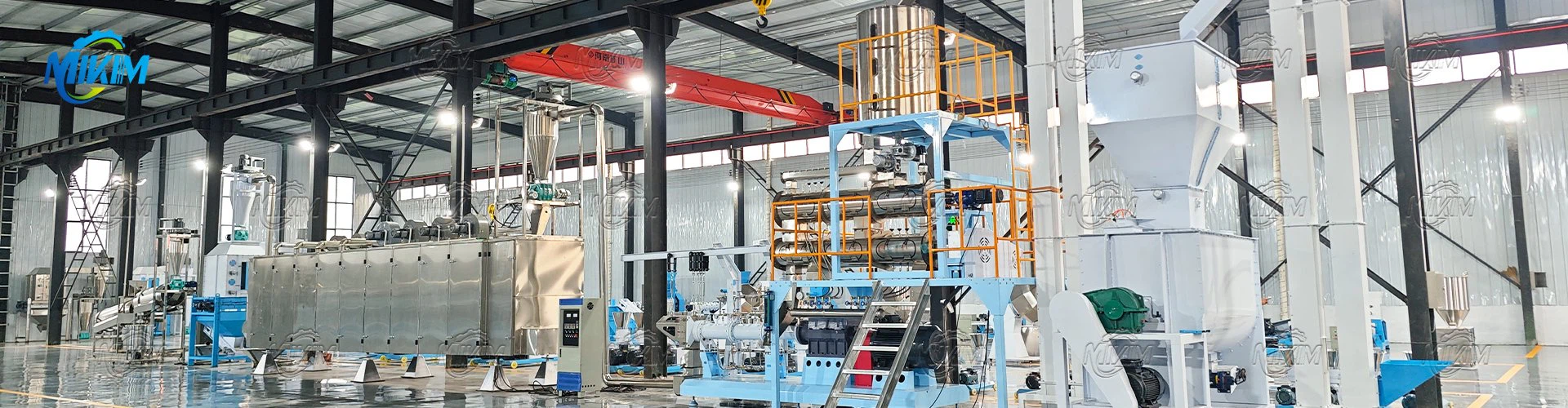
For producing floating fish feed pellets, a Twin-Screw fish feed extruder is the preferred choice, as it outperforms the Single-Screw fish feed pellet extruder. The Twin-Screw floating fish food extruder uses two screws to extrude the feed in tandem, resulting in more uniform mixing and expansion of the raw materials, producing pellets with stable buoyancy and uniform texture. The Single-Screw fish feed extruder, due to its poorer mixing and extrusion, produces floating pellets with greater buoyancy fluctuations and a higher likelihood of some settling to the bottom. The Twin-Screw Type Fish Feed Extruder features an interlocking screw design, allowing for precise control of the feed residence time and degree of expansion, making it suitable for producing different types of floating feed (e.g., freshwater fish, saltwater fish, juvenile fish, and adult fish feed). For large-scale aquaculture (yields exceeding 500 catties per mu), a twin-screw fish feed extruder is recommended, offering high capacity (30-50 kg/h) and stable floating pellet quality.
Select automatic fish food making equipment with a capacity appropriate to the scale of aquaculture to avoid mismatch between capacity and demand, which could negatively impact buoyancy quality. For small-scale family farming (yield less than 200 catties per mu), a small fish feed extruder (capacity 5-10 kg/h) is suitable. Its small size and simple operation make it ideal for small-batch production of floating pellets. For medium-sized farms (yield 200-500 catties per mu), a medium-sized extruder (capacity 10-30 kg/h) is recommended. For large-scale industrial farming, a large twin-screw extruder (capacity over 50 kg/h) is recommended. It is important to note that overloading an extruder with insufficient capacity can lead to unstable pressure and temperature, resulting in decreased quality of the floating pellets. Conversely, overloading an extruder in small-batch production can cause excessively long residence time of the raw material in the extrusion chamber, leading to over-expansion.
Pay attention to the auxiliary system configuration of the floating fish feed extruder machine to improve the stability of floating pellet production. A high-quality fish feed extruder should be equipped with a precise temperature control system (temperature accuracy ±1℃), pressure monitoring instruments, a variable frequency feeding system, and a cooling and drying system. A temperature control system ensures stable temperature, a pressure gauge monitors pressure changes in real time, a variable frequency feeding system precisely controls the feeding speed, and a cooling and drying system quickly reduces pellet temperature, fixes the internal pore structure of the pellets, and improves buoyancy stability. Furthermore, a Floating Fish Feed Pellets Extruder Machine with quick-release die head function is selected, facilitating the replacement of die heads with different apertures to adapt to the production of different sizes of floating pellets (e.g., 1-2mm pellets for juvenile fish, 3-5mm pellets for adult fish).
Related equipment


about Us
Customer visit

Certificate of Honor

FAQ
1. What is the price of the best Floating fish feed pellet extruder machine?
The price ranges from approximately $1,500-$55,000
2. Do you provide maintenance services for your customers?
Yes, we offer comprehensive after-sales maintenance services to our customers.
If you would like to learn more about MIKIM machinery, please contact us. We offer one-stop service and welcome your inquiries!!!