
Dog food manufacturing centers on starch gelatinization and pathogen elimination. Production involves two primary technologies: Dry Type dog food pellet making machine (ideal for 100-1000kg/h scales using dry meals) and Wet Type dog food pellet extruder machine (essential for premium kibble with fresh meat and 1-10t/h capacities). Key technical parameters include maintaining a final moisture level of 8-10% and ensuring a starch gelatinization rate above 80-90% for optimal digestibility.
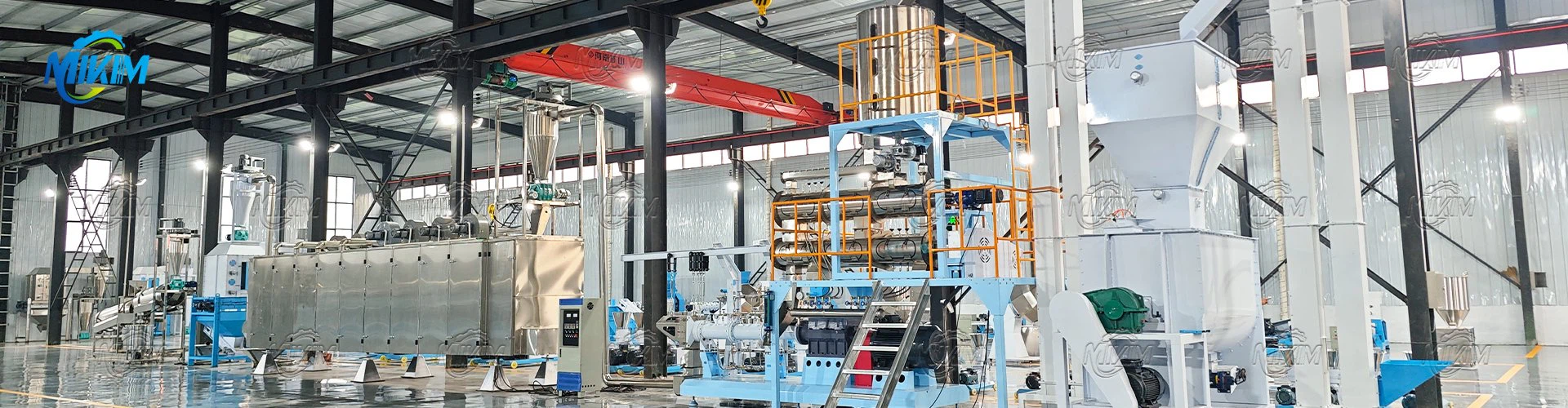
40-300kg/h Dry dog food extrusion machine production line testing
1. Technical Steps of Dog Food Production
Step 1: Raw Material Micronization
For a professional finish, raw materials (corn, wheat, poultry meal) must be ground to a particle size of 60-80 mesh.
Why? Fine grinding ensures uniform heat absorption during extrusion, preventing "white cores" (uncooked starch) in the kibble.
Step 2: Precision Mixing
Ingredients are blended in a ribbon or paddle mixer. If using a Dry Type dog food pellet maker machine, only dry powders and minimal liquid (oil <5%) can be added here.
Step 3: Steam Conditioning (The "Wet" Process)
This is where Dry and Wet methods diverge. Wet Type dog food processing machines use a Pre-conditioner to inject steam and water.
Parameter: Moisture is raised to 25-30%, and temperature reaches 80-90°C, pre-cooking the starch before it even enters the screw.
Step 4: Extrusion & Shaping
The dough is forced through a die at high pressure.
Dry Type pet food extruder machine: Generates heat via mechanical friction alone.
Wet Type dog food manufacturing machine: Uses external steam plus friction, allowing for much higher fresh meat content (up to 40% slurry).
Step 5: Differential Drying
Dry-Extruded Kibble: Enters the dryer at 12-15% moisture. It requires less energy to stabilize.
Wet-Extruded Kibble: Enters at 20-30% moisture. It requires a professional multi-layer conveyor dryer to ensure the core is dry without burning the surface.
Target: All kibble must finish at 8-10% moisture to prevent mold.
Step 6: Coating & Flavoring
Dried kibble is sprayed with fats and palatants.
Pro Tip: For high-performance dog food, use Vacuum Coating to pull fats into the kibble's pores, increasing energy density without a greasy exterior.
2. Dry vs. Wet Type Pet Food pellet Extruder: Which Should You Choose?
Selecting the right machine depends on your budget, recipe, and target market.
Method A: Dry Type dog food manufacturing machine
Best for: Startups, small-scale factories, and standard-grade kibble.
Pros:
- Low CAPEX: No steam boiler or complex piping required.
- Small Footprint: Compact design fits in smaller warehouses.
- Easy Operation: Fewer variables to control, lower training costs.
Cons:
- Limited Recipe Flexibility: Cannot handle high levels of fresh meat or high-fat formulas.
- Wear & Tear: Higher friction leads to faster wear on the screw and sleeve.
- Appearance: Pellets may have a slightly rougher texture.
Method B: Wet pet food manufacturing process
Best for: Industrial manufacturers, premium brands, and high-meat recipes.
Pros:
- Superior Quality: Better expansion, smoother surface, and higher digestibility (>90%).
- High Fresh Meat Handling: Twin-screw design handles sticky meat slurries (20-40%) with ease.
- Energy Efficiency: At large scales (over 1 ton/h), steam is a more efficient heat source than friction.
- Durability: Steam lubrication reduces mechanical friction on the screws.
Cons:
- Higher Investment: Requires a steam boiler and more sophisticated control systems.
- Complexity: Needs skilled operators to manage steam-pressure-moisture balance.
According to the method of quenching and tempering, there are two kinds of dry puffing method and wet puffing method mentioned above. According to the screw structure of the puffing equipment, it can be divided into single-screw extrusion puffing method and twin-screw extrusion puffing method. kind.
☆Click to learn more about single screw vs. Twin-Screw extruders.
3. Decision Framework for Buyers
| Feature | Choose Dry-Type if... | Choose Wet-Type if... |
| Production Scale | < 800 kg/hour | > 1,000 kg/hour |
| Main Ingredients | Mostly grain & meat meals | High fresh meat & fat |
| Target Market | Economy / Standard | Premium / Prescription |
| Steam Source | No boiler access | Boiler available/planned |
| Budget | Limited initial capital | Focus on long-term ROI |
4. FAQ:
Q1: Can I Use The Same Dry Type dog food processing machine For Dog Food And Cat Food?
A: Yes. However, cat food usually requires a higher protein/fat content and smaller pellet sizes (2mm-6mm). A Wet Type Twin screw Pet Food pellet Extruder is highly recommended for cat food to handle the specific nutritional density and ensure the small pellets don't crumble.
Q2: How Often Should I Replace The Wet Type Twin screw dog food maker machine Screws?
A: This depends on the material. If you use high-fiber or poorly ground ingredients, wear is faster. Typically, high-alloy screws last 2,000–4,000 hours of production. Using a wet-type system with proper steam conditioning can extend this life by 30%.
Q3: What Is The Most Common Cause Of "Poor Expansion" In Kibble?
A: Usually, it is a lack of Starch Content or Inadequate Temperature. For proper "puffing," the formula needs at least 20% starch (from corn, rice, or potato). If the temperature at the die head is below 120°C, the moisture won't flash into steam, resulting in a dense, hard pellet.
Q4: Is A Steam Boiler Really Necessary?
A: Only for Wet Type Twin screw dog food pellet maker machines. If your local regulations make boiler certification difficult, you should opt for a Dry Type dog food pellet mill or an Electric-heating extruder, though the latter is only suitable for very small-scale production.
5. Why Our Extrusion Solutions?
We specialize in turnkey pet food production lines. Whether you are looking for a compact dry-type system to start your brand or a fully automated 5-ton/h twin-screw factory, our engineering team provides:
- Custom Screw Profiles for specific ingredients.
- Energy-Saving Dryers with heat recovery systems.
- Global On-site Installation and technician training.
👉Get a Technical Consultation & Factory Layout Plan Today
Company Profile