
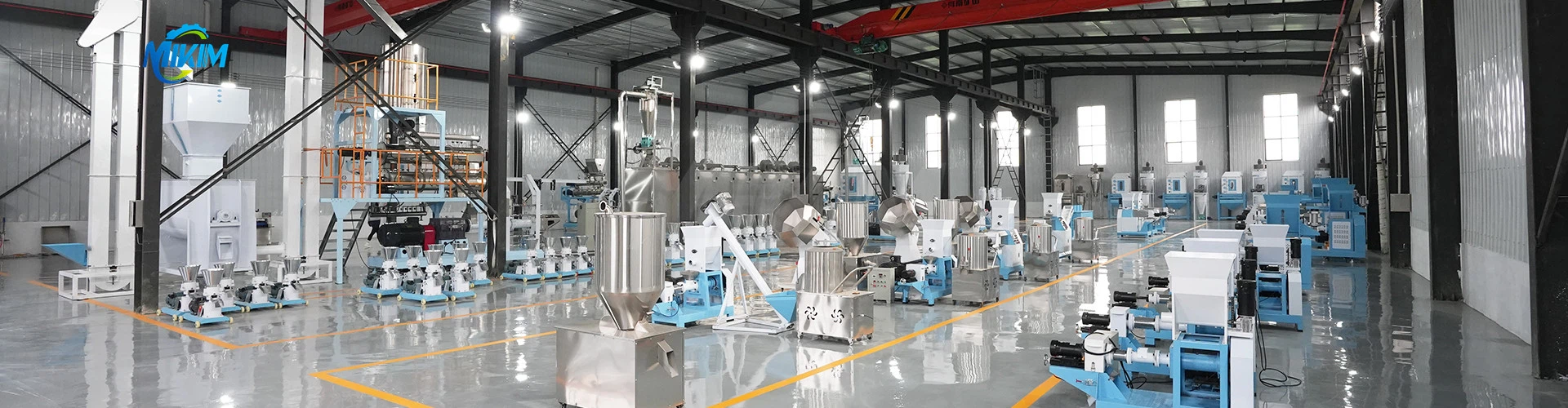
In the process of making self-mixed feed, crushing, mixing, granulation and other links are indispensable. When making feed, attention should be paid to the process control of crushing, mixing, granulation and other links to ensure the adaptability and digestibility of feed.
The raw materials of fish feed should all be able to pass through the 40 mesh sieve, and the material above the 60 mesh sieve should not exceed 20%. Conditioning is a key step before feed pelleting. By mixing the feed with steam, the starch is gelatinized, thereby improving the digestibility. At the same time, the fluidity of the feed after conditioning is enhanced, which is more conducive to the formation of feed.

| Model | Power | Feeder | Cutter | Capacity | Dimension | Weight |
| DGP40 | 4KW | 0.4KW | 0.4KW | 0.04-0.05T/H | 1400*1030*1200MM | 240KG |
| DGP50 | 11KW | 0.4KW | 0.4KW | 0.06-0.08T/H | 1400*1030*1200MM | 320KG |
| DGP60 | 15KW | 0.4KW | 0.4KW | 0.12-0.15T/H | 1450*950*1430MM | 480KG |
| DGP70 | 18.5KW | 0.4KW | 0.4KW | 0.18-0.25T/H | 1600*1400*1450MM | 600KG |
| DGP80 | 22KW | 0.4KW | 0.75KW | 0.3-0.35T/H | 1850*1470*1500MM | 800KG |
| DGP90 | 30KW | 1.1KW | 1.5KW | 0.4-0.45T/H | 1900*1500*1600MM | 1200KG |
In the process of conditioning, the conditioning steam needs to be strictly controlled. Saturated steam is usually used, and the required steam volume is calculated according to the proportion of 5% of the material. In addition, it is also very important to determine the conditioning temperature according to the composition of the feed. For example, fish feed has a high protein content, and its material temperature needs to reach above 85°C. Finally, the particle size of pellet feed is also very important. It should be less than half the width of the fish's mouth to ensure that the fish can eat smoothly.
In addition, farmers should also be careful to avoid excessive use of cheap oil residue and meat meal. The animal fur mixed in these raw materials may affect the crushing and pelleting process, and their fat utilization rate is low. Excessive intake may affect the health of fish. Therefore, it is recommended to control the use of such raw materials to less than 5%.