
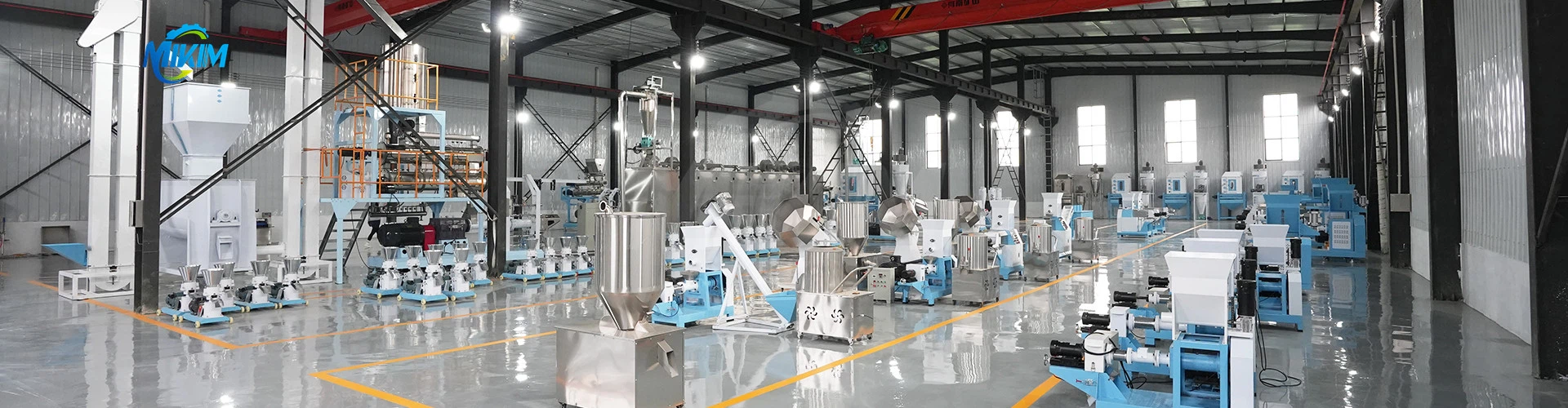
The puffing process helps the penetration of fat, improves the palatability of feed, and thus increases the feeding rate. For young animals whose digestive organs are not fully developed, such as suckling pigs, piglets and calves, it is difficult for them to digest complex plant feeds, and puffed feed can effectively improve their digestibility. Experiments have shown that puffed feed mainly improves the digestibility of starch and energy, and has a relatively small effect on protein digestibility, which may be due to the energy-saving effect on protein. Although the improvement in protein digestibility is not significant, it can still improve the deposition efficiency of protein in the end.

| Model | Power | Feeder | Cutter | Capacity | Dimension | Weight |
| DGP40 | 4KW | 0.4KW | 0.4KW | 0.04-0.05T/H | 1400*1030*1200MM | 240KG |
| DGP50 | 11KW | 0.4KW | 0.4KW | 0.06-0.08T/H | 1400*1030*1200MM | 320KG |
| DGP60 | 15KW | 0.4KW | 0.4KW | 0.12-0.15T/H | 1450*950*1430MM | 480KG |
| DGP70 | 18.5KW | 0.4KW | 0.4KW | 0.18-0.25T/H | 1600*1400*1450MM | 600KG |
| DGP80 | 22KW | 0.4KW | 0.75KW | 0.3-0.35T/H | 1850*1470*1500MM | 800KG |
| DGP90 | 30KW | 1.1KW | 1.5KW | 0.4-0.45T/H | 1900*1500*1600MM | 1200KG |
| DGP100 | 37KW | 1.1KW | 1.5KW | 0.45-0.5T/H | 2000*1600*1600MM | 1500KG |
Harmful microorganisms such as Salmonella, mold, Escherichia coli and neutrophilic bacteria are often present in feed, which may cause animal digestive system diseases. However, puffed feed that has been sterilized at high temperature can effectively kill these pathogens and eggs. Data show that Salmonella is basically completely eliminated in a high temperature environment above 85°C. At the same time, the number of Escherichia coli in the original feed is 10,000/gram, and after puffing, the number is significantly reduced to 10/gram.
Extruded feed not only improves the hygienic standards of feed, but also helps maintain water quality, reduce adverse environmental factors in aquaculture, and reduce animal mortality.
After high-temperature processing, the moisture content of extruded feed is significantly reduced. At the same time, under high temperature and high pressure, the number of pathogens and the base number of insect eggs are effectively controlled. After drying and cooling, the water activity of the feed can be reduced to 0.6, or even lower to 0.4.