
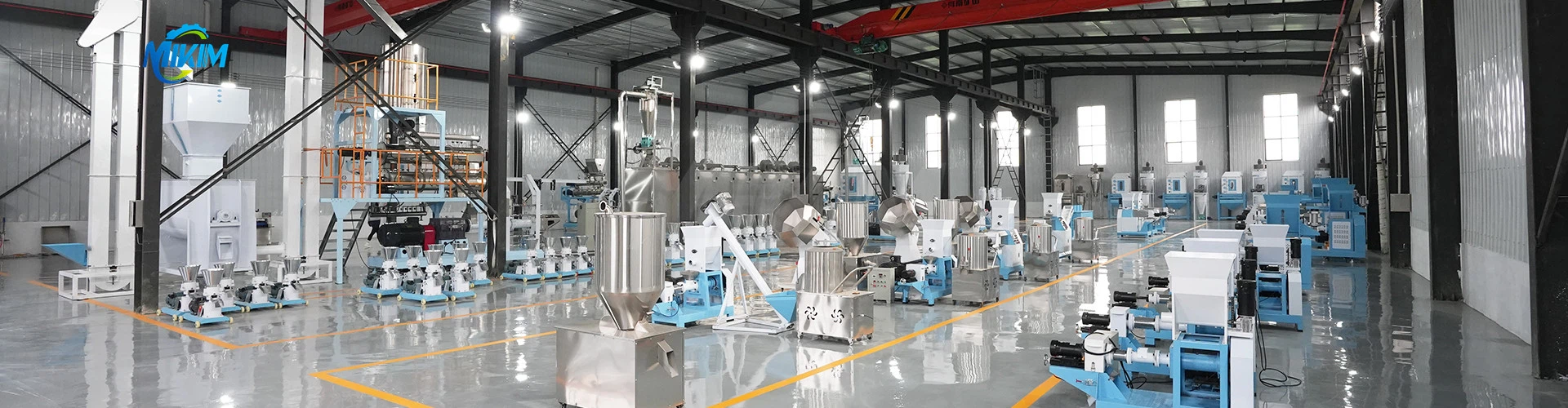
In order to improve the production performance and health level of these animals, scientific and reasonable feed formulas and advanced feed processing equipment are particularly critical. This article will focus on the main advantages of ruminant feed processing equipment and its role in practical applications.
The ruminant feed production line realizes an integrated process from raw material processing to finished product packaging through automation and intelligent technology. Specifically, the automatic batching system can accurately control the proportion of feed ingredients according to different animal species, growth stages and nutritional needs, ensuring that each batch of feed reaches the optimal nutritional ratio. Intelligent control of processes such as crushing, mixing and particle forming significantly reduces manual operations and increases production speed and consistency.

| Model | Capacity(t/h) | Power(kw) | Screw Diameter(mm) | Weight |
| 75-B | 0.3-0.4 | 22 | 80 | 1000 |
| 85-B | 0.5-0.6 | 30 | 90 | 2000 |
| 90-B | 0.6-0.7 | 37 | 100 | 2100 |
| 100-B | 0.7-0.8 | 55 | 120 | 2200 |
| 135-B | 1-1.5 | 75 | 135 | 3200 |
| 145-B | 2-3 | 90 | 145 | 4000 |
Innovative technology allows feed production lines to adjust feed ingredients in real time through data analysis and sensing technology, thereby providing more precise nutritional support.
Feed quality directly affects animal health and production performance. The ruminant feed production line is equipped with real-time monitoring and data recording functions, which can strictly control key parameters such as temperature, humidity, and mixing uniformity throughout the production process.