
content
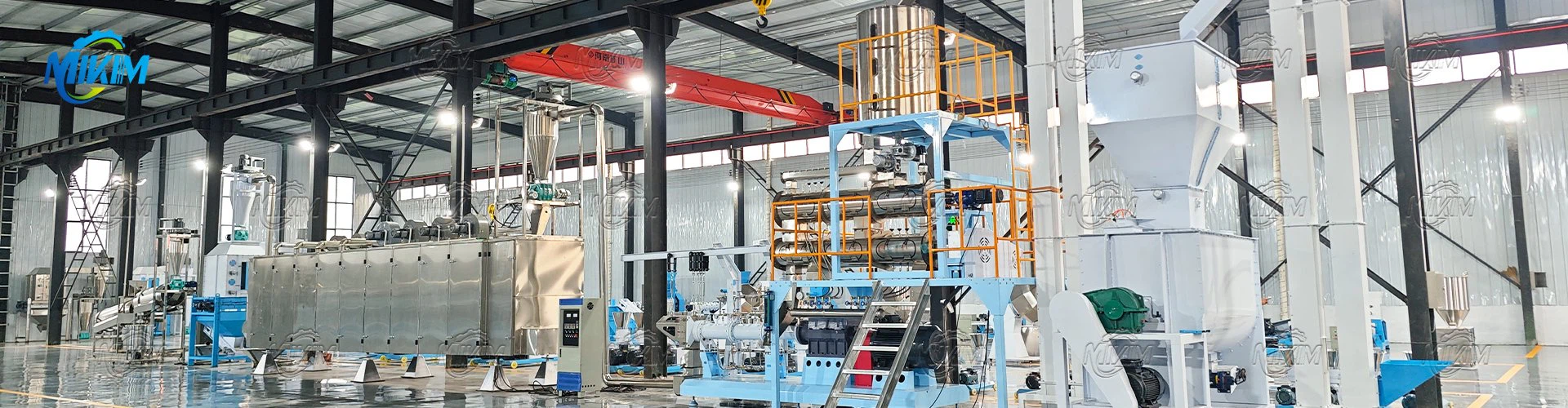
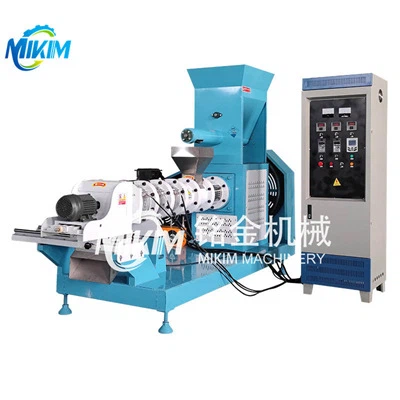
The overall structure of a floating fish extruder machine follows the core logic of "raw material conveying - extrusion maturation - forming and cutting - auxiliary control," primarily composed of six core modules: feeding system, extrusion system, forming system, cutting system, temperature control system, and transmission system. These modules work closely together to achieve the complete transformation from raw materials to extruded feed pellets.
The feeding system is the "raw material inlet" of the fish feed processing machine, responsible for stably conveying the uniformly mixed raw materials to the extrusion chamber. It mainly consists of a feeding hopper, a feeding screw, and a feeding regulating valve. The feeding hopper is used to temporarily store raw materials and is usually made of stainless steel to prevent contamination. The feeding screw is driven by a motor to rotate, pushing the raw materials at a uniform speed to ensure continuous and uninterrupted feeding and avoid sudden changes in pressure within the extrusion chamber. The feeding regulating valve can adjust the feeding speed in real time according to the pressure in the extrusion chamber and is a fundamental component ensuring stable operation of the equipment. The feeding system of small fish feed extruders is mostly manually adjusted, while large industrial-grade equipment is equipped with intelligent feeding devices that enable automated and precise control.
The extrusion system is the "core working area" of the fish extruder machine, undertaking the crucial task of raw material maturation. It consists of the extrusion chamber, screw, and bushing, and is the core component of the entire equipment. The extrusion chamber is a closed cylindrical cavity made of high-temperature and wear-resistant alloy material, capable of withstanding high temperatures of 120-160℃ and high pressures of 3-8MPa. The screw is the core of the extrusion system, with helical blades on its surface. The screw pitch gradually decreases from the feed end to the discharge end, generating strong extrusion and shearing forces through high-speed rotation (300-600 r/min), compressing the raw material and generating frictional heat. The bushing is installed on the inner wall of the extrusion chamber, cooperating with the screw to form the extrusion space while protecting the extrusion chamber from wear; it can be replaced periodically.
The forming system, cutting system, temperature control system, and transmission system are important auxiliary modules ensuring the normal operation of the floating fish feed machine. The forming system mainly consists of a die head with multiple small holes (1-8mm) evenly distributed on it. The raw material is extruded through the holes under high pressure and instantly expanded into shape. The cutting system consists of a rotary cutter and a cutter holder. The cutter is driven by a motor to rotate and cut the extruded continuous strip into particles of uniform length (3-5mm). The temperature control system consists of a heating tube, a cooling device, and a temperature sensor. It monitors and adjusts the temperature of the extrusion chamber in real time to ensure stable curing effect. The transmission system consists of a motor, a reducer, and a belt. It provides power for the operation of the screw, feeding spiral, and cutter, and ensures precise matching of the rotation speed of each component.
Related equipment


about Us
Customer visit

Certificate of Honor

FAQ
1. What is the price of the fish feed extruder machine?
The price ranges from approximately $1,500-$55,000
2. Do you provide maintenance services for your customers?
Yes, we offer comprehensive after-sales maintenance services to our customers.
If you would like to learn more about MIKIM machinery, please contact us. We offer one-stop service and welcome your inquiries!!!