
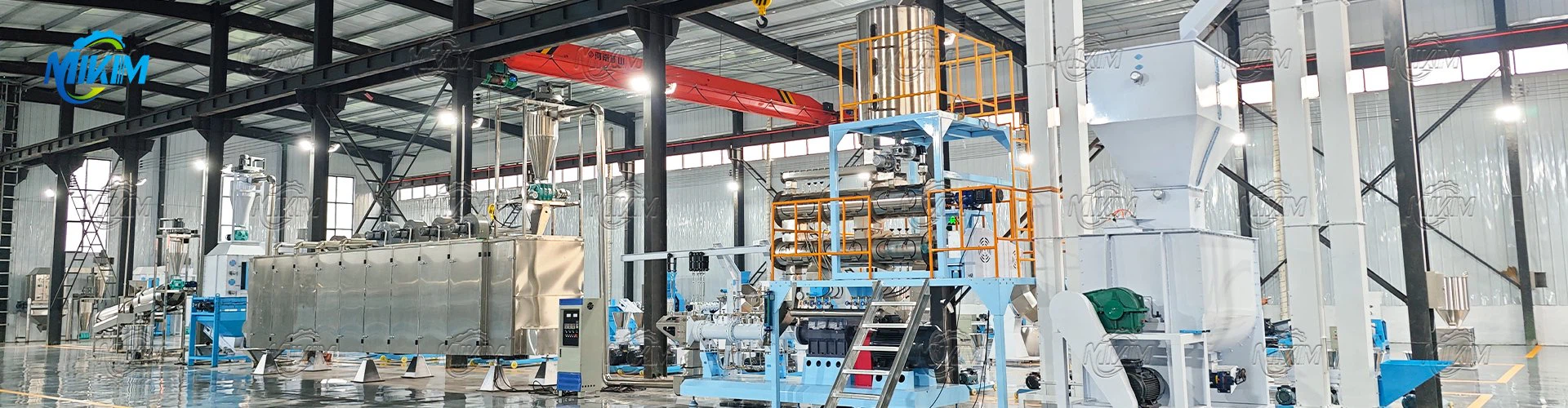

Advantages of Automatic Fish Food Equipment for Producing Floating Pellets
1. Improved Feed Utilization and Reduced Waste
Floating fish feed stays on the water surface, allowing fish to fully consume it and preventing it from sinking and being decomposed by aquatic microorganisms. The waste rate can drop from 20–30% with traditional sinking feed to below 5% (typical). Floating pellets produced by the extruder are stable and float for 8–12 hours - sufficient time for fish to feed. Example: in tilapia farming, floating feed can increase feed utilization by more than 25%, saving about 100–200 yuan per mu in feed costs (typical example).
2. Better Aquatic Environment and Lower Disease Risk
Sinking feed raises ammonia-nitrogen and phosphorus levels in the water, deteriorating water quality. Floating feed, without sinking waste, effectively controls nutrient concentration and reduces algal blooms. The high temperature and pressure of extrusion kill harmful microorganisms such as Salmonella and E. coli in the raw materials, ensuring feed safety and reducing foodborne disease in fish. Example: in high-density pond aquaculture, floating feed can reduce ammonia-nitrogen by over 40% and reduce the incidence of diseases such as enteritis and gill rot by about 50% (typical example).
3. Wide Application Scenarios
| Scenario | Why floating feed fits |
|---|---|
| Freshwater fish (grass carp, common carp, tilapia) | These fish feed mainly in upper layers; floating feed matches their habits |
| Marine fish (grouper, golden pomfret) | Floating pellets meet marine buoyancy needs and have strong salt tolerance |
| Juvenile fish | 1–2 mm fine floating particles with a soft texture - easy to chew and digest |
| High-density industrialized aquaculture | Floating feed supports automated feeding and monitoring with precise feeding control |
| Rice-fish farming, cage culture | Floating feed prevents feed loss in these environments |
4. Note
Figures above are typical/example values - verify under your own farming conditions.