
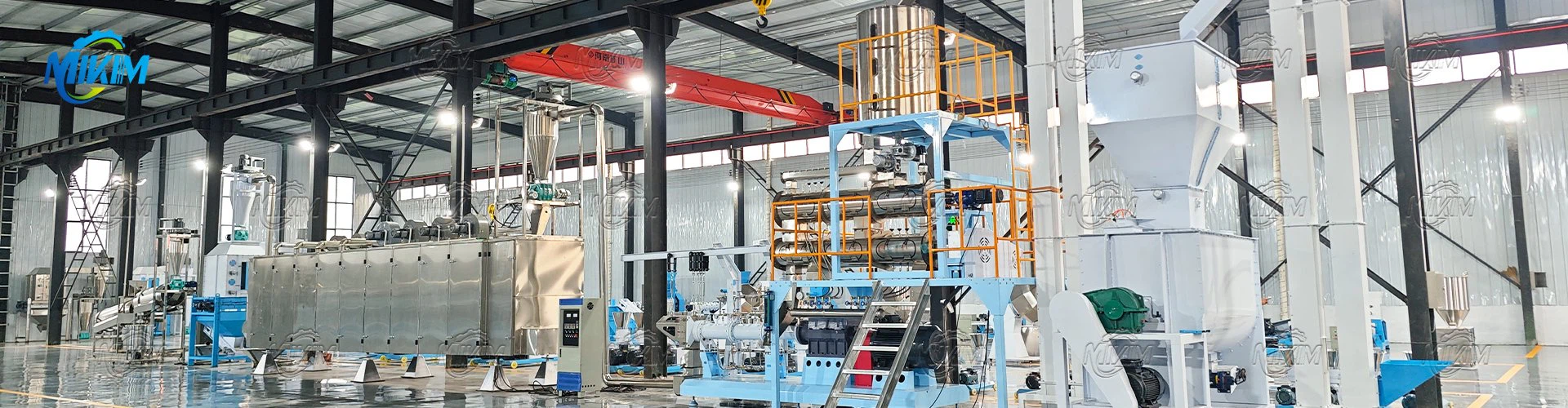
What a Large Feed Pellet Machine Delivers
A large feed pellet machine is defined by its power and output. A representative model is the 400-type flat-die pellet mill with 37 kW of power, producing 1.5 to 2 tons of pellets per hour. Machines in this class are used in chicken, duck, goose and livestock farms, and in small and medium feed processing plants, where they convert mixed powder feed into dense pellets in one pass. The high power translates directly into throughput, and the even granulation keeps pellet quality consistent across the production run.
Working Principle
The large machine works on the same principle as smaller flat-die mills, scaled up. The template, or die, and the pressure rollers are made of high-quality alloy steel with special treatment. Under friction between the spindle and the flat die, the rollers rotate and force the material through the die holes under high pressure and temperature. The material forms a high-temperature paste in which protein coagulates and denatures, and the pellets exit through the discharge tray, where a cutter at the outlet adjusts the pellet length. The internal heat, rising naturally to about 70 degrees, gelatinizes the starch, producing pellets with smooth surfaces, high hardness and deep internal ripening.
Production Line Integration
The large pellet mill is designed to be the heart of a production line. It can be combined with a crusher, guillotine hay cutter, conveyor and mixer to form a line that runs from crushing and mixing to pelletizing. Where required, a cooling machine and packaging machine are added at the end. This modular approach lets the farm start with the pellet mill and expand the line as production grows, keeping the initial investment proportional to the need.
Raw Material Flexibility
Large machines accept an arbitrary ratio of raw materials, which is their practical strength. In summer, when grass is plentiful, crushed corn, wheat bran, grass or straw, rice hulls and soybean cake can be combined into feed pellets. In autumn, silage, corn stalks, peanut shells and other crop residues are paired with grain for pellets. The finished pellets can be fed directly to cattle and sheep or stored until winter, ensuring animal nutrition while reducing breeding cost. The pellet length is adjusted by the cutter, and the pellet thickness by changing the grinding disc aperture: large animals need larger apertures, small animals smaller ones.
Operational Advantages
Because the machine pellets without added water and without a separate drying step, the process is compact and energy-efficient. The natural heat of compression pasteurizes the surface, and the dense pellets store well. For rabbit, fish, chicken, pig, goat and cattle operations, and for professional households and small feed plants, the large machine combines throughput, flexibility and low processing cost.
Frequently Asked Questions
How much can a large feed pellet machine produce? typical 400-type machine with 37 kW produces 1.5 to 2 tons of pellets per hour.
Does the large machine need water added during pelleting? No, the material is compressed without added water and without drying; natural heat of about 70 degrees gelatinizes the starch.
Can the pellet size be adjusted? Yes, the cutter adjusts pellet length and the die aperture adjusts pellet thickness for different animal sizes.
What raw materials can the machine process? Grains, bran, straw, grass, rice hulls, soybean cake, silage and crop residues in almost any combination.
Can the machine be built into a production line? Yes, it combines with crusher, hay cutter, conveyor, mixer, cooler and packaging machine into a complete line.