
content
Establish a blockage early warning mechanism to achieve advance prediction and rapid response. For automated fish food making equipment used in large-scale production, configure an intelligent monitoring system to collect real-time data such as output, current, pressure, temperature, and die head discharge images. Set early warning thresholds (e.g., pressure exceeding 5.5 MPa, current fluctuation exceeding 20%, output decrease of 15%). When the data triggers the threshold, the system automatically issues an audible and visual warning and pushes information to operators. Simultaneously, assign dedicated personnel to conduct hourly inspections, observing pellet quality, die head discharge status, and equipment operating sounds, achieving "dual monitoring" by combining data from the intelligent system. Furthermore, establish a blockage problem log, recording the time, raw material batch, parameter settings, and solutions for each blockage, analyzing patterns, and optimizing accordingly.
Construct a comprehensive prevention system to eliminate blockages from four aspects: raw materials, equipment, operation, and management. Strict inspection and pretreatment standards are established for raw materials to ensure the quality of each batch. A regular maintenance plan is implemented for equipment: daily cleaning of the die head and extrusion cavity, weekly inspection of screw and screw edge wear, monthly calibration of instruments and lubrication transmission systems, and quarterly comprehensive equipment overhaul. Standardized operating procedures (SOPs) are implemented to regulate all aspects of operation, including start-up, feeding, parameter adjustment, and shutdown, with regular skills training and assessments. A quality traceability system is established for management, linking small fish feed pellet extruder clogging issues to production team performance to increase overall awareness.
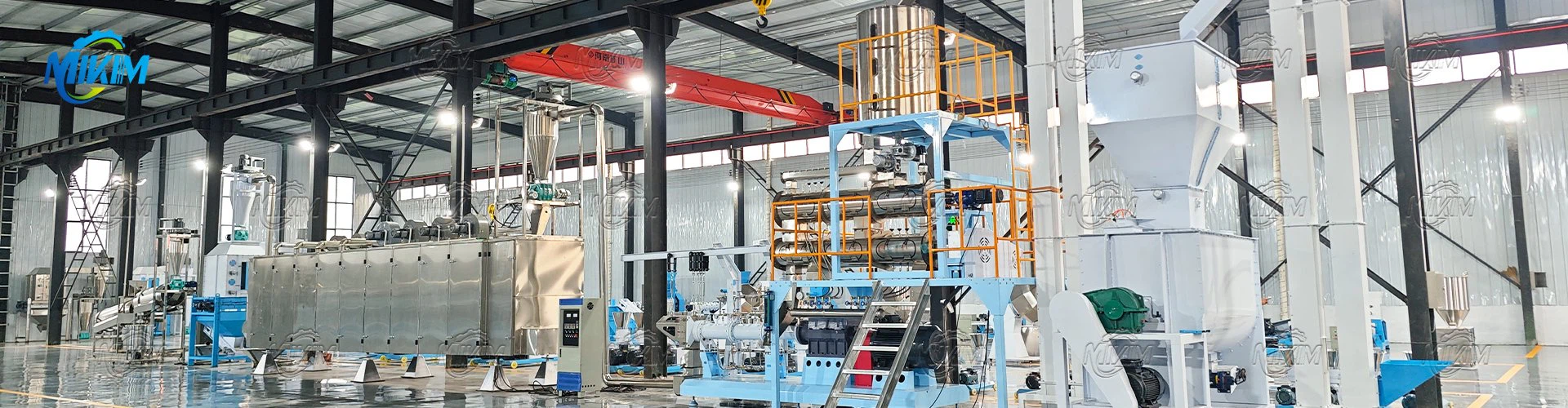
The configuration of the floating fish feed making machine is optimized to improve its anti-clogging capabilities. For companies that produce high-viscosity, high-protein feeds, twin-screw extruders are recommended. These offer more uniform raw material mixing, stronger propulsion, and superior anti-clogging capabilities compared to single-screw extruders. The die head is made of wear-resistant, anti-adhesion materials (such as stainless steel alloy) and features a quick-disassembly design for easy cleaning and replacement. Adding automatic cleaning devices, such as an online die head cleaning system, allows for preliminary cleaning of the die head orifices without stopping the machine. Optimizing the extrusion chamber structure reduces dead zones for raw material residue. For example, an aquatic feed mill upgraded its single-screw extruder to a twin-screw model and equipped it with an online die head cleaning system. This significantly reduced the clogging rate and shortened cleaning time from 30 minutes to 5 minutes, substantially improving production continuity. Through early warning mechanisms, comprehensive process prevention, and equipment upgrades, the extruder can achieve long-term stable operation, completely resolving the problem of die head clogging.
Related equipment


about Us
Customer visit

Certificate of Honor

FAQ
1. What is the price of the small fish feed pellet making machine?
The price ranges from approximately $1,500-$55,000
2. Do you provide maintenance services for your customers?
Yes, we offer comprehensive after-sales maintenance services to our customers.
If you would like to learn more about MIKIM machinery, please contact us. We offer one-stop service and welcome your inquiries!!!