
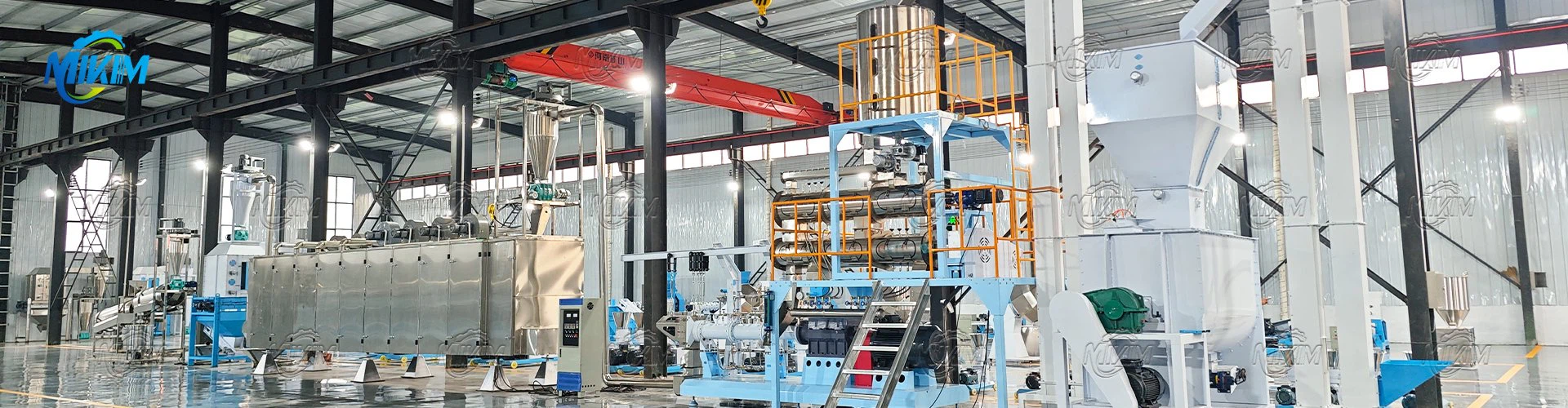
content
Key Check Point 1: The Extruder's Ability to Guarantee Pellet Forming Quality
Before selecting a model, on-site testing of the equipment is necessary to check whether the mini floating fish feed machine can produce uniform and compact fish feed pellets. Three key points should be checked: First, pellet uniformity: the particle size error should be ≤±0.2mm, with no excessively large or small pellets. This depends on the precision of the extruder screw and the machining precision of the die head. Second, pellet water resistance: adult fish feed should remain in water for 4-6 hours without disintegrating, and juvenile fish feed should remain in water for 2-3 hours without disintegrating. This is directly related to the pressure control precision of the extruder and the degree of material maturation. Third, pellet buoyancy: the buoyancy rate of floating fish feed should be ≥95%, and sinking feed should sink quickly. This needs to be achieved through the extruder's expansion degree adjustment. Before selection, it must be confirmed that the extruder can accurately control the expansion degree (fluctuation ≤±5%).


Key Check Point 2: The Floating Feed Extruder Machine's Ability to Guarantee Nutrient Retention Rate
The nutrient retention rate of fish feed (especially heat-sensitive nutrients such as vitamins and amino acids) directly affects fish growth. Before selecting a machine, the extruder's curing process and temperature control capabilities must be checked. Twin screw pet food processing machines must employ High Temperature Short Time (HTST) curing technology, rapidly completing curing at 120-160℃ to shorten the material's residence time in the high-temperature environment, ensuring a heat-sensitive nutrient retention rate of ≥75%. Simultaneously, the extruder's temperature control accuracy must be checked to avoid excessively high temperatures leading to nutrient loss, or excessively low temperatures resulting in insufficient curing and inability for fish to absorb nutrients. Furthermore, the extruder's mixing capacity must be checked to ensure thorough mixing of raw materials and additives, uniform nutrient distribution, and to avoid localized nutrient imbalances.


Key Check Point 3: Equipment Quality Inspection and Control Design
Before selecting a model, it is necessary to check whether the sinking fish feed extruder machine is equipped with a complete quality inspection and control device, linking it to the extruder for real-time optimization: First, it should be equipped with an online pellet quality inspection system that can monitor pellet uniformity and water resistance in real time, automatically fine-tuning the extruder parameters upon detecting abnormalities; second, it should be equipped with a temperature and pressure control early warning system that promptly alarms and shuts down the machine when the extruder temperature or pressure exceeds the set range, preventing pellet quality defects; third, it should be equipped with a raw material pretreatment adaptation device to ensure that the raw materials (particle size 80-100 mesh, moisture 12%-14%) are suitable for extruder operation, guaranteeing finished product quality from the source. This also aligns with the core requirements of the "Operating Procedures for Aquatic Feed Production Equipment".
about Us
Customer visit

Certificate of Honor

FAQ
1. What is the price of the Twin screw pet food making machine?
The price ranges from approximately $1,500-$55,000
2. Do you provide maintenance services for your customers?
Yes, we offer comprehensive after-sales maintenance services to our customers.
If you would like to learn more about MIKIM machinery, please contact us. We offer one-stop service and welcome your inquiries!!!