
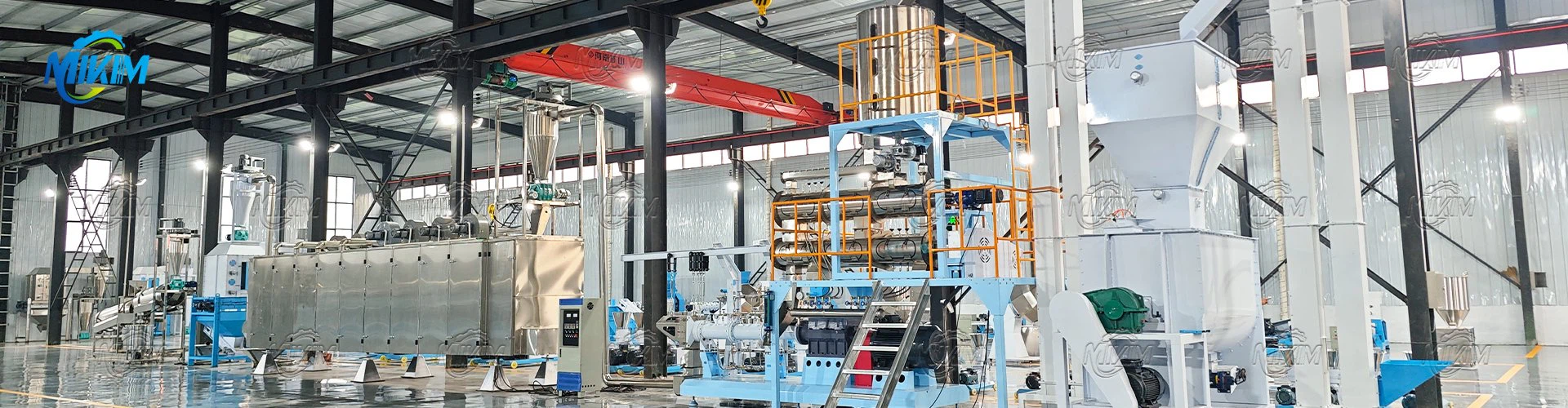
Before purchasing a pet food pellet machine, you must clearly define your production scale and market positioning, as this forms the basis for determining the type of extruder. If you are a small-scale producer (monthly output below 5 tons) focusing on personalized, localized sales, a small single-screw extruder is more suitable. These extruders have low investment costs (US$3,000-10,000), small footprint (only 2-3 square meters), and are easy to operate, meeting the needs of small-batch, multi-variety production.
Operating steps
If you are a medium-sized producer (monthly output 5-50 tons) focusing on regional market sales, a medium-sized twin-screw fish feed making machine is a better choice. Compared to a single-screw fish feed extrusion process, a twin-screw extruder has stronger mixing and extrusion capabilities, higher production efficiency (500-1000 kg per hour), better product quality consistency, and can process various raw materials (including grain-free and high-protein raw materials), making it suitable for large-scale production of standardized products. The price of a medium-sized twin-screw extruder ranges from $20,000 to $50,000. For a factory with a monthly output of 20 tons, the investment can be recovered in 4-6 months.
Secondly, it's crucial to focus on the core performance parameters of the small floating fish feed machine, as these directly impact production efficiency and product quality. Key parameters include extrusion temperature control accuracy, screw speed adjustment range, and output stability. Extrusion temperature control accuracy must be within ±2℃; excessive temperature fluctuations can lead to uneven product cooking, affecting nutrient retention and palatability. A wide screw speed adjustment range (50-300 rpm) is necessary to meet the production needs of different types of dog food-for example, higher speeds are required for producing hard adult dog food, while lower speeds are needed for producing soft puppy food. Output stability is also critical; a high-quality extruder should have an hourly output fluctuation of less than 5% to ensure the stability of production plans and cost control.
Thirdly, the energy consumption and maintenance costs of the floating fish food extruder must be considered, as these are important factors affecting long-term profitability. When purchasing extruders, it's crucial not only to consider the initial purchase price but also to calculate long-term operating costs, with energy consumption per ton of product being a key indicator. Currently, advanced extruders consume less than 800 kWh per ton of product, while outdated models exceed 1200 kWh. Based on an annual production capacity of 100 tons and an electricity price of $0.1 per kWh, the annual electricity cost difference is (1200-800) × 100 × 0.1 = $4000. Regarding maintenance costs, choose extruders with standardized and easy-to-maintain parts. High-quality extruders have long-lasting wear parts (such as screws and die holes) (screws can last 1-2 years, die holes 3-6 months), and these parts are readily available on the market. Annual maintenance costs are typically less than 5% of the equipment price, while maintenance costs for inferior extruders can reach 10%-15% of the equipment price.
Fourth, pay attention to the extruder manufacturer's after-sales service. This can prevent production losses caused by Floating Fish Feed Extruder process malfunctions. Reputable manufacturers should provide a comprehensive after-sales service system, including installation and commissioning, technical training, spare parts supply, and troubleshooting. When purchasing, inquire whether the manufacturer provides on-site installation and commissioning services, the duration of free technical training, and the warranty period (preferably more than one year). Furthermore, understand the supply cycle of easily damaged parts; it should be controlled within 3 days to avoid prolonged production downtime due to a lack of spare parts. Some well-known manufacturers also offer remote fault diagnosis services, allowing for rapid resolution of equipment problems via the internet, minimizing production losses.
Finally, it is recommended to conduct on-site inspections and sample testing before purchasing. Visit the manufacturer's production base to observe the production process and quality control system of the "small fish feed pellet making machine," and observe the equipment's operating status on-site. Simultaneously, provide your own raw material formula to the manufacturer for sample production testing, examining the sample's appearance, taste, nutritional components, and other indicators to ensure the extruder meets production requirements. Additionally, communicate with other users who have purchased the same model of extruder to understand the manufacturer's user reputation and make a more accurate purchasing decision.
Choosing the right dog food extruder is a crucial step in achieving profitable dog food production. By clearly defining your production scale and market positioning, focusing on core performance parameters, calculating operating costs, and paying attention to after-sales service, you can choose the most suitable extruder for your needs. A high-quality extruder is not only a production tool but also a profit growth point. It can help you improve production efficiency, ensure product quality, reduce operating costs, and maximize the profitability of dog food production.
Related equipment


about Us
Customer visit

Certificate of Honor

FAQ
1. What is the price of the dog food pellet maker?
The price ranges from approximately $1,500-$55,000
2. Do you provide maintenance services for your customers?
Yes, we offer comprehensive after-sales maintenance services to our customers.
If you would like to learn more about MIKIM machinery, please contact us. We offer one-stop service and welcome your inquiries!!!