
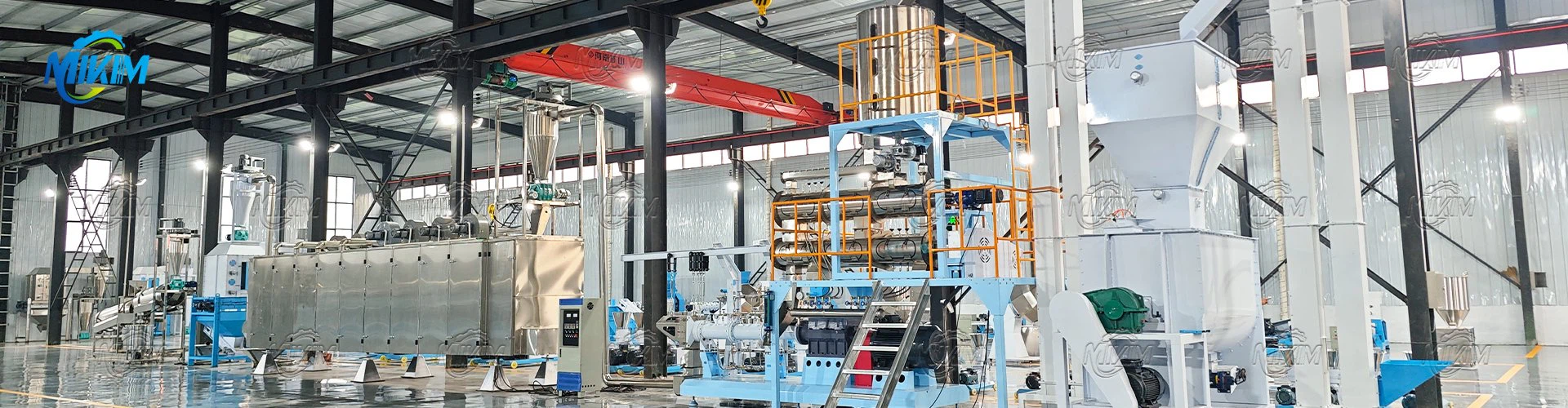
Line Structure and Steel Frame Design
A feed pellet production line is built around a steel frame structure that supports all processing systems in a fixed layout. The steel frame provides the rigidity needed for long-term operation, keeps vibration within acceptable limits and allows the components to be arranged in a logical flow from raw material intake to finished product discharge. A well-designed frame also simplifies installation, maintenance access and future capacity expansion.
System by System: What Each Part Does
The line consists of several key systems, each with a specific job. The raw material pretreatment system cleans, crushes and dries the incoming ingredients, preparing them for downstream processing and removing contaminants that would damage equipment. The grinding system reduces the material to the particle size required for homogeneous mixing; the more uniform the grind, the more consistent the final pellet. The mixing system blends all ingredients into a homogeneous feed, ensuring every pellet carries the full formula. The pelletizing system compresses the mixed material into pellets, and the cooling and packaging systems condition and pack the finished product. Because each system is matched to the capacity of the others, the line runs without bottlenecks.
Where the Time Savings Come From
In a manual operation, each step is a separate job with its own handling: material is carried between machines, weighed by hand and processed in batches. In a production line, conveyors move material between systems automatically, sensors control the feed rate, and the process runs continuously. This eliminates most of the material handling labor and cuts the total processing time per ton substantially. One or two operators can supervise the whole line, and the reduction in manual weighing and transfer also removes a major source of errors.
Where the Labor Savings Come From
The line replaces the tasks that previously required several workers: feeding the crusher, carrying crushed material, mixing by shovel and monitoring the pelleting machine. In a line layout, these tasks are performed by the equipment itself, and the operator's role changes from doing the work to supervising it. The labor saving is largest in mixing and handling, which are the most physically demanding and time-consuming steps in traditional feed making.
Planning a Line for Your Farm
Start from the target output: the line capacity should match the farm's daily feed requirement with a margin for future growth. Select each system at the same capacity so no single machine limits the rest, and plan the layout for a logical material flow with enough space for maintenance access. Confirm the automation level matches the available skill: a fully automatic line is only an advantage if the operators can run and maintain it.
Frequently Asked Questions
What systems make up a feed pellet production line? Typical lines include raw material pretreatment, grinding, mixing, pelletizing, cooling and packaging systems connected by conveyors.
How much labor does a production line save? line can reduce the workforce for feed production from several workers to one or two supervisors, depending on automation level.
Can a small farm use a production line? Yes, lines are available from small capacities of a few hundred kilograms per hour up to several tons per hour.
Is a production line difficult to install? Installation is straightforward with the steel frame structure and factory-provided layout drawings, and most suppliers offer commissioning support.
What is the most important thing when planning a line? Matching the capacity of every system so the line runs without bottlenecks, and planning the layout for smooth material flow.