
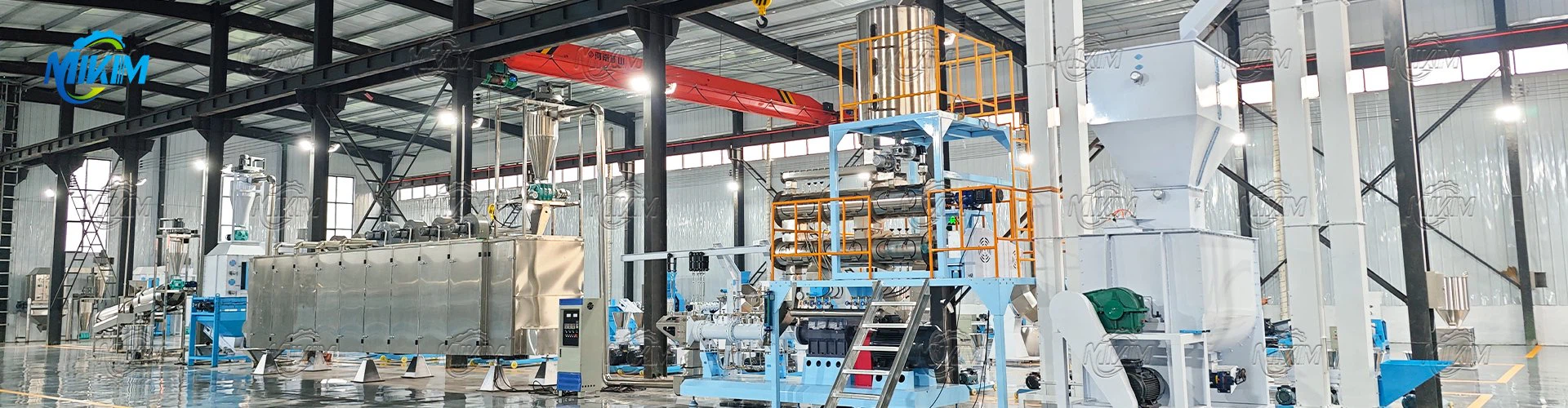
content
The length-to-diameter ratio (L/D ratio) of the screw is a core structural parameter affecting the maturation effect. A larger L/D ratio means the raw material stays in the extrusion chamber longer, experiences more thorough extrusion and shearing forces, and achieves a higher starch gelatinization rate (up to 90% or more), thus improving feed digestibility. However, an excessively large L/D ratio leads to increased energy consumption and decreased production efficiency. Typically, a L/D ratio of 10:1-15:1 is chosen for dry dog food making machines producing ordinary feed, while a ratio of 15:1-20:1 is needed for producing high-nutrient-density feeds (such as juvenile fish feed). Furthermore, the screw pitch gradient design also affects performance. A reasonable pitch gradient ensures smooth compression and heating of the raw material, avoiding excessive local pressure or sudden temperature rises, and improving maturation uniformity.
The structural design of the die head in dog food manufacturing equipment directly determines the quality and forming effect of the feed pellets. The size and uniformity of the die's aperture affect the consistency of particle size. Smaller aperture errors and more uniform distribution result in more uniform particle size, avoiding mixing of sizes. The length of the die's discharge channel affects the extrusion pressure. A longer channel results in higher extrusion pressure and higher particle density, suitable for producing sinking feeds; a shorter channel results in lower extrusion pressure and higher particle expansion, suitable for producing floating feeds. Some high-end dies employ a conical discharge channel design, which allows for smoother raw material extrusion, reduces pressure loss, and improves molding stability.
The structural design of the temperature control system in pet food extrusion equipment machines affects temperature control accuracy, which in turn affects the cooking effect and nutrient retention rate. The zoned temperature control structure (separate temperature controls for the feeding section, compression section, and maturation section) can precisely adjust the temperature according to the maturation requirements of the raw materials at different stages. For example, the feeding section preheats at a low temperature, the compression section gradually increases the temperature, and the maturation section maintains a stable temperature of 120-140℃, avoiding localized scorching or under-maturation of the raw materials due to sudden temperature increases or decreases. The temperature control structure equipped with a cooling device can quickly cool down when the temperature is too high, ensuring that the temperature remains stable within ±1℃, effectively preserving heat-sensitive nutrients (such as vitamins) in the feed.
The structural design of the feeding system affects the production stability and efficiency of the dog food processing machine. Compared to ordinary feeding structures, a forced feeding structure ensures stable delivery of raw materials even with high-moisture and high-oil formulations, avoiding feeding interruptions. The intelligent feeding adjustment structure can adjust the feeding speed in real time according to the extrusion chamber pressure, precisely matching the feeding speed with the screw speed, improving production efficiency while ensuring stable extrusion chamber pressure, avoiding equipment failure or feed quality fluctuations caused by pressure fluctuations.
Related equipment


about Us
Customer visit

Certificate of Honor

FAQ
1. What is the price of the pet food extrusion machine?
The price ranges from approximately $1,500-$55,000
2. Do you provide maintenance services for your customers?
Yes, we offer comprehensive after-sales maintenance services to our customers.
If you would like to learn more about MIKIM machinery, please contact us. We offer one-stop service and welcome your inquiries!!!