
content
The core design principle of the Small Fish Feed Extruder Machine (capacity 50-200 catties/hour) is "simple, practical, and easy to operate." The overall structure is simplified with a low degree of automation. The feeding system consists of a manual feeding hopper and a simple feeding screw; the feeding speed is controlled manually via a valve, eliminating the need for complex intelligent controls. The extrusion system uses a single-screw design with a small screw diameter (typically 30-50mm), a length-to-diameter ratio of 10:1-15:1, and a motor power of 2.2-7.5kW, sufficient for the curing needs of small batches of raw materials. The forming system uses a fixed-diameter die head; changing the diameter requires manual removal of bolts, and it is compatible with common hole diameters of 1-3mm. The cutting system uses a manually adjustable cutter with speed controlled by a knob. The temperature control system is a simple electric heater with a thermometer, resulting in relatively low temperature control accuracy (error ±5℃). The overall equipment is small in size (occupying 1-2㎡), lightweight (tens of kilograms), requires no special installation foundation, and is easily movable.
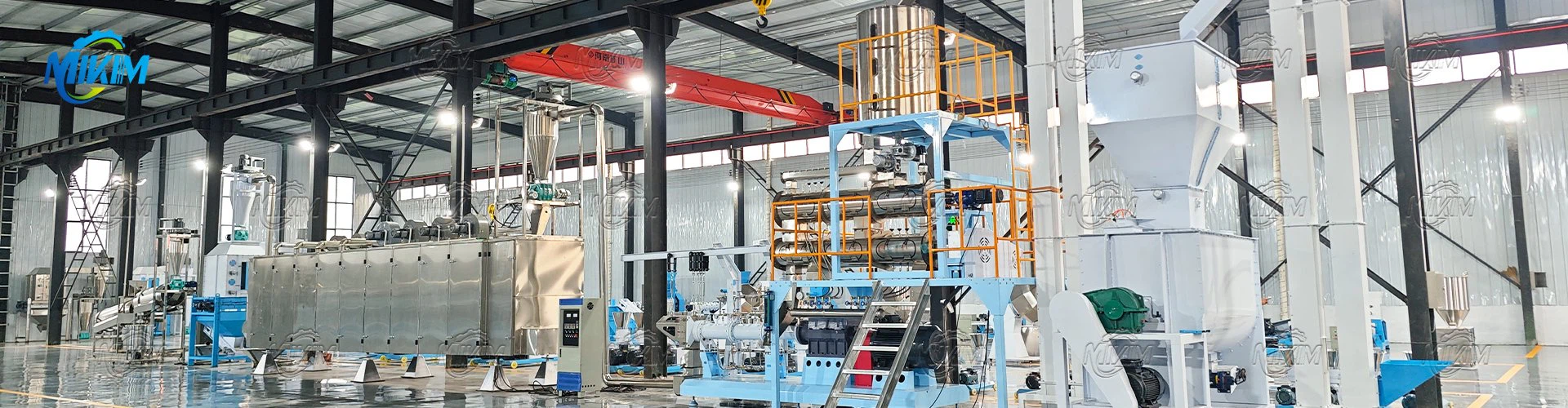
The core structure of the industrial-grade floating fish feed pellet making machine (with a capacity of over 1000 catties per hour) is "high efficiency, stability, automation, and precision." Its overall structure is complex, with larger and more precise components. The feeding system consists of a large storage silo, a forced feeding screw, and an intelligent feeding adjustment system, enabling continuous automated conveying of raw materials. Pressure sensors adjust the feeding speed in real time to ensure stable pressure in the extrusion chamber. The extrusion system employs a twin-screw design with a large screw diameter (80-150mm), a length-to-diameter ratio of 15:1-20:1, and a motor power of 30-100kW, generating stronger extrusion shearing forces to meet the production needs of high-volume, complex formulations. The forming system features a quick-change die head device, eliminating the need to disassemble numerous bolts and allowing for bore diameter changes within minutes. It supports bore diameters from 1-8mm, and the die head is equipped with a cooling device to prevent high-temperature deformation. The cutting system uses a variable frequency speed-controlled cutter, with a PLC control system precisely matching the output speed, controlling the pellet length error within ±0.1mm.
In addition, the Twin-Screw fish feed extruder machine is equipped with a comprehensive auxiliary structure: the temperature control system uses zoned precise temperature control, with heating elements and cooling devices installed in the feeding section, compression section, and maturation section, achieving a temperature control accuracy of ±1℃; the transmission system uses a precision reducer and servo motor to ensure precise synchronization of the rotation speed of each component; it also features an intelligent monitoring system that can monitor parameters such as temperature, pressure, and rotation speed in real time, automatically alarming and shutting down in case of abnormalities; and the equipment has a fixed mounting foundation at the bottom to ensure stability during long-term high-load operation. These structural differences determine that the small-scale equipment is suitable for family farming and small workshops, while the industrial-grade equipment is suitable for large-scale feed mills and large-scale farms.
Related equipment


about Us
Customer visit

Certificate of Honor

FAQ
1. What is the price of the fish feed processing machine?
The price ranges from approximately $1,500-$55,000
2. Do you provide maintenance services for your customers?
Yes, we offer comprehensive after-sales maintenance services to our customers.
If you would like to learn more about MIKIM machinery, please contact us. We offer one-stop service and welcome your inquiries!!!