
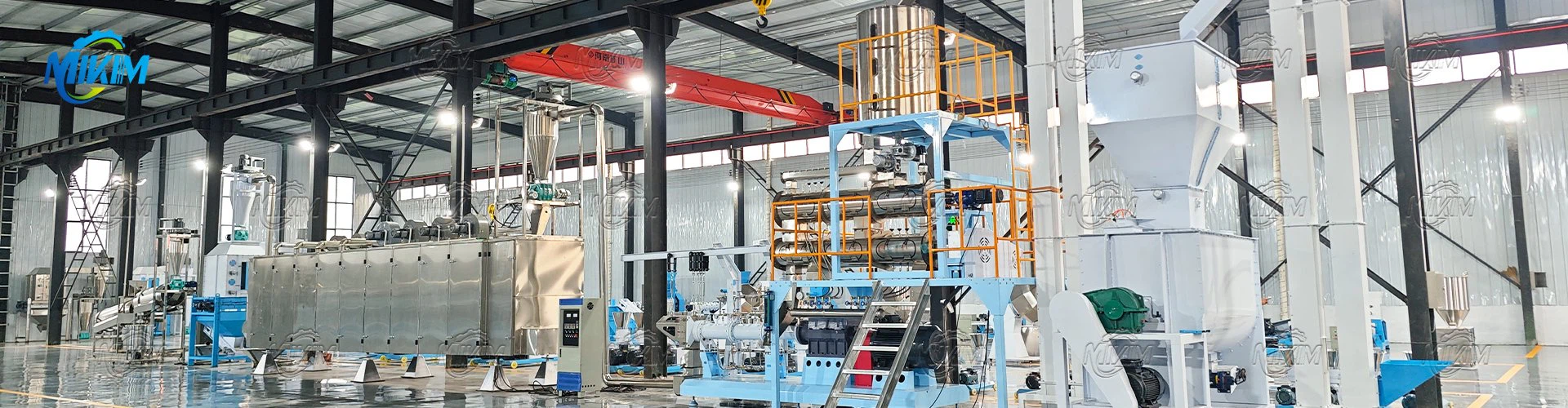
Pellet processing is the core link of fish feed pellet production. The raw materials are mixed and sent to the pellet machine. After the action of high temperature and high pressure, they are formed into granules with good taste and nutritional content. At the same time, the particle size of the pellet machine can be adjusted as needed.
The granulated fish feed pellets need to be dried and baked. Generally, the airflow drying method is adopted, and the moisture inside the pellets is removed by oven heating to make the pellets easier to store. At the same time, after high temperature treatment, it can also sterilize, disinfect and improve the taste of the pellets.

| Model | Capacity(t/h) | Power(kw) | Screw Diameter(mm) | Weight |
| 75-B | 0.3-0.4 | 22 | 80 | 1000 |
| 85-B | 0.5-0.6 | 30 | 90 | 2000 |
| 90-B | 0.6-0.7 | 37 | 100 | 2100 |
| 100-B | 0.7-0.8 | 55 | 120 | 2200 |
| 135-B | 1-1.5 | 75 | 135 | 3200 |
The dried and baked fish feed pellets need to be packaged and stored. The packaging materials need to choose moisture-proof and insect-proof packaging bags, and the storage environment should avoid direct sunlight and high temperature and humidity.
Summary:
Fish feed pellets are completed through raw material preparation, pellet processing, drying and baking, packaging and storage. Among them, pelletization is the core link of fish feed production, which is formed into granules through high temperature and high pressure. After drying and baking, fish feed pellets need to be stored in appropriate packaging materials to ensure their nutritional content and taste.