


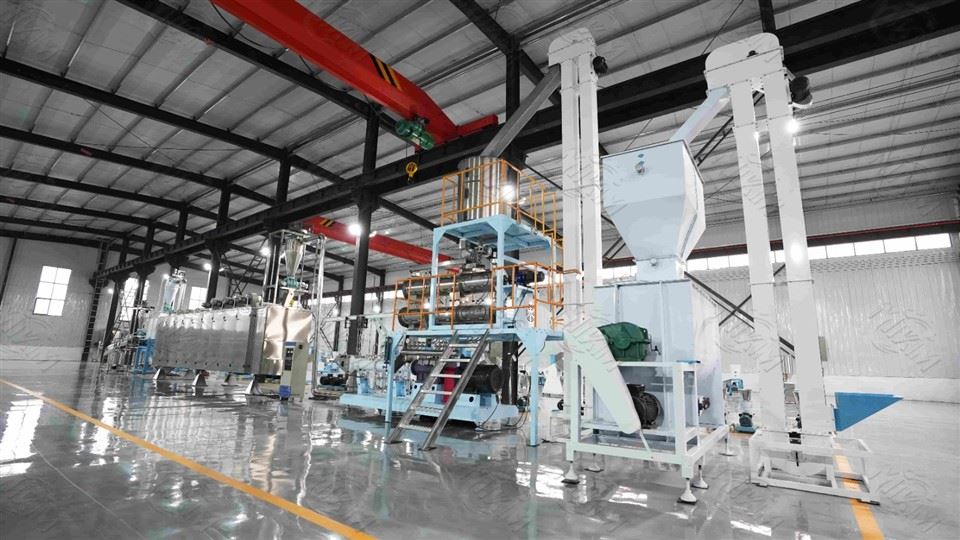
1 T/H Aquafeed Production Line
Pellet Size: 0.5-9 mm
Voltage: 220 V / 380 V / 450 V (Customizable)
Frequency: 50 Hz / 60 Hz (Customizable)
Feed Pellet Type: Floating, Slow-Sinking, and Sinking Feed
Product Type: Dry-Type (Non-Steam) Extruder / Wet-Type (Steam-Assisted) Extruder
Send Inquiry
Product Details of1 T/H Aquafeed Production Line
Tianjin Mikim Technique Co., Ltd. is one of the most experienced manufacturers and suppliers of 1 t/h aquafeed production line in China. If you're going to buy cheap 1 t/h aquafeed production line made in China, welcome to get more information from our factory. All our products are with high quality and low price.
The 1 T/H Aquafeed Production Line, also known as the Aquaculture Feed Production Line, is designed to produce floating, slow-sinking, and sinking feed pellets for aquaculture. It is compatible with a wide range of feed ingredients, including corn meal, soybean meal, fish meal, wheat flour, rice bran, vitamin premixes, mineral premixes, and other feed additives.
The production process includes Crushing → Mixing → Extrusion → Drying → Seasoning → Cooling → Screening → Packaging, providing a complete processing solution from raw materials to finished feed pellets.
The line can produce feed for tilapia, catfish, carp, trout, shrimp, crab, and other freshwater and marine species. By changing the die and adjusting the production parameters, it can produce pellets from 0.5 mm to 9 mm to suit different species and growth stages.
1 T/H Aquafeed Pellet Production Line test for US customers
1–2 t/h Aquafeed Production Line Plant Technical Specifications
|
ITEM |
Reference Photo |
MACHINE NAME |
MACHINE PARAMETER
|
Notes |
| 1 |
|
Water drop crusher |
Main power: 55kw |
1. Teardrop-shaped grinding chamber Improves material flow and grinding efficiency. Compared with conventional chamber designs, production capacity can increase by up to 20%. 2. Wear-resistant serrated inlet plates Increase material impact and shearing while reducing material circulation inside the grinding chamber. 3. Shaft-end air supply system Improves airflow inside the grinding chamber to enhance grinding efficiency and reduce heat buildup. 4. Multiple rotor and screen configurations Different hammer-to-screen clearances and rotor configurations are available for aquaculture feed and livestock feed production. 5. Wear-resistant hammers Manufactured from alloy steel with a tungsten carbide coating to extend service life and reduce replacement frequency. 6. Safety interlock system Prevents operation when the inspection door is open, improving operator safety during maintenance. |
| 2 |
|
Bucket Screw elevator |
|
To feed the crushed materials into mixer |
| 3 |
|
U-shaped horizontal mixer |
|
The horizontal single-shaft mixer is used to blend dry feed ingredients before extrusion or pelletizing. It delivers uniform mixing with a coefficient of variation (CV) of ≤ 5% to 7%, helping ensure consistent ingredient distribution throughout the feed production process. |
| 4 |
|
Bucket elevator |
Power: 2.2kW
|
The bucket elevator is 5 m high and is constructed from 2 mm thick steel plate with wear-resistant nylon buckets. It is used to transport raw materials to the hammer mill, providing continuous and stable material conveying during the production process. |
| 5 |
|
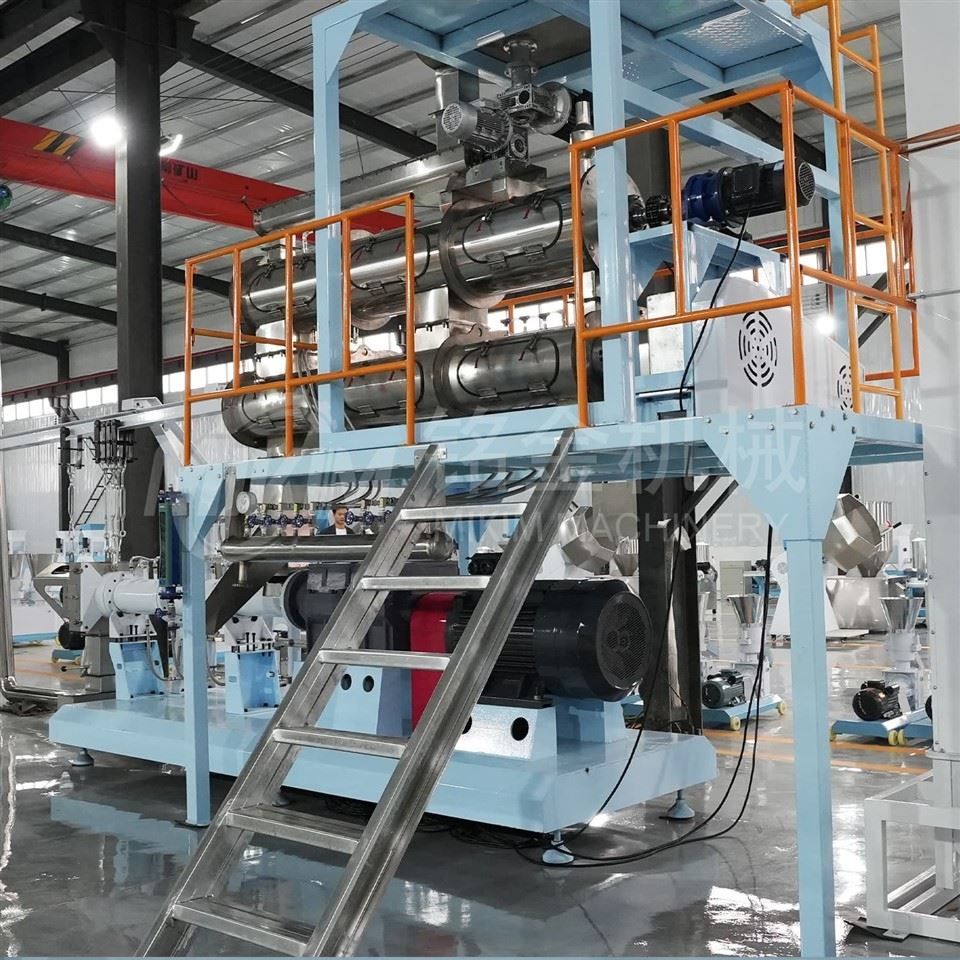
Wet-type Twin-Screw floating fish feed extruder machine
(We also offer dry-type extruders for customers who do not require steam conditioning.)
|
Requires a steam boiler or steam generator. |
1. Steam-assisted extrusion 2. Wide formulation compatibility 3. Consistent pellet quality 4. Stable operation and easy cleaning 5. Long service life 6. Flexible pellet production
|
| 6 |
|
Pneumatic conveyor |
Fan motor power: 2.2 kW |
The pneumatic conveyor uses airflow to transfer feed pellets from the extruder outlet to the dryer inlet as part of the continuous production process. Constructed from stainless steel, it provides reliable material conveying with good corrosion resistance and easy maintenance. |
| 7 |
|
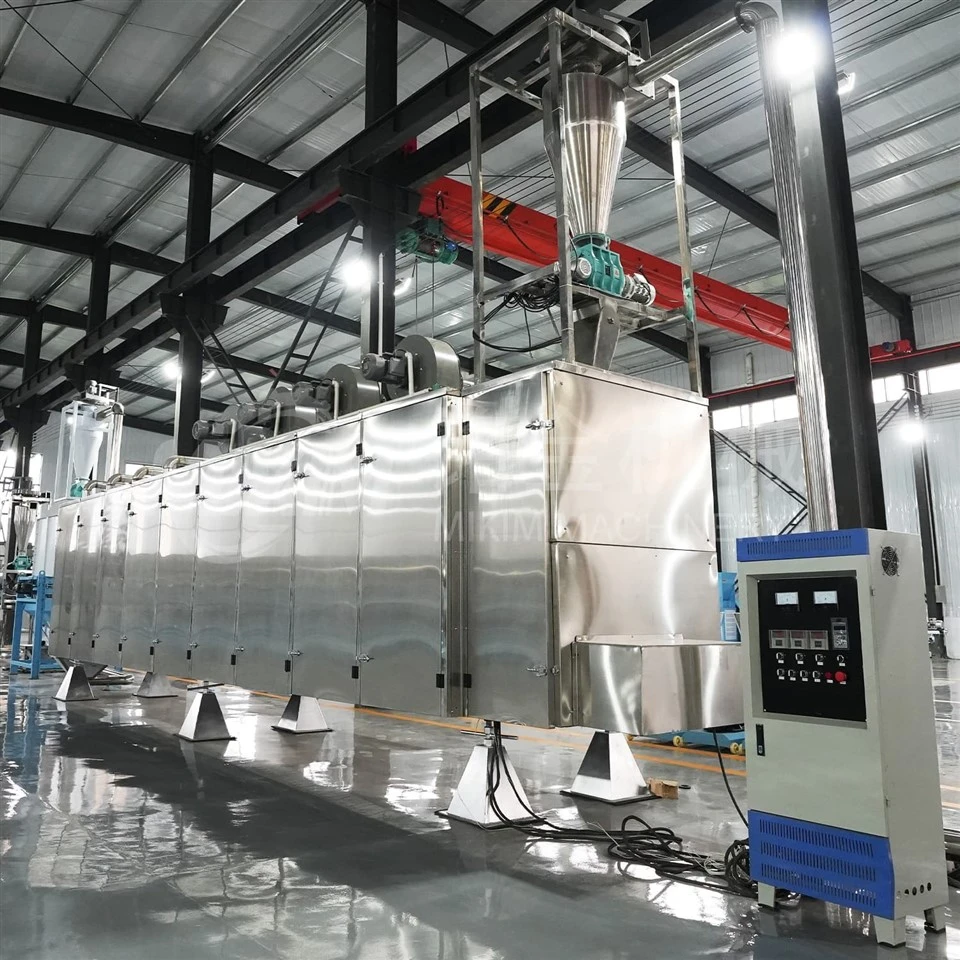
Animal Feed Pellet Drying Machine |
Dryer: 5-tier structure / 8 m Heating power: 45 kW Fan motor power: 2.2 kW × 4 units Conveyor motor power: 3 kW Dimensions: 5.5*1*2 m Weight: 1.5t Material: 304 stainless steel |
The automatic dryer is equipped with a 5-layer, 8 m mesh belt conveyor for continuous pellet drying. Feed pellets move through each layer in sequence, providing sufficient drying time while maintaining a compact machine footprint. The drying temperature is automatically controlled, and the conveyor speed can be adjusted with a variable-frequency drive (VFD) to regulate the drying time according to different production requirements. The multi-layer drying structure and circulating hot air system provide uniform heat distribution, helping achieve consistent moisture reduction throughout the drying process. The dryer is constructed from stainless steel for improved corrosion resistance, hygiene, and long-term durability.
|
| 8 |
|
Pneumatic conveyor |
Fan motor power: 2.2 kW |
The pneumatic conveyor uses airflow to transfer feed pellets from the extruder outlet to the dryer inlet as part of the continuous production process. Constructed from stainless steel, it provides reliable material conveying with good corrosion resistance and easy maintenance. |
| 9 |
|
Automatic Octagonal Drum Seasoning Machine |
|
1. Uniform coating 2. Automatic operation 3. Stainless steel construction |
| 10 |
|
Oil Sprayer |
|
The oil spraying machine is used to apply oil or other liquid additives evenly to the surface of feed pellets after drying. It integrates automatic oil heating, mixing, and spraying to provide a continuous and controlled coating process while reducing manual operation. The spraying volume can be adjusted according to different feed formulations, helping achieve uniform oil distribution on each pellet. The machine is constructed from stainless steel for improved corrosion resistance, hygiene, and easy cleaning. |
| 11 |
|
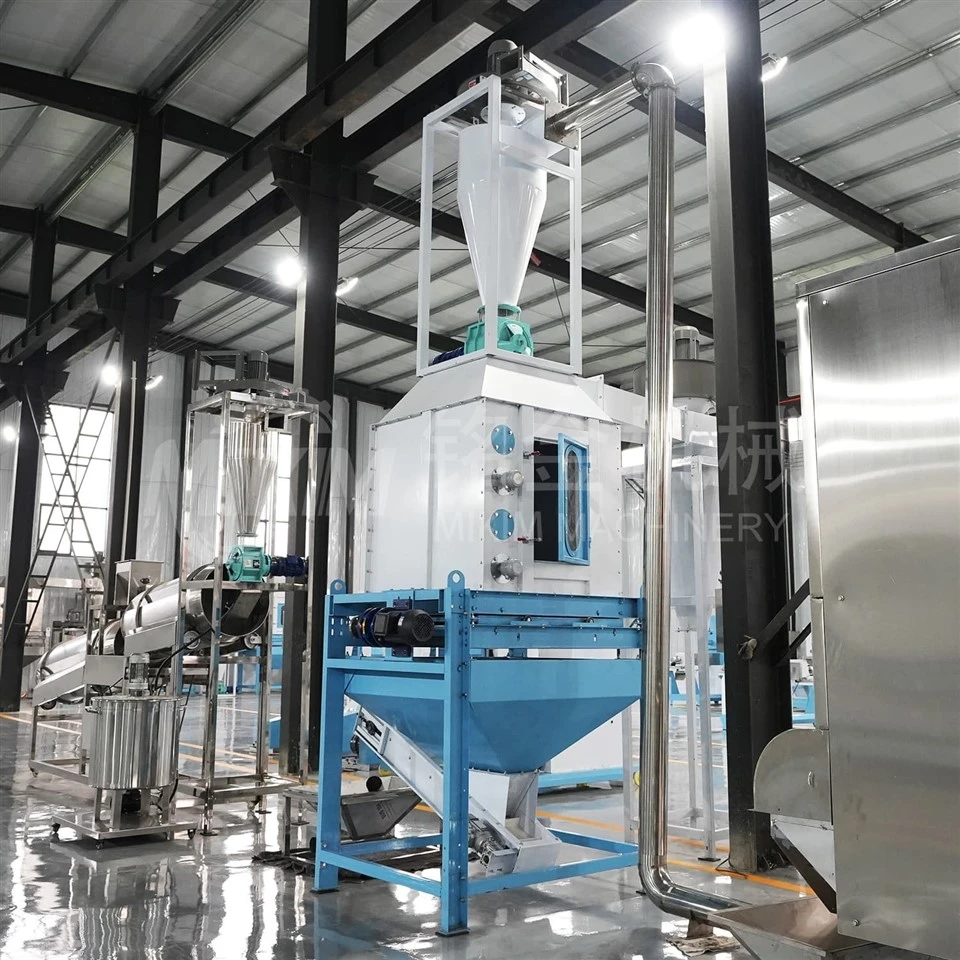
Counter flow cooler |
Main powr: 2.2kw |
The counterflow cooler is used to reduce the temperature and moisture content of freshly extruded or pelleted feed to levels suitable for storage and packaging. The counterflow cooling process provides uniform cooling while helping maintain pellet quality and stability. The machine features stable operation, low energy consumption, and easy maintenance. |
| 12 | Conveyor | Main powr: 0.75kw |
To deliver the cooled feed into the conveyor. | |
| 13 |
|
Bucket elevator |
Power: 2.2kW
|
The bucket elevator is 5 m high and is constructed from 2 mm thick steel plate with wear-resistant nylon buckets. It is used to transport raw materials to the hammer mill, providing continuous and stable material conveying during the production process. |
| 14 |
|
Automatic Bag Filling Packing Machine |
Packaging System Packaging Capacity: 200-300 bags/hour Weighing Accuracy: Static: ±0.1% Dynamic: ±0.2% Power Supply:380 V, 50 Hz ±2%, 4.5 kW Compressed Air Supply:0.6-0.8 MPa Compressed Air Consumption:0.2 Nm³/min Quantity:1 unit |
Conveyor Function:Conveying filled bags to the next processing stage. Technical Parameters: Conveyor Length:3000 mm Power Supply:380 V, 50 Hz, 0.37 kW Quantity:1 unit
Bag Sewing System Sewing Machine Model:35-6A / 35-2C Technical Parameters: Maximum Sewing Speed:1,600 stitches/min Stitch Length:6.5-11 mm Stitch Type:Double-thread chain stitch Thread Specification:21S/5 and 21S/3 polyester thread Needle Type:80800, 280-250# Power Supply:380 V, 50 Hz, 0.37 kW Quantity:1 unit
Finish your line with precision. This [Automatic Bag Filling Packing Machine] offers ±0.2% gravimetric accuracy, ensuring every bag is retail-ready and perfectly sealed. |
| 15 |  |
Air compressor |
2.2kw | Used to transfer finished feed pellets to the packaging machine for automatic packaging. |
| 16 |
|
Steam generator |
48kw | The steam boiler supplies steam to the extruder for raw material conditioning before extrusion. |
| 17 |
|
Electric control |
Motor Brand: Chinese Brand or Siemens (Optional) |


Aquafeed Production Line Working Principle
We offer two types of extruders: a dry-type (non-steam) extruder and a wet-type (steam-assisted) extruder. The working principles of both types are explained below.
Dry-Type Fish Feed Extruder (non-steam)


Working Principle of Dry-Type Extruders
A Dry Type floating fish feed pellet extruder machine generates heat by converting mechanical energy into thermal energy. Unlike a wet Type fish feed pellet machine, it does not require external steam. During extrusion, the required heat and pressure are produced through mechanical friction and compression inside the machine.
1. Frictional Heating and Shearing
After entering the extrusion chamber, the raw material is conveyed forward by a high-speed rotating screw. Strong friction and shear forces are generated between the screw, the barrel, and the material itself. This mechanical action rapidly increases the material temperature to approximately 120°C–160°C within a few seconds.
2. Compression and Plasticization
As the material moves through the barrel, the screw gradually compresses it, causing the pressure inside the extrusion chamber to increase to approximately 3–10 MPa. Under these high-temperature and high-pressure conditions, the material becomes plasticized. During this process, starch is gelatinized, proteins are denatured, and the feed mixture is thoroughly cooked.
3. Instant Expansion
When the material is forced through the die, the pressure drops immediately from high pressure to atmospheric pressure. The moisture trapped inside the material rapidly vaporizes, causing the pellets to expand instantly and form a porous internal structure. This expansion improves pellet buoyancy, digestibility, and water stability.
wet Type fish feed extruder machine (steam-assisted)


Working Principle of Wet-Type Extruders
Wet-type twin-screw aquatic feed extruders are widely used in medium and large-scale Aquafeed Pellet Production Line because they provide more stable processing conditions and produce higher-quality feed pellets. Their operating principle combines steam conditioning with mechanical extrusion.
1. Steam Conditioning
Before entering the extruder, the raw material passes through a conditioner, where saturated steam and, when necessary, hot water are added. This increases the moisture content to approximately 20%–30% while preheating the material to 70°C–90°C. The conditioning process partially cooks and softens the material, making it easier to extrude.
2. Combined Heat Generation
After conditioning, the material enters the extrusion barrel. Heat is generated through both mechanical friction from the rotating screw and external heating provided by steam or barrel heaters. Because the material contains more moisture, it flows more smoothly through the barrel, reducing resistance and minimizing wear on the screw and barrel components.
3. Complete Cooking and Expansion
Inside the extrusion chamber, the material is fully cooked under carefully controlled temperature and pressure, resulting in a higher degree of starch gelatinization and improved nutrient availability. As the material exits the die, the sudden pressure drop causes rapid expansion, producing feed pellets with excellent buoyancy, durability, and water stability.
☆Want to learn more about twin-screw extruders? Click here.
Application
Both dry-type and wet-type floating fish food extruder machines are suitable for producing floating and sinking feed pellets for a wide range of aquatic species, including tilapia, grass carp, common carp, crucian carp, catfish, and shrimp. They can also be used to manufacture dry pet food for cats and dogs.
Wet Type floating fish feed pellet extruder machines offer greater formulation flexibility and are particularly suitable for producing high-quality feed for salmon, rainbow trout, eel, sea bass, grouper, turbot, sturgeon, snakehead, crab, various aquatic fry, high-value ornamental fish, and fur animals such as foxes. Their superior cooking performance and starch gelatinization make them ideal for premium aquafeed applications.


Customer Case Studies
Poland 500 kg/h Fish Feed Pellet Production Line – MIKIM


Download Customer Case Studies
FAQ
1. What type of oil is used in the chamber housing the gears and rollers of the extruder?
The gearbox chamber of the extruder uses industrial gear oil with suitable viscosity and anti-wear properties, such as ISO VG 220–320 gear oil (depending on the machine model and operating conditions). The oil lubricates the gears and bearings, reduces friction, and helps extend the service life of the transmission system. Regular oil inspection and replacement are recommended according to operating hours and maintenance guidelines.
2. What is the price of the Aquafeed Pellet Extrusion Line?
The price of an aquafeed pellet production line typically ranges from $7,500 to $55,000, depending on the production capacity, equipment configuration, automation level, and specific requirements. Since each production line is customized according to customer needs, please contact us with your required output and raw materials for an accurate quotation.
3. Can I purchase your Aquafeed Production Line in Nigeria?
Yes, our Aquaculture Feed Pellet Production Lines are available for customers in Nigeria. We have supplied feed processing equipment to customers in India, Zambia, Brazil, Poland, South Korea, and other countries. We are currently seeking local distributors and partners in Nigeria. If you are interested in cooperation opportunities, please contact us for further information.
4. How many liters of water are needed to process 100 kg of raw material using the mixing process?
The required water amount depends on the raw material formula and the extrusion process. Generally, 10–20 liters of water are added per 100 kg of dry ingredients during mixing to achieve suitable moisture content before extrusion. For wet-type extrusion, steam conditioning is also used to further increase moisture and improve cooking performance. The exact amount should be adjusted according to the feed formula and pellet requirements.
5. What temperature is used during the Aquafeed Production Line process?
The temperature is typically controlled between 120°C and 160°C, depending on the feed formula, moisture content, and product type. During this process, heat and pressure gelatinize starch, denature proteins, and improve pellet expansion. For wet-type extrusion, pre-conditioning usually heats the material to approximately 70°C–90°C before entering the extrusion chamber.
6. Do you also offer dog food extruders?
Yes, we offer dog food extruders for producing dry pet food pellets. Our pet food extrusion machines are available in dry-type and wet-type configurations. Dry Type dog food pellet extruder machines are suitable for small and medium-scale production without steam, while Wet Type dog food extruder machines use steam conditioning to achieve better cooking performance, pellet quality, and production stability.
7. Can the wet Type fish feed pellet extruder machine produce chicken feed and shrimp feed?
Yes, a wet Type Floating fish feed extruder machine can produce both chicken feed and shrimp feed when the appropriate formulation and processing parameters are applied. Its steam conditioning system improves moisture distribution, cooking performance, and starch gelatinization, making it suitable for producing high-quality feed pellets for shrimp, fish, poultry, and other animals. It is also widely used for premium aquafeed applications, including salmon, trout, sturgeon, and other high-value aquatic species.
8. What is the difference between a dry-type and wet-type Floating Fish Feed Extruder?
A dry-type extruder generates heat mainly through mechanical friction and does not require steam, making it suitable for small and medium-scale production. A wet Type floating fish feed pellet mill uses steam conditioning before extrusion, providing better cooking performance, higher starch gelatinization, and more stable pellet quality.
☆Click to learn more about the differences between dry-type and wet-type extruders.
9. What raw materials can be used in an Aquafeed Production Line Plant?
Aquafeed extruders can process a wide range of ingredients, including corn meal, soybean meal, fish meal, wheat flour, rice bran, cassava flour, protein meals, vitamin premixes, mineral additives, and other feed ingredients. The exact formula depends on the target species, such as fish, shrimp, crab, or other aquatic animals.
Our factory


Hot Tags: 1 t/h aquafeed production line, China, manufacturers, factory, cheap, low price, made in China
Previous
No InformationSend Inquiry
