
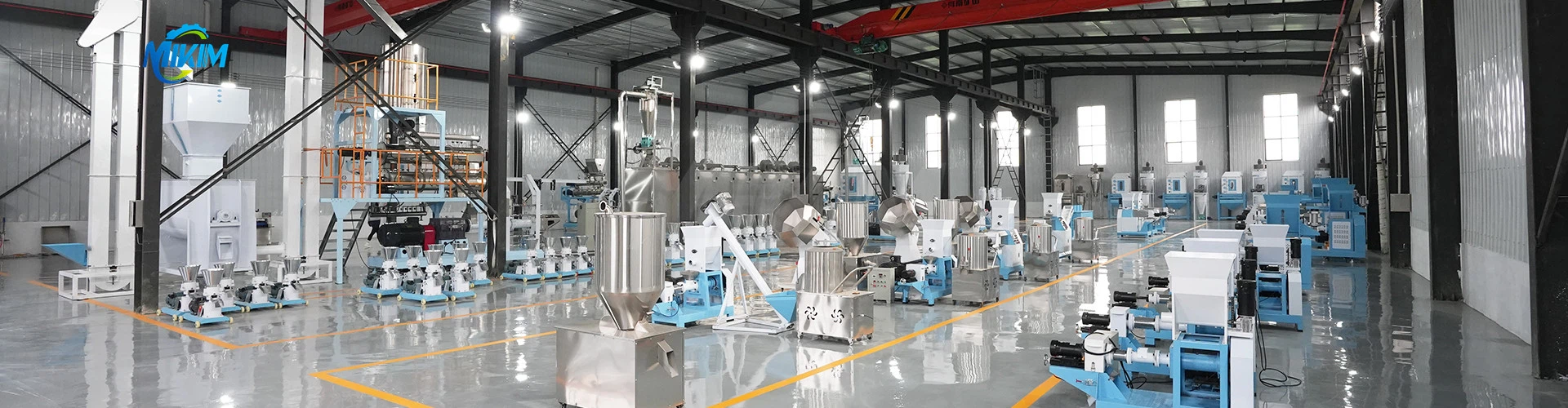
Introduction to the internal structure and principle of pellet mill
(I) Product structure: The pellet machine consists of machine base, big reducer box, bearing room, feeding cover, discharging part, motor, pressure roller assembly, mold and so on.
(ii) Working principle: the pellet machine runs in direct connection with the motor. The motor is connected to the reducer shaft through a toothed coupling. after 90 degree commutation, the horizontal motor drives the vertical casting hollow transfer spindle, and the spindle drives the pressure roller to crush the inner surface of the mold to complete the pressing process. During operation, the biomass straw raw material falls vertically from the inlet, and through the rotation of the pressure roller, the material is continuously and uniformly distributed on the surface of the inner cavity of the mold (the vertical surface of the contact between the pressure roller and the mold). Under the rolling of the pressure roller, the powdery material passes through the holes of the mold (holes evenly distributed on the inner surface of the mold). During this process, the material is subjected to high pressure and high temperature, resulting in physical changes or appropriate chemical changes (depending on the material), which induces the powdered material to form complete and extended cylindrical solids, and then the pellets are cut off by the cutter and discharged through the discharge outlet, thus completing the pellet pressing process.
Pellet mill has many advantages in producing pellet fuel:
1. Clean and environmentally friendly: Biomass pellet fuel is a natural biomass pellet fuel.
2. Space-saving: As the biomass fuel is compressed at high temperature, it greatly saves storage space and is easy to transport.
3. Burning 1 ton of biomass pellet fuel produces heat equivalent to 0.8 tons of coal.
4. Raw materials are: various. Biomass raw materials are inexhaustible.
