
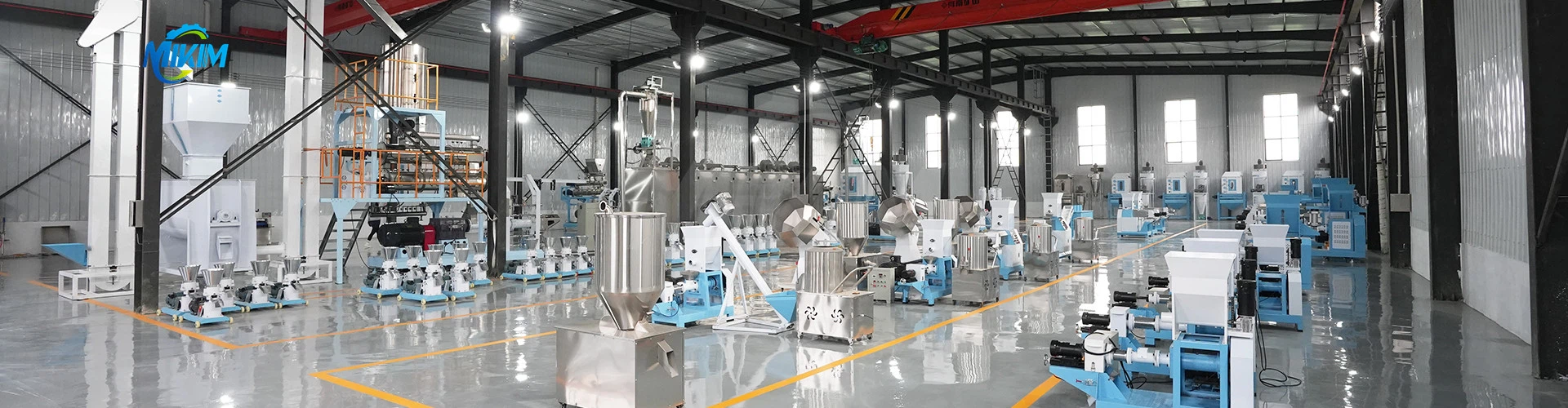
Traditional aquaculture methods have problems such as low efficiency, large waste of resources, and serious environmental pollution, which can no longer meet the development needs of modern aquaculture. For this reason, complete sets of aquatic feed equipment came into being, with its efficient performance, scientific formula and perfect service, to help the aquaculture industry achieve a significant improvement in benefits.
First of all, complete sets of aquatic feed equipment can significantly improve the efficiency of feed production. Traditional feed production methods often require a lot of manual operation, which not only consumes a lot of time and manpower, but also has low production efficiency. The complete set of aquatic feed equipment realizes fully automated operation from raw material input to finished product output through automated production processes, greatly reducing the time and workload of manual operation and improving production efficiency.

| Model | 40 | 60 | 70 | 80 |
| Power | 5.5KW | 15KW | 18.5KW | 22KW |
| Yield | 120-150 | 180-220 | 240-300 | 400-500 |
| Weight | 350KG | 450KG | 500KG | 580KG |
| Size(mm) | 1500*1100*1100 | 1600*1300*1250 | 1600*1300*1250 | 1800*1400*1350 |
Secondly, the scientific formula of complete sets of aquatic feed equipment can also help improve breeding benefits. Through in-depth research on the nutritional needs of aquatic organisms such as different fish and shrimps, aquatic feed complete sets of equipment can ensure that aquatic organisms obtain sufficient nutrition according to scientific and reasonable feed formulas, thereby improving their growth rate and breeding results.
Furthermore, the perfect service of aquatic feed complete sets of equipment is also an important means to improve breeding benefits. In addition to providing efficient feed production and scientific formulas, some advanced aquatic feed complete sets of equipment also provide one-stop services such as breeding guidance and disease prevention and control, helping farmers solve many problems that may be encountered in the breeding process, and further improving breeding benefits.