
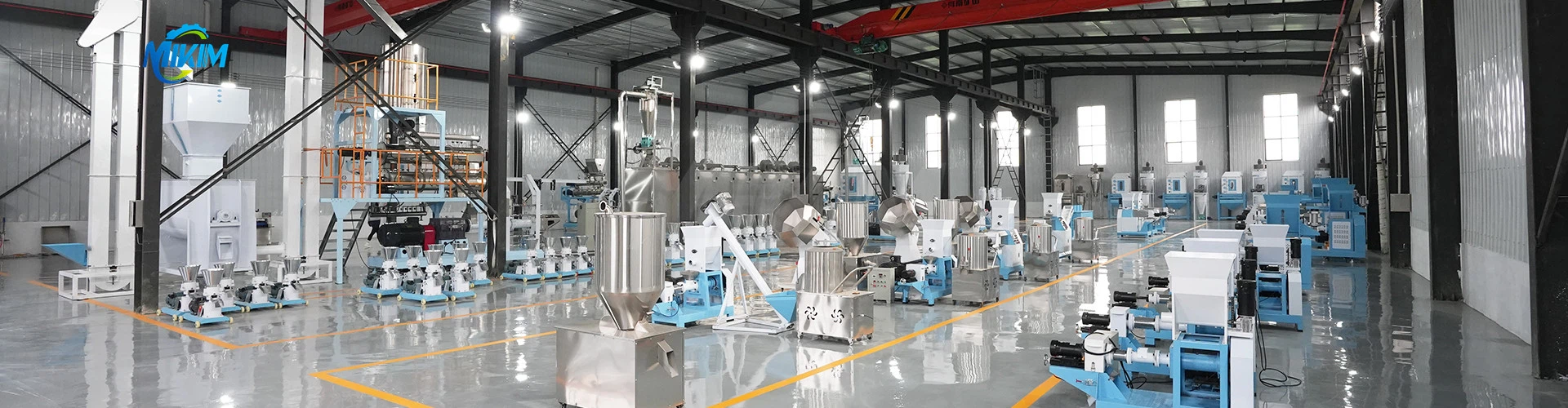
When configuring the feed extrusion production line, equipment purchase accounts for 60% of the total investment, installation and commissioning accounts for 15%, and 10%-15% is reserved for the reserve of wearing parts (such as rollers and molds).
When configuring the feed extrusion production line, equipment purchase accounts for 60% of the total investment, installation and commissioning accounts for 15%, and 10%-15% is reserved for the reserve of vulnerable parts (such as rollers and molds).
Manufacturers are required to provide equipment test runs to verify indicators such as crushing fineness and mixing uniformity, and suppliers who promise to repair and provide maintenance within 24 hours are preferred.
Environmental compliance: The equipment needs to integrate a pulse dust removal system and noise reduction design.

| Model | Power | Feeder | Cutter | Capacity | Dimension | Weight |
| DGP40 | 4KW | 0.4KW | 0.4KW | 0.04-0.05T/H | 1400*1030*1200MM | 240KG |
| DGP50 | 11KW | 0.4KW | 0.4KW | 0.06-0.08T/H | 1400*1030*1200MM | 320KG |
| DGP60 | 15KW | 0.4KW | 0.4KW | 0.12-0.15T/H | 1450*950*1430MM | 480KG |
| DGP70 | 18.5KW | 0.4KW | 0.4KW | 0.18-0.25T/H | 1600*1400*1450MM | 600KG |
| DGP80 | 22KW | 0.4KW | 0.75KW | 0.3-0.35T/H | 1850*1470*1500MM | 800KG |
| DGP90 | 30KW | 1.1KW | 1.5KW | 0.4-0.45T/H | 1900*1500*1600MM | 1200KG |
| DGP100 | 37KW | 1.1KW | 1.5KW | 0.45-0.5T/H | 2000*1600*1600MM | 1500KG |
Modular design supports the subsequent addition of functional units such as ultra-fine crushing and extrusion to meet the needs of subdivided categories such as shrimp seed feed.
Small farms (daily output <1 ton): Semi-automatic or modular equipment is preferred, such as a crushing-mixing granulation machine, to reduce initial investment costs.
Medium-sized breeding enterprises (daily output 1-5 tons): Automated batching systems and independent cooling and packaging units are required to improve standardized production capacity.
Large feed mills (daily output >5 tons): Select fully automatic production lines, including intelligent control systems, extrusion/spraying expansion modules, to meet the needs of large-scale production.
Extrusion may reduce the nutritional value of fat, and its mechanisms include oxidation, hydrogenation, and cis-trans isomerization. After extrusion, the fat content will decrease with the formation of amylose-lipid complexes; the ratio between unsaturated fatty acids and saturated fatty acids will decrease, and trans fatty acids will increase. However, this change is too small to have a significant impact on the nutritional value.