
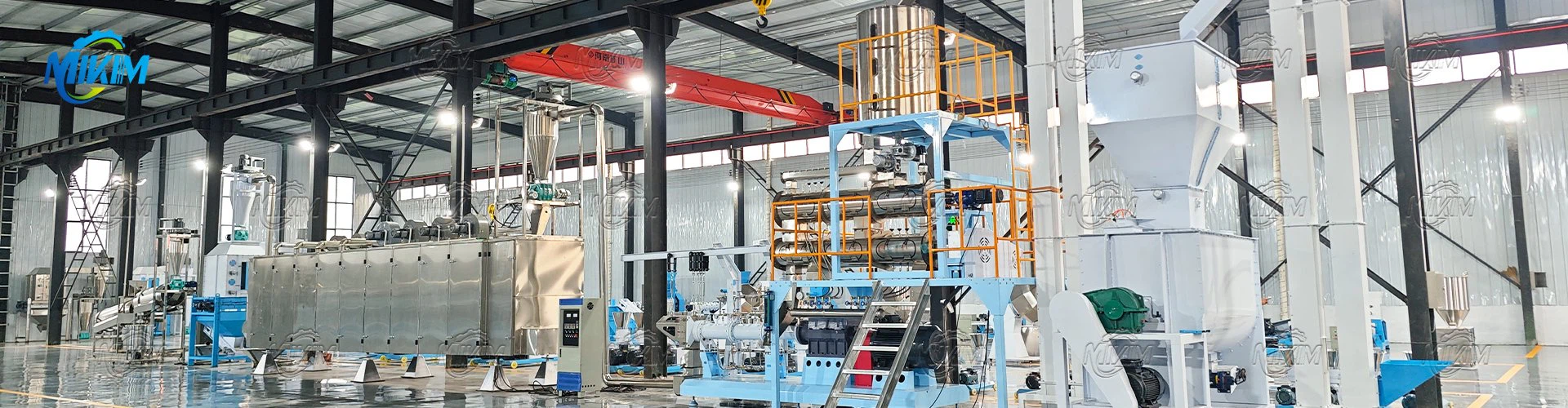
The feed pellet production line is very suitable for users such as aquaculture farms. As we all know, the cost of feeding animals and aquatic products is relatively high. Therefore, the feed pellet production line has become your best choice. Feed pellet production line When using it, it is important to maintain uniform feeding of raw materials during the material transportation stage. If it is too fast, it will easily cause the pellet machine to become stuffy; if it is too slow, it will not be conducive to molding, so it is important to maintain a uniform feeding speed. During the material conveying stage, many friends use manual loading, but the disadvantage is that it increases labor, and this may seem simple, but it is not a simple job. The most important thing is that if you slack off a little, loading may occur. The problem of fast and slow feeding.

| Model | 65 | 70 | 85 | 95 |
| Installed capacity | 76kw | 95kw | 178kw | 256kw |
| Power | 54kw | 66kw | 125kw | 195kw |
| Output | 140-160kg/h | 240-260kg/h | 500kg/h | 1000-1200kg/h |
| Dimension | 17*2*2.5m | 22*2*2.5m | 26*2*3.5m | 42*2.8*4m |
So if you don't want to have trouble, you can choose to use a screw feeder at this stage of material transportation. Easy to move, simple loading, convenient operation, and power saving are its main features. Granulation molding is the core. The most indispensable part of a complete granulation process is the granulation process. Granulation is actually a fully automatic operation. Particles of uniform size and smooth surface can be seen at the discharge port. The last step in the production line is bag sealing and packaging. It can be seen that choosing a complete set of pellet production lines can solve your worries and effectively reduce your costs.