
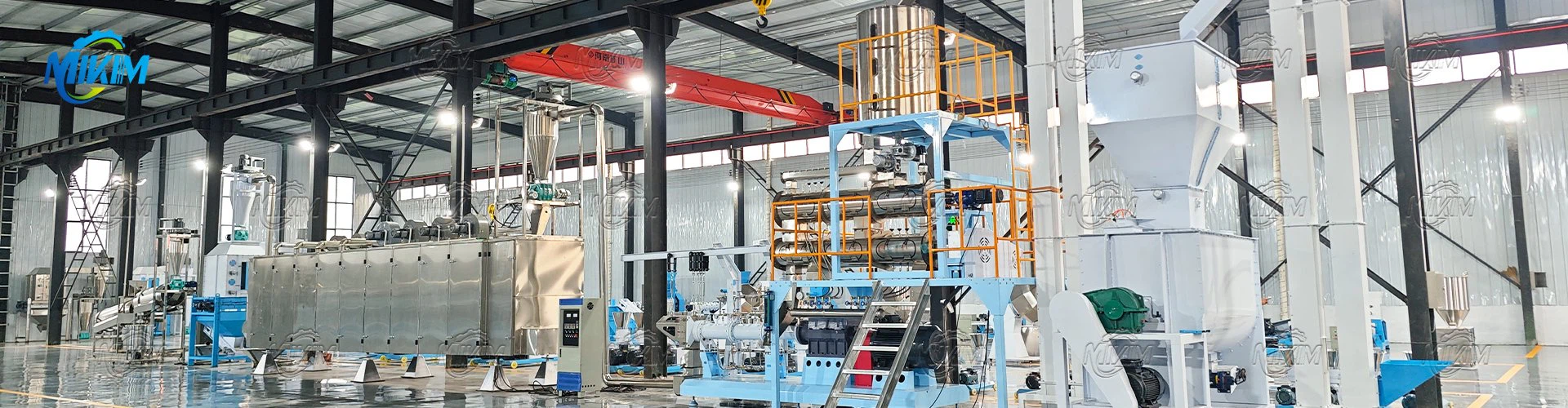
What a Small Line Can Produce
A small feed pellet production line can make all kinds of animal feed pellets. It combines a small pellet machine, a small crusher and a small mixer, and small refers to the output, not the function: the crushing, mixing and pelletizing functions are the same as on a large line, just at a smaller scale. The line produces feed for poultry, pigs, cattle, sheep, rabbits and fish, and can be adapted to specialty products such as organic fertilizer granules.
The Workflow of a Small Line
The workflow follows the same logic as a large line, scaled down. First, fibrous raw materials such as straw and grass are crushed, using a guillotine crusher or guillotine kneading machine that cuts the fiber to length. Second, grain materials such as corn and wheat bran are crushed with a hammer mill to the required particle size. Third, the crushed materials are mixed in a feed blender, combining the fiber and the grain into a homogeneous formula. Finally, the mixed material is fed to the pellet machine, which forms the pellets, and the finished feed is cooled and bagged.
Who Benefits from a Small Line
The line serves the farm that wants to control its feed: family farms that keep poultry and livestock, small feed workshops that serve neighboring farms, and specialty producers who need consistent quality at moderate volume. On-farm production cuts the margin paid to commercial feed suppliers, uses local raw materials including crop residues, and gives the farmer full control over the formula. For farms with mixed livestock, the line's flexibility is the key advantage: different formulas and pellet sizes are produced by changing the settings and dies.
Advantages at Small Scale
The small line has the same benefits as large lines: uniform pellets prevent ingredient segregation, the pelleting process improves digestibility, and the dense, dry pellets store well. The compact layout fits into a normal farm building, the power requirement is compatible with farm supplies, and the investment is proportionally lower. Because the components are simple, the line can be operated and maintained by the farm family without specialized staff.
Choosing the Right Small Line
Match the line to the farm's daily consumption and the target animals. Confirm that the crusher can handle the fibrous materials available, that the mixer capacity matches the pellet machine output, and that the pellet machine can produce the required pellet diameters. Plan the layout with a logical flow from crushing to bagging, and leave space for cleaning and maintenance.
Frequently Asked Questions
What feeds can a small line produce? Feed pellets for poultry, pigs, cattle, sheep, rabbits and fish, plus specialty granules such as organic fertilizer.
What machines make up a small line? small crusher, a small mixer and a small pellet machine, with the same functions as large equipment at lower output.
How are fibrous materials handled? Straw and grass are first cut with a guillotine crusher or kneading machine, then mixed with crushed grain.
Who should buy a small feed line? Family farms, small feed workshops and specialty producers who need controlled, consistent feed at moderate volume.
What are the benefits of on-farm feed production? Lower feed cost, use of local raw materials, full formula control and better storage stability of pellet feed.