
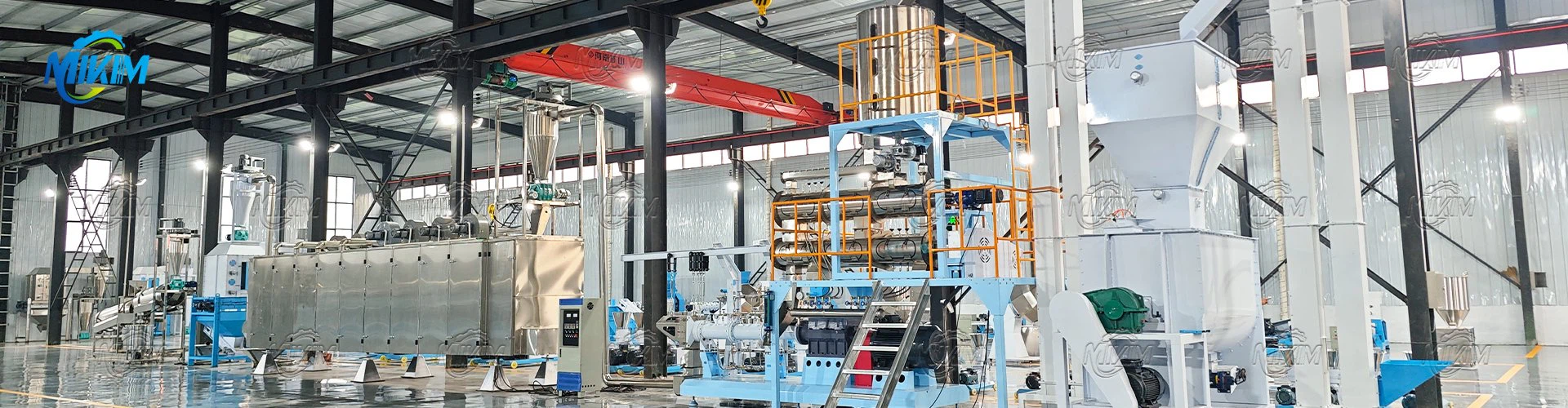

Large-Scale Automatic Pellet Feed Production Process
Published by the Mikim technical team.
Large-scale Chicken feed production lines turn raw ingredients into finished pellet feed in one continuous flow. This article explains the production process step by step - from crushing to packaging - and the two pelletizing technologies used in feed processing.

1. Crushing
First, the raw materials undergo a crushing process to form fine particles for subsequent processing. A hammer mill grinds corn, soybean meal, wheat bran and other ingredients to the fineness required for good mixing and pellet quality.
2. Batching and Mixing
Next, the raw materials enter the batching and blending stage. In a large Agricultural Poultry Feed Production Line, a computer dosing system weighs each ingredient precisely, and the materials are thoroughly mixed in a blender to ensure uniform distribution of nutrients. The mixed powdered feed is then conveyed to the pelletizer.
3. Pelletizing
Pellet feed is produced by two main technologies:
-
Hard Pellet (Ring-Die) Feed Machine
The material first enters the conditioner and is mixed with steam, forming a water film on the surface and softening it. Then a roller presses the material into the die holes, where it is extruded through the outer wall and cut into pellets by a cutter. Conditioning temperature and steam addition are controlled to gelatinize the starch and improve pellet durability.
-
Extruder (Expanded Pellet) Feed Machine
In the extruder, the material is subjected to high pressure and high temperature in the expansion chamber under the extrusion of the screw, forming a viscous flow. Upon exiting the die holes, the pressure drops suddenly, vaporizing the water and causing the pellets to expand. The cutter then cuts them into segments. This technology is used to produce floating fish feed and expanded pet food.
4. Drying and Cooling
The hot pellets are air-dried in an exhaust cooling device that removes surface moisture and heat, stabilizing the pellets so they can be handled, stored and packaged without breakage.
5. Screening and Packaging
After cooling, the pellets pass through a screener that removes fines and broken pellets, and the finished product is weighed and packed automatically. Pellet size can be selected from about 1 to 12 mm, depending on the target animal.
Example of an Automatic Animal Feed Production Line
A complete feed production system can integrate crushing, mixing, pelletizing, cooling, screening, conveying, and automatic packaging. For a practical 1–2 TPH configuration, see our 1–2 TPH Animal Feed Pellet Production Line.
Advantages of Large Poultry feed pellet production lines
- High adaptability: the line can process a wide range of raw materials, from common corn and soybean meal to straw and grass meal, into high-quality pellet feed.
- High automation: computer control of ingredients, pelletizing, temperature control and conveying reduces manual intervention, improves production efficiency and ensures stable product quality.
- Economy of scale: a large line (for example 15–20 t/h) needs only 4–5 operators and can produce chicken, sheep, cow and shrimp feed with one continuous system.
FAQ
What Is the Difference Between Hard Pellets and Extruded Pellets in an Animal Feed Pellet Production Line?
Hard pellets are typically produced by steam conditioning and mechanical compression through a ring die pellet mill. They are dense and commonly used for livestock and poultry feed. Extruded pellets are produced under controlled temperature, pressure, and moisture conditions. When the material exits the extruder die, the sudden pressure drop causes expansion, creating a lower-density structure that can produce floating or slow-sinking pellets for aquaculture feed.
Why Is Steam Conditioning Important in a Livestock and poultry feed production line?
Steam conditioning adds controlled heat and moisture to feed materials before pelletizing. It softens the raw materials, promotes starch gelatinization, improves binding, and can increase pellet durability while reducing the energy required for compression. The appropriate steam temperature, moisture level, and conditioning time depend on the feed formulation and production requirements.
How Long Do Animal Feed Pellets Need to Cool After Pelletizing?
Animal feed pellets generally need to be cooled until their temperature and moisture content reach levels suitable for storage and packaging. Cooling time depends on pellet diameter, moisture content, pellet temperature, airflow, and cooler capacity. A counterflow or similar pellet cooling system removes heat and excess moisture, helping prevent condensation, mold growth, and pellet quality problems during storage.
What Is the Recommended Animal Feed Pellet Size for Different Animals?
The recommended animal feed pellet size depends on the animal species, age, growth stage, and feeding method. Typical pellet diameters range from about 1–12 mm. Smaller pellets around 1–3 mm are commonly used for young poultry, fish fry, and small aquatic animals; 3–6 mm pellets are often used for poultry, pigs, and growing fish; larger pellets around 6–12 mm may be suitable for cattle, sheep, and other larger animals. The final pellet size should be selected according to the target species and feed formulation.
What Are the Main Processes in a Fully Automatic Chicken Feed Production Line?
A fully automatic Poultry feed pellet production line typically includes raw material receiving, cleaning, crushing, batching, mixing, pelletizing, cooling, screening, conveying, and packaging. Depending on the feed type and production capacity, the line may also include steam conditioning, crumbler, liquid spraying, or other auxiliary equipment. Automated control systems coordinate material feeding, processing parameters, and equipment operation to improve production consistency and reduce manual intervention.
Need a Customized Animal Feed Production Line?
Tell us your target capacity, feed type, raw materials, and pellet size. Our engineers can recommend a suitable production process, equipment configuration, and production line layout for your project.
Contact MIKIM today for a customized animal feed production line solution and equipment quotation.
Our Factory


Packaging and Shipping

Certificate of Quality Compliance
