
content
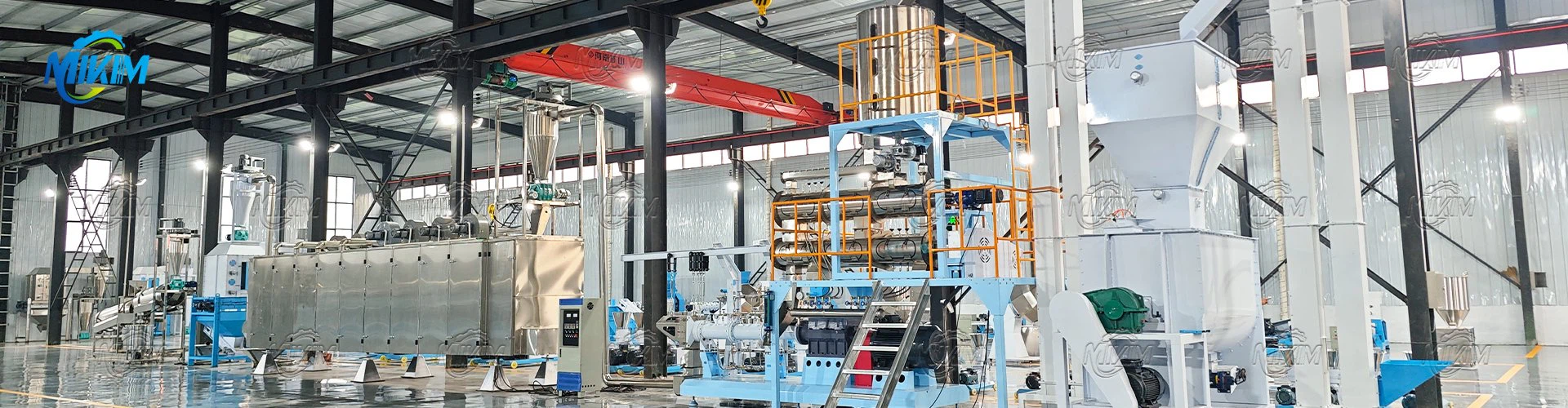
The core definition of a single-screw floating fish feed machine: a feed extrusion device driven by a single screw. It's an integrated processing device that uses a single screw as the core transmission component, leveraging the thrust and frictional heat generated by the screw's rotation to melt, extrude, and shape feed ingredients. Compared to twin-screw extruders, its core feature is its simplified "single screw + extrusion chamber" structure, eliminating the need for complex meshing transmission systems. It's widely used in small to medium-sized production scenarios such as fish feed, poultry and livestock feed, and pet food. As an important sub-type of extruder, the core function of a single-screw extruder is to change the characteristics of raw materials through extrusion and extrusion, improving feed digestibility, water resistance, and palatability, while simultaneously killing harmful microorganisms in the raw materials to ensure feed safety.
Core working principle: Four-stage progressive extrusion and extrusion logic. The working principle of the single-screw floating fish feed extruder is consistent with that of a general extruder, following a four-stage core process of "raw material conveying - compression melting - extrusion extrusion - shaping and discharge." Its uniqueness lies in the power transmission and material handling method driven by a single screw. The first stage is raw material conveying: Fishmeal, soybean meal, corn flour, and other mixed raw materials enter the extrusion chamber through the feed hopper. The axial thrust generated by the high-speed rotation of the single-screw fish feed processing machine (200-400 r/min) smoothly conveys the raw materials forward along the screw groove. The screw groove depth design ensures a balance between raw material capacity and conveying efficiency. The second stage is compression and melting: As the screw groove depth gradually decreases, the raw material is continuously compressed. Simultaneously, friction between the raw material and the screw, the inner wall of the extrusion chamber, and the mutual friction between the internal particles generate a large amount of frictional heat, causing the raw material temperature to rapidly rise to 120-160℃, achieving the transformation from a solid to a molten state. The third stage is extrusion and expansion: The molten raw material is pushed to the die head area. Due to the throttling effect of the die head aperture, a high-pressure environment of 3-6 MPa is created. When the raw material is extruded from the die head, the pressure is released rapidly, the internal moisture instantly vaporizes, and the volume expands rapidly, completing the expansion and modification. The fourth stage is forming and discharging: The expanded material is cut into particles of a preset length by the die head cutting device and discharged directly or cooled to become finished feed.
Key Features: Fundamental differences from the Twin-Screw fish feed extruder machine. The advantages of a single-screw extruder stem from its simplified structure; the equipment purchase cost is only 50%-70% of that of a twin-screw extruder with the same capacity. It also boasts a low operating threshold and convenient maintenance. However, limited by the single-screw drive, its adaptability to raw materials is weaker, making it more suitable for processing basic feed formulations with simple compositions and good flowability. For example, a single-screw extruder can meet the needs when producing ordinary corn-soybean meal fish feed; while the synergistic extrusion advantage of a twin-screw extruder is more pronounced when processing complex formulations with high fiber and high moisture content.
Related equipment


about Us
Customer visit

Certificate of Honor

FAQ
1. What is the price of the single screw floating fish extruder machine?
The price ranges from approximately $1,500-$55,000
2. Do you provide maintenance services for your customers?
Yes, we offer comprehensive after-sales maintenance services to our customers.
If you would like to learn more about MIKIM machinery, please contact us. We offer one-stop service and welcome your inquiries!!!