
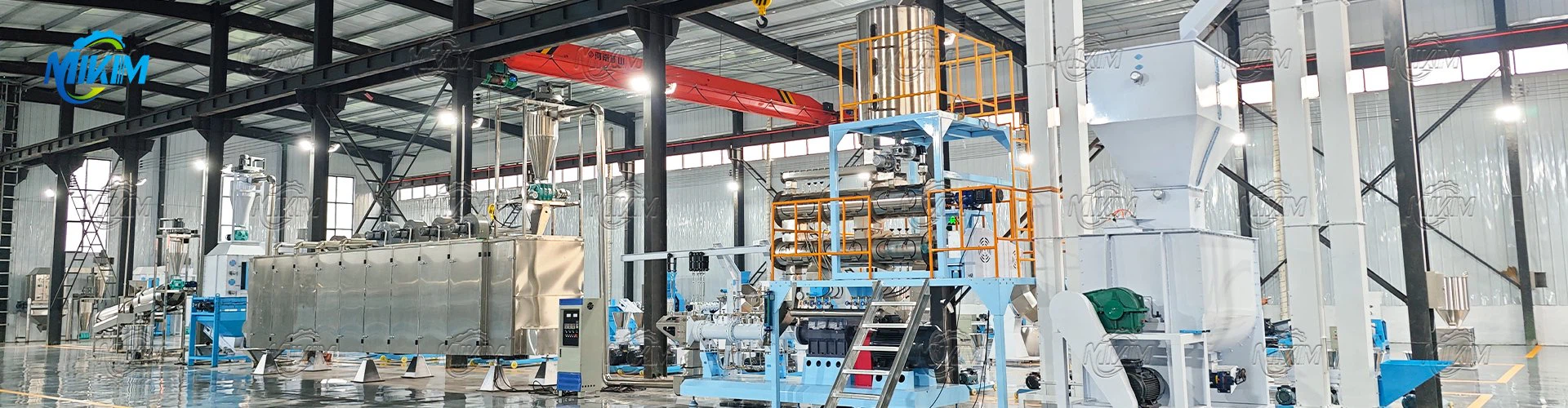
The Eight Systems in Brief
A fully automatic pellet feed production line generally has eight systems: feeding, crushing, batching, mixing, granulation, conveying, cooling and screening, and packaging. The feeding system uses self-suction pipes and soft augers to move material that needs crushing to the grinder, while material that mixes directly is loaded into the batching scale through another auger. The crushing system grinds the material, the batching scale weighs it, the mixer blends it, and the ring die pellet machine forms the pellets.
Transport After Granulation
Transportation is the system that ties the line together. After the feed is prepared, bucket elevators are generally used for vertical transport, because they lift material reliably and gently. For powder materials, screw conveyors are the standard choice, moving the material horizontally or at an angle within an enclosed trough, which prevents dust and spillage. The conveying design must match the material: pellets need gentle handling to avoid breakage, while powders need enclosed conveying to control dust.
Why Conveying Quality Matters
Every transfer in the line is a potential source of damage, dust and contamination. Pellets that fall too far or rub against sharp surfaces break into fines, which reduces the salable yield and creates dust. Powders that leak from open conveyors create a fire and health hazard and waste material. Good conveying design uses the right conveyor type, gentle transfer points, and enclosures where dust is a risk, protecting both the product and the working environment.
Matching the Components
Each system must be matched to the line's capacity and to the material properties. The batching scale accuracy, the mixer type and mixing time, and the pellet machine model are all selected together. If the feed contains many light components, a forced feeder is added before the die, and the conditioner is selected according to the required feed quality. The conveying system is then rated at or above the nominal line output, so no conveyor becomes a bottleneck.
Control and Automation
The batching of the fully automatic line can be viewed and operated through a computer or display, and the same control philosophy extends to the whole line: sensors monitor levels, speeds and motor loads, and the control system coordinates the sequence. Automation removes the manual weighing and transfer steps that are the main source of errors, and it keeps the line running consistently through the production day.
Frequently Asked Questions
What conveyors are used for pellets? Bucket elevators for vertical lifting and belt conveyors for horizontal movement, both designed to handle pellets gently.
What conveyor suits powder materials? Screw conveyors are standard for powders, moving material in an enclosed trough to control dust and spillage.
Why is conveying quality important? Poor transfers break pellets into fines and create dust, wasting product and creating hazards.
When is a forced feeder added to the pellet machine? When the feed contains many light components that would not enter the die reliably under gravity.
What does the control system do in an automatic line? It coordinates the sequence, monitors levels and loads, and removes the manual steps that cause errors.