
content
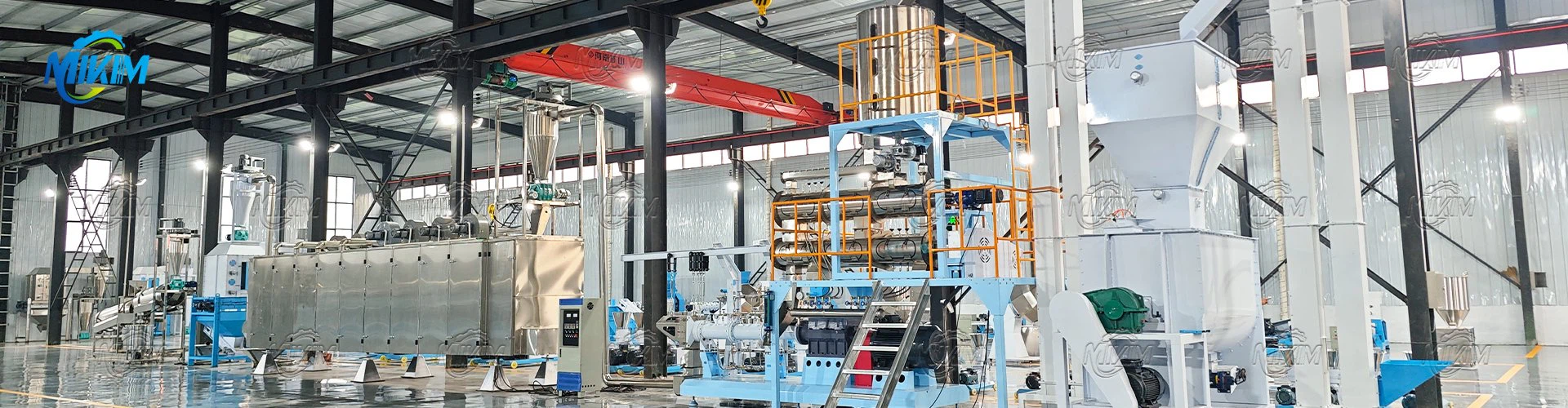
When purchasing fish feed, it's crucial to first identify your commonly used raw material formulas, and then specifically consider the equipment's (especially the extruder's) compatibility with these materials. Different raw materials vary significantly in moisture content, particle size, and fat content, thus requiring different extruders. For example, high-protein raw materials like fish meal and meat meal require higher cooking temperatures and pressures to ensure sufficient protein denaturation; while coarse-fiber raw materials like grass meal and straw meal require stronger extrusion shear forces to prevent particle breakage. A high-quality floating fish feed pellet making machine should have a wide range of adjustable parameters, allowing for flexible adjustments of temperature (120-160℃), pressure (3-8MPa), and speed (300-600r/min) to adapt to different raw material characteristics.
The extruder's structural design also affects raw material compatibility. Compared to single-screw extruders, twin-screw fish feed extruders offer greater adaptability to raw materials, especially suitable for processing high-moisture (15%-20%), high-fat (8%-12%), or multi-component complex formulas. The meshing rotation of twin-screw extruders generates stronger shearing force and mixing effect, ensuring thorough and uniform mixing of different raw materials and more complete maturation. Therefore, if you plan to use multiple raw materials or complex formulations to produce fish feed, it is recommended to prioritize purchasing equipment equipped with a twin-screw extruder. If the raw materials are mainly conventional grains and soybean meal, a single-screw extruder can meet the needs and is less expensive.
It is also necessary to consider the extruder's adaptability to raw material particle size and moisture content. The best pet food pellet machine should be able to handle raw material particle sizes between 60-120 mesh and moisture contents between 12%-18%, without the need for excessive grinding or strict moisture control, thus reducing raw material pretreatment costs. When purchasing, you can request the manufacturer to provide trial runs with different raw material formulations to test the equipment's maturation effect on commonly used raw materials: for example, test run with a high-fiber grass meal formulation to observe pellet formation and maturation degree; test run with a high-moisture fish meal formulation to check for problems such as clogging and poor pelleting.
Furthermore, if the plan is to produce specialty feeds (such as floating feeds, sinking feeds, and functional feeds), the compatibility of the floating fish extruder machine with these specialty products must be considered. Producing floating feed requires a machine with a stronger extrusion capacity, resulting in porous pellets with low density; producing sinking feed requires a reduced degree of extrusion to increase pellet density. During procurement, it is necessary to confirm whether the equipment supports producing different types of feed by adjusting extruder parameters (temperature, pressure, speed) to avoid being unable to meet diverse production needs later.
Related equipment


about Us
Customer visit

Certificate of Honor

FAQ
1. What is the price of the Single-Screw pet food extrusion machine?
The price ranges from approximately $1,500-$55,000
2. Do you provide maintenance services for your customers?
Yes, we offer comprehensive after-sales maintenance services to our customers.
If you would like to learn more about MIKIM machinery, please contact us. We offer one-stop service and welcome your inquiries!!!