
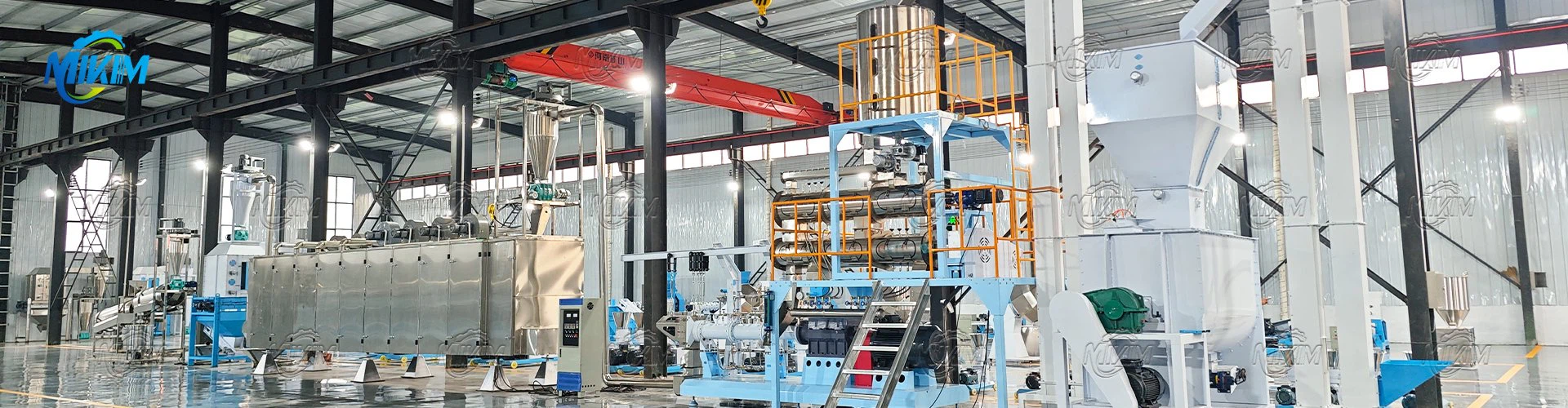
The amount of water in the raw materials and the temperature of the water used for conditioning are closely related to the quality of the puffed product, the processing stability and the pressure state in the puffing chamber. When the water content is low, the energy consumption is large and the output is also reduced, and vice versa. When the water content is similar, steam conditioning has a higher output and lower power consumption than cold water conditioning.

| Model | 100 | 120 | 135 | 160 |
| Power | 37KW | 55KW | 75KW | 90KW |
| Yield | 700-1000 | 1200-1500 | 1500-1800 | 2000-2400 |
| Weight | 750KG | 850KG | 950KG | 1200KG |
| Size(mm) | 1970*2900*1150 | 2200*2900*1200 | 2350*2900*1200 | 2350*2900*1400 |
If the raw material has a high oil content or too much oil is added during the extrusion process, it is easy to cause the wall sliding idling phenomenon, so that the extrusion force of the material does not meet the requirements and the material cannot be fully expanded. At this time, the amount of material added should be appropriately increased, the diameter of the pressure ring should be increased, or the diameter of the die hole should be reduced.
When the starch content in the raw material is high, the temperature adjustment and steam addition should be appropriate, otherwise it is easy to cause machine blocking, thereby affecting production efficiency. In particular, if too much material is added at the beginning, it is easy to cause machine blocking, thereby affecting the continuous production. After extruding the raw materials with higher viscosity, it is best to clean the puffing cavity with materials with higher fat content (such as soybean powder) to maintain its good working characteristics.