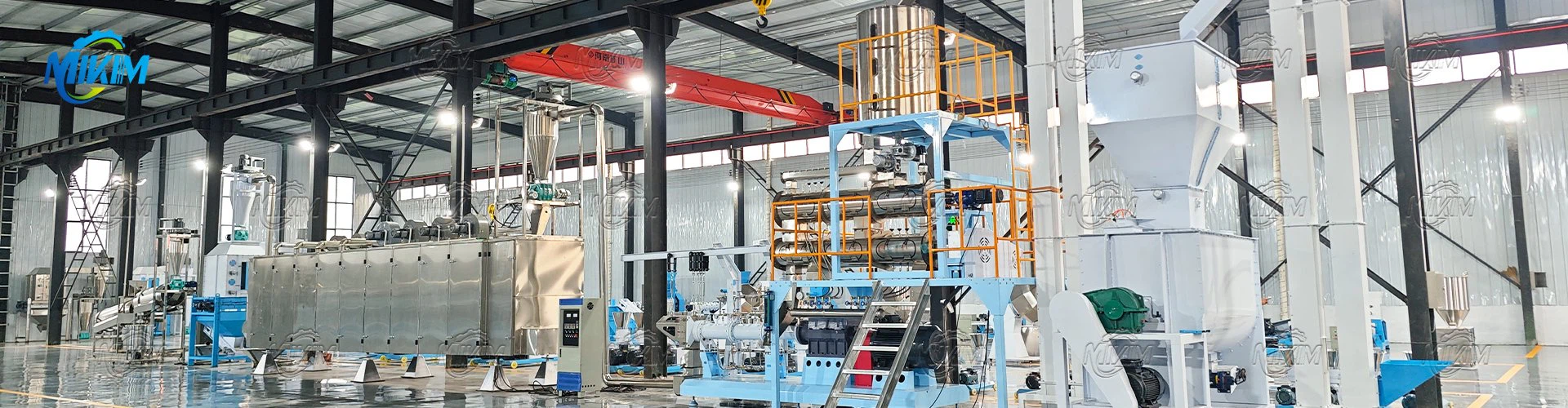
What Is small floating fish food pellet maker machine Testing?
Small fish food production machine for home use testing is the factory verification process where a compact fish feed machine is operated using real aquaculture feed formulas to evaluate extrusion stability, floating pellet quality, feeding consistency, and continuous production performance before shipment or commercial use.
Why Testing Is Important for small fish feed pellet maker machines
For small aquaculture businesses, machine testing is not just a technical procedure. It is a direct way to verify whether the equipment can produce stable floating fish feed under real working conditions.
Customers usually focus on:
- whether pellets can float consistently in water
- if the machine can run continuously without blockage
- whether the output capacity is stable
- if local raw materials can be processed smoothly
- whether the machine is suitable for small-scale fish farms
What Makes small floating fish feed pellet mills Different
Small floating fish feed processing machines are designed for:
small fish farms
startup aquaculture businesses
rural feed production
low-investment feed manufacturing
Unlike large industrial systems, compact machines require:
stable feeding control
efficient extrusion in limited space
easy operation and maintenance
Raw Materials Used During Testing
Real feed ingredients are used during testing to simulate actual production conditions.
Typical materials include:
- corn flour
- soybean meal
- fish meal
- wheat bran
- vitamin premix
Technicians evaluate:
- raw material flow behavior
- moisture consistency
- extrusion adaptability
Step-by-Step Testing Process
Step 1: Machine Start-Up Inspection
Before production begins, technicians check:
motor operation stability
screw rotation direction
electrical system response
Step 2: Feeding System Testing
Raw materials are added gradually.
Observed during testing:
feeding smoothness
hopper flow consistency
absence of material blockage
Step 3: Extrusion Stability Testing
Inside the extrusion chamber:
pressure builds gradually
raw materials are cooked and compressed
pellets begin expanding
Technicians monitor:
extrusion pressure stability
discharge continuity
material flow consistency
Step 4: Floating Pellet Formation Test
This is the most critical testing stage.
Engineers inspect:
pellet size consistency
pellet surface smoothness
expansion quality
structural integrity
Step 5: Floating Performance Water Test
Fresh pellets are placed in water tanks.
Observed results:
floating duration
resistance to fast sinking
pellet stability in water
Step 6: Continuous Running Test
The machine operates continuously under load.
Technicians evaluate:
motor temperature stability
vibration level
production continuity
output consistency over time
Key Performance Factors Verified During Testing
Stable Floating Pellet Production
Ensures pellets remain afloat for effective feeding observation.
Compact but Continuous Processing Ability
Suitable for small farms requiring stable daily feed production.
Adaptability to Local Raw Materials
Supports common agricultural ingredients used in aquaculture feed formulas.
Easy Operational Control
Important for beginner-level operators and rural production environments.
Real Factory Testing Data
| Item | Result |
|---|---|
| Machine Type | small floating fish feed pellet maker machine |
| Capacity | 50–300kg/h |
| Pellet Size | 1–6mm adjustable |
| Floating Rate | ≥90% |
| Formula Type | Floating fish feed |
| Operation Mode | Continuous small-scale production |
| Application | Tilapia & freshwater fish farming |
Common Problems Checked During Testing
Problem: pellets sink too quickly
Possible cause:
insufficient extrusion pressure
incorrect formula moisture ratio
Problem: uneven pellet size
Possible cause:
unstable feeding speed
inconsistent cutting operation
Problem: extrusion blockage
Possible cause:
oversized raw material particles
improper moisture balance
Suitable Applications
This machine is suitable for:
- small fish farms
- startup aquaculture businesses
- floating fish feed pilot production
- rural aquaculture projects
- small commercial feed workshops
FAQ
Why is testing important for floating fish feed machines?
Testing verifies floating performance, extrusion stability, and production reliability.
Does testing use real feed ingredients?
Yes. Real aquaculture feed formulas are used during factory testing.
Can small machines produce stable floating pellets?
Yes, testing confirms floating pellet performance under working conditions.
Is the machine suitable for beginner fish farmers?
Yes. Small floating fish feed machines are designed for easy operation.
Company Profile