
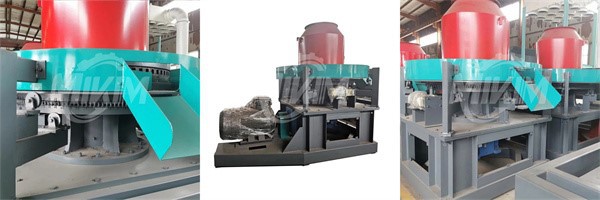
The biomass briquetting machine adopts the principle of interaction between the straw block and the pressing wheel and the extrusion force and die hole friction to shape the material. There is no need to add any additives or binders to the material during processing. Materials such as straw contain cellulose and lignin. Lignin is the structural monomer in the material and is a phenylpropanoid-type polymer compound. Biomass briquetting machine has the function of strengthening cell walls and binding cellulose. Lignin is amorphous, and its main part is insoluble in any solvent at room temperature. It has no melting point, but has a softening point.
|
Model |
Power |
Capacity |
Briquette size |
Hole quantity |
|
MK-550 |
55kw |
1t/h-1.5t/h |
32*32mm |
36pcs |
|
MK-750 |
75kw |
1.5t/h-2t/h |
32*32mm |
54pcs |
|
MK-900 |
90kw |
2t/h-2.5t/h |
32*32mm |
72pcs |
|
MK-1600 |
160kw |
2.5t/h-3t/h |
32*32mm |
120pcs |
When the temperature reaches a specific value, the lignin softens and the bonding force increases, and under the action of a specific pressure, its cellulose molecular groups are dislocated, deformed, and extended. The adjacent biomass particles inside are meshed with each other, recombined, and suppressed. forming. The biomass briquetting machine has a wide processing range, including various agricultural and forestry biomass wastes; some industrial product initial processing wastes. Such as: corn stalks, wheat straw, cotton stalks, sunflower stalks, soybean stalks, corn cobs, grass, sawdust, wood powder, branches, leaves, bark, firewood, rice husks, straw, peanut shells, palm silk, mushroom sticks, furfural residue Xylitol residue, medicine residue, animal feces, domestic garbage, cloth velvet strips, etc.