
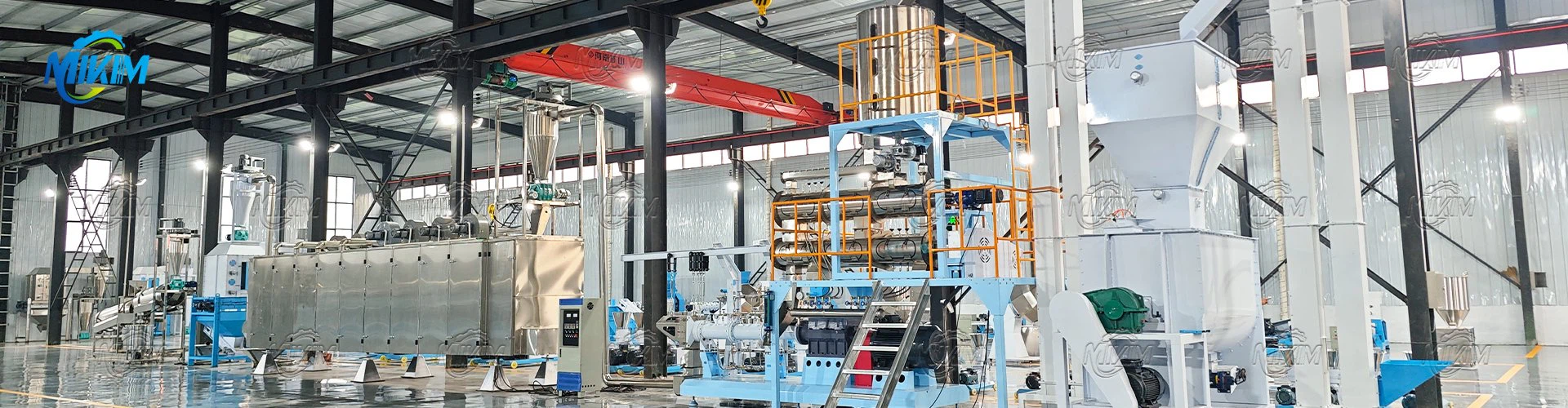
Pneumatic Conveying: Moving Material Without Damage
Conveying is where fragile feed pellets are most often damaged. Small production lines use a positive-pressure air feeder as the conveying force, while large fish feed lines use a high-power negative-pressure air feeder. In both cases, stainless steel pipes carry the material, which effectively prevents the feed pellets from generating crushed residual product during conveying. The choice between positive and negative pressure depends on the line's scale and layout: negative-pressure systems keep the product cleaner and are preferred for large lines, while positive-pressure systems are simpler and suit smaller installations.
The Elevator: Lifting Pellets Into the Next Stage
After drying, the baked fish feed pellets must be lifted into the seasoning line. The elevator performs this job, using an edge-type structure that prevents the pellets from falling back during lifting. The elevator must be sized to the line's throughput and gentle enough not to damage the pellets, because every crushed pellet at this stage is lost product. Bucket elevators are the standard choice, and their buckets and belts should be inspected regularly for wear.
The Seasoning Line: Adding Flavor and Nutrition
The seasoning line applies oil and nutritional additives to the dried pellets. Two equipment families are available: fully automatic single or double drum seasoning lines, which coat pellets evenly at high throughput, and semi-automatic octagonal seasoning lines, which suit smaller batches and more varied products. The choice depends on the production volume and the products: automatic drum lines are standard in large plants, while octagonal lines give flexibility for specialty runs.
Why Seasoning Matters
Seasoning does more than add flavor. Oil application increases the energy density of the feed and improves its palatability, while nutritional additives such as vitamins and attractants are applied at this stage because they would be damaged by the heat of drying. Uniform coating is essential: if the oil or additive is not distributed evenly, some pellets carry too much and others too little, and feed quality becomes inconsistent. The drum design, rotation speed and spray system determine the coating uniformity.
Integrating the Components
The conveying, elevating and seasoning stages must be matched to the capacity of the dryer and pellet mill. A line is only as fast as its slowest component, so each stage should be rated at or above the nominal line output. The layout should also minimize the number of transfer points, since each transfer is a source of pellet damage and dust. A well-integrated line moves the product gently, quickly and continuously from the pellet mill to the packaging station.
Frequently Asked Questions
Why are stainless steel pipes used for conveying feed pellets? Stainless steel avoids contamination and reduces friction damage, preventing crushed residual product during conveying.
What is the difference between positive and negative pressure feeders? Small lines use positive pressure; large fish feed lines use high-power negative pressure for cleaner, more careful conveying.
What does the seasoning line do? It applies oil and nutritional additives to dried pellets, increasing energy density, palatability and nutrient content.
Which seasoning line should I choose? automatic single or double drum lines suit high volume; semi-automatic octagonal lines suit smaller batches and varied products.
Why is the elevator designed to prevent pellets falling back? The edge-type structure keeps pellets moving upward reliably, avoiding damage and spillage during lifting.