
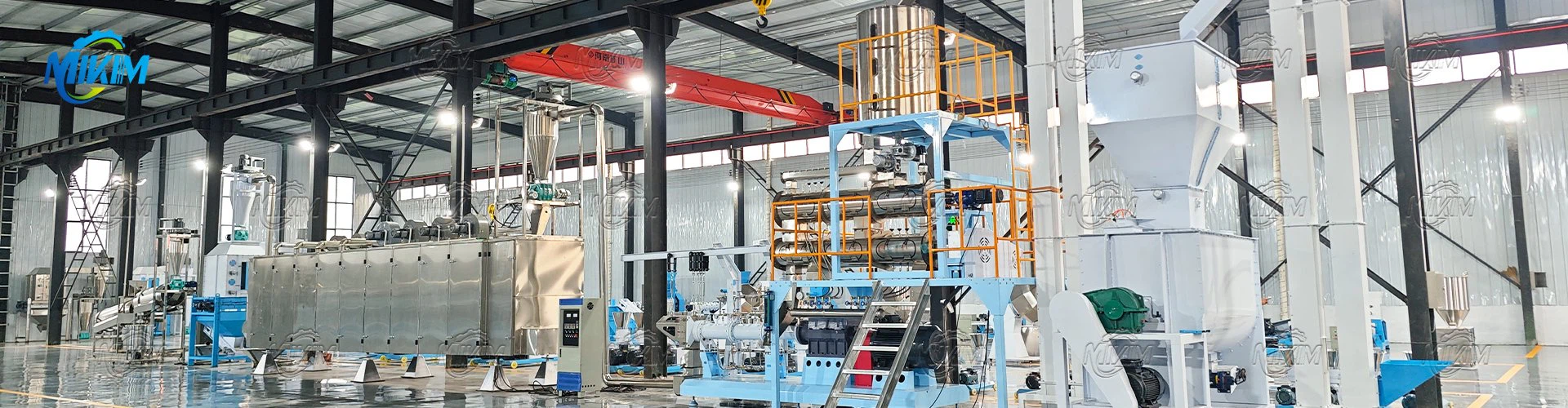
What a Production Line Delivers
A complete production line covers the steps that define pellet feed: crushing, sieving, drying, pelletizing, cooling and packaging. The value of the line is not in any single machine but in the integration: material moves automatically from one stage to the next, parameters are controlled consistently, and the output is uniform. Modern machines are increasingly automated, which is precisely why many producers choose a line over separate machines.
The Problem with Manual Mixing
Manual mixing illustrates the core problem the line solves. Hand mixing is labor-intensive, and more importantly it cannot stir uniformly, so the feed has an unbalanced distribution of nutrients: one animal gets more premix, the next gets less. The same logic applies to manual feeding of the pellet mill. A small machine can be fed by hand, but for medium and large machines manual feeding is troublesome and inconsistent: feed too much and the machine jams, feed too little and the pellets do not form properly. The feeder solves this by delivering material at a controlled, uniform rate.
Consistency Is the Real Product
The most valuable output of a production line is consistency. Every batch has the same particle size, the same moisture, the same nutrient distribution and the same pellet quality. Consistency matters economically because it converts a fixed formula into predictable animal performance: the farmer knows exactly what each kilogram of feed delivers. It also simplifies quality control, because the process, not the operator, determines the result.
Labor and Throughput
Automation changes the labor structure of feed making. The line's conveyors, feeders and control systems replace the workers who would otherwise carry material, weigh ingredients and watch the machine. One or two operators can supervise a line that would require several people working manually, and the line can run longer hours without the fatigue-related errors of manual processing. Throughput rises because the process never waits for a person.
Is It Right for Every Farm?
A production line is justified when the farm's scale makes consistency and labor savings economically meaningful. Small farms with low consumption may be better served by a single pellet mill with manual feeding. The decision should be based on daily consumption, the cost of labor, and the value of consistent feed quality to the operation. As the herd grows, the line becomes the logical next step.
Frequently Asked Questions
What is the biggest advantage of a feed production line? Consistency: automatic control of feeding, mixing and processing produces uniform feed batch after batch.
Why is manual mixing a problem in feed making? Hand mixing cannot stir uniformly, so nutrients are unevenly distributed and animal performance becomes unpredictable.
What does the feeder do in a pellet line? It delivers raw material to the pellet mill at a controlled, uniform rate, preventing jams and incomplete pellet formation.
How much labor does a line save? line typically reduces the workforce from several workers to one or two supervisors, depending on the automation level.
When is a production line not justified? For very small farms with low daily consumption, a single pellet mill with manual feeding may be more economical.