
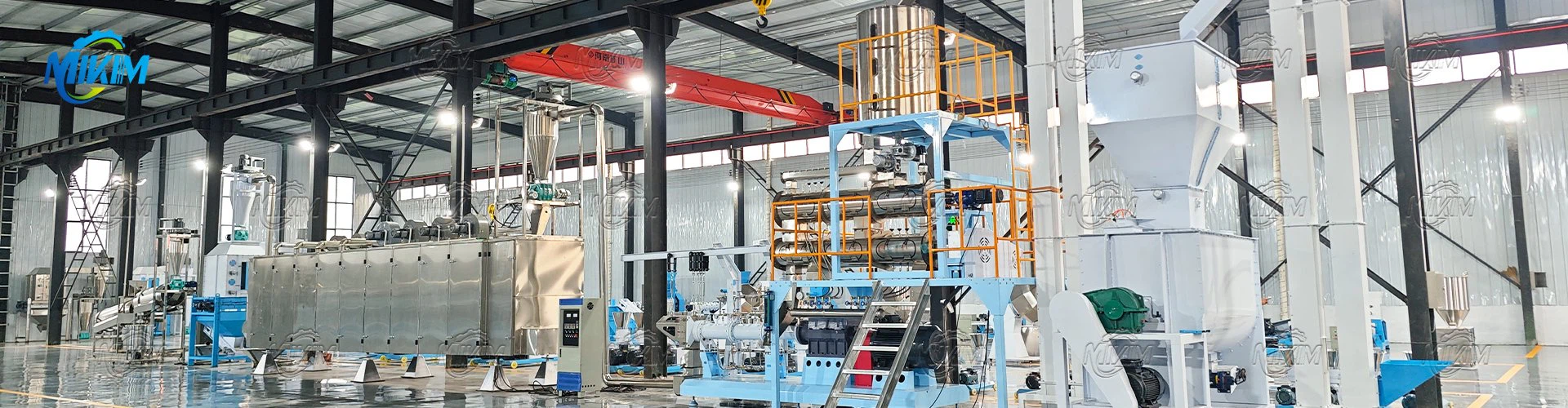
Profitability Depends on Scale
The profitability of a wet pet food extruder machine is closely tied to the scale of operation, because investment, cost structure, and market channels differ completely between small and large lines. Small-scale operation emphasizes fast payback and flexibility; large-scale operation emphasizes unit-cost reduction and stable margins.
Small-Scale Operation: Light Investment and Fast Return
Small-scale operation of 100-300 kg per hour suits small and medium farmers and start-up workshops. The equipment investment is roughly $8,000-$25,000, the space requirement is small, and only 2-3 workers are needed. The profit model relies mainly on local direct sales, regional specialty products, and customized formulas, with flexible service to build customer loyalty. The advantages are a fast return on investment of about 1-3 months and low risk, and the operator can optimize the formula through small-batch trial production. The disadvantages are higher unit costs and weak economies of scale.
Large-Scale Operation: Economies of Scale Increase Profit
Large-scale operation of 1-10 tons per hour suits feed companies and exporters. It requires a twin-screw machine with an investment of $80,000-$650,000, and relies on a PLC automated control system for continuous production with a daily capacity of 16-40 tons. The core profitability comes from reducing raw material cost through large-scale purchasing and expanding revenue through integrated services. The advantages are stable unit profits, strong market competitiveness, and a payback period of 3-8 months. The disadvantages are the high initial investment and high requirements for operational management capability.
Matching Machine Selection to Demand
The core of selection is matching scale with demand. For small-scale operation, a dry-type extruder is usually preferred to balance cost and basic extrusion effect, while large-scale operation must use a twin-screw machine to ensure stable product quality and sufficient capacity. To allow smooth growth, choose a machine with an adjustable capacity range, for example from 100 kg to 10 tons per hour, so that the workshop can upgrade from small to large scale without a second full-line investment.
Cost Factors to Watch
Before investing, calculate the full picture: raw material cost and its fluctuation, energy and water consumption, labor cost, packaging, and local selling prices. For small lines, the payback period is short but the margin per kilogram is thin; for large lines, the margin per kilogram is higher but any production stoppage costs more. A realistic sales plan, not the machine price alone, determines whether the business is profitable.
FAQ
1. How much does a small wet pet food extruder machine cost?
A small-scale line of 100-300 kg per hour typically costs about $8,000-$25,000, including the core machines for a start-up workshop.
2. How many workers are needed for a small line?
About 2-3 workers can run a small-scale line, because most steps are semi-automated.
3. How fast is the return on investment for small scale?
Small-scale operation can pay back in about 1-3 months when local direct sales channels are established, according to the article's figures.
4. What is the daily capacity of a large-scale line?
A large line of 1-10 tons per hour with PLC control can produce about 16-40 tons per day.
5. Which machine type should a large producer choose?
Large-scale producers should use a twin-screw machine to ensure stable product quality and sufficient capacity.
6. Can a small workshop upgrade later?
Yes, choosing a machine with an adjustable capacity range from 100 kg to 10 tons per hour allows upgrading without replacing the whole line.