
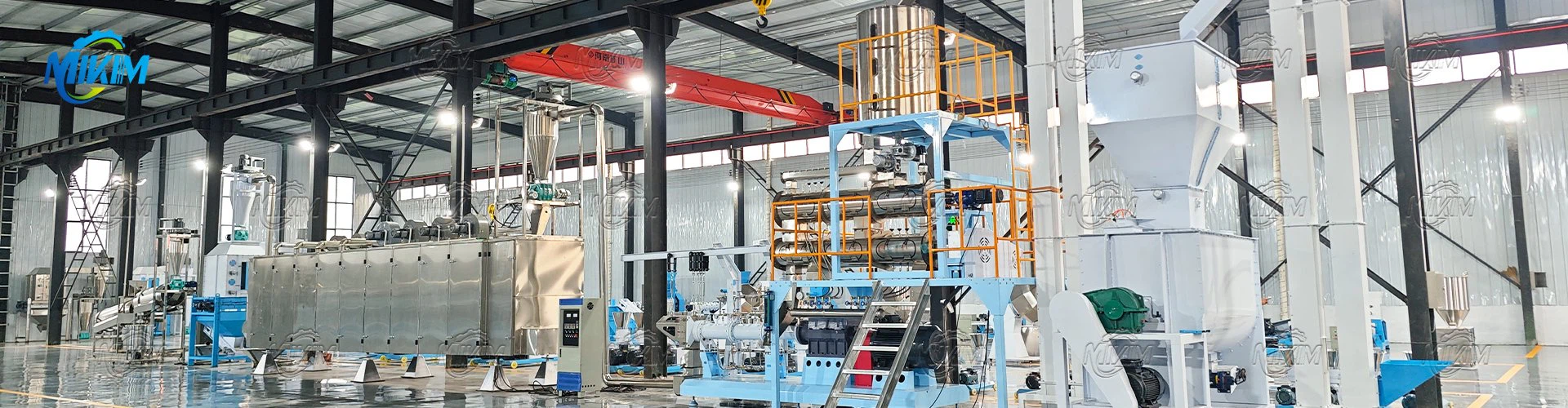
The Role of Machinery in Feed Quality and Efficiency
Feed processing machinery exists for one reason: to convert variable raw materials into a consistent, safe, nutritionally correct pellet at a cost the livestock operation can carry. Rising demand for livestock products makes that conversion more demanding, because the ration has to deliver daily weight gain reliably while ingredient prices and labour costs move. Machinery addresses the problem in two ways at once - it makes production faster and it makes the product more uniform - and it is the uniformity, not the speed, that ultimately decides feed conversion on the farm.
Automated Production and Throughput
Automation is what allows a mill to produce a large tonnage in a short working window. A properly sequenced line performs pre-treatment, proportioning, mixing, pelleting and packing as a coordinated set of operations, so material moves at a steady rate and the pelleting section never has to stop and wait for a batch. The value of the sequence is measured in cycle time and in start-stop frequency: every unnecessary stop costs both energy and pellet quality, because the first pellets after a restart are always the least stable.
Typical machine data for a floating fish feed extrusion range illustrates how throughput, drive power and auxiliary power scale together:
| Model | Capacity (t/h) | Main motor (kW) | Conditioner (kW) | Cutter (kW) |
|---|---|---|---|---|
| 65 | 0.3 | 22 | 3.0 | 0.75 |
| 70 | 0.5 | 37 | 3.0 | 1.1 |
| 80 | 0.8 | 55 | 5.5 | 1.5 |
| 85 | 1.0 | 75 | 7.5 | 2.2 |
| 90 | 1.5 | 90 | 11 | 3.0 |
| 120 | 2.0 | 110 | 15 | 3.0 |
Two points are worth reading from this table. Specific energy per tonne falls as model size rises, so a larger machine running at part load can still be more efficient than a small machine running flat out. And conditioner and cutter power scale with capacity, which confirms that temperature control and pellet length control are production variables rather than optional refinements.
Controlling Nutrients, Moisture and Pellet Stability
Quality control in a feed mill is a metering problem before it is a mechanical one. Accurate proportioning of the major ingredients and the micro-ingredients, followed by a mixing cycle long enough to homogenise the batch, is what makes the analysed composition of the feed match the formulation. Where the line includes a conditioner with controlled steam or water addition, the moisture window can be held within a narrow band instead of drifting with ambient conditions, and the pelleting process then proceeds at a stable temperature.
Cooling closes the loop. A counter-flow cooler removes the heat and the excess surface moisture that the conditioning step introduced, so the finished pellet presents a low moisture level to storage. This is the step that prevents moulding and deterioration in the bag, and it is normally verified by oven determination of moisture using the method for animal feeding stuffs given in ISO 6496, with protein checked by ISO 5983-1 and ash by ISO 5984. Compound feed that is placed on the market must also satisfy the mandatory contaminant limits that apply in the destination market, for example GB 13078-2017 in China.
Cost Reduction: Labour, Energy and Waste
The economic case for automated feed machinery rests on three savings. Labour is the most visible: a line that doses, mixes, pellets, cools and packs automatically needs far fewer operators per tonne than manual batching, and it removes the operator-to-operator variation that shows up as inconsistent pellet quality. Energy is the second: where the pelleting section runs continuously at its design load instead of in short bursts, specific energy consumption per tonne falls. Waste is the third and the least obvious: fewer stoppages mean fewer off-specification starts, less regrinding of broken pellets and less dust lost to the extraction system.
Cost control therefore comes from stable operation rather than from cheap components. A machine bought on price alone usually shows its cost later in die life, spare parts and stoppage hours.
Challenges and Countermeasures
The recurring challenges on a feed line are raw material variability, die and roller wear, moisture control in humid conditions, and dust and hygiene management. Variability is managed by incoming inspection and by dosing from silos that are emptied on rotation rather than in layers. Wear is managed by monitoring motor current at constant output and by keeping die and roller clearance within the value specified by the machine builder. Moisture is managed by controlling conditioning and cooling rather than by adding water at the mixer. Dust and hygiene are managed by closed conveying, sealed transfer points and a fixed cleaning schedule, which also reduces the risk of cross-contamination when the formula changes.
For a mill operating under a formal quality system, these routines fit naturally into an ISO 9001 framework, where each check has a defined frequency, a record and a responsible person. Electrical safety on the line should follow recognised machinery practice such as EN 60204-1, and the guarding and interlock logic should be based on a documented risk assessment under ISO 12100.
Frequently Asked Questions
Q: How does feed processing machinery improve feed quality?
A: By metering ingredients accurately, mixing to a defined uniformity, and holding moisture and temperature in a narrow window during conditioning and cooling, so the analysis and physical quality of every batch match the formulation.
Q: Why is a larger machine sometimes more efficient?
A: Specific energy per tonne falls as model size increases, so a larger unit at part load can consume less energy per tonne than a small unit running at its limit.
Q: What is the purpose of the cooling stage?
A: To remove the heat and surface moisture added during conditioning so the pellet is stable and low in moisture before bagging, which prevents moulding in storage.
Q: How should moisture and composition be verified?
A: Moisture by ISO 6496, nitrogen and crude protein by ISO 5983-1 and crude ash by ISO 5984, with contaminant limits applied as required by the market, for example GB 13078-2017.
Q: Where do the main cost savings come from?
A: Fewer operators per tonne, lower specific energy use from continuous running at design load, and less off-specification product and regrinding caused by stoppages.
Q: What is the biggest operational risk on a feed line?
A: Raw material variability, which is controlled through incoming inspection, rotation of silo stock and routine verification of the dosing system rather than by adjusting the pelleting section.