
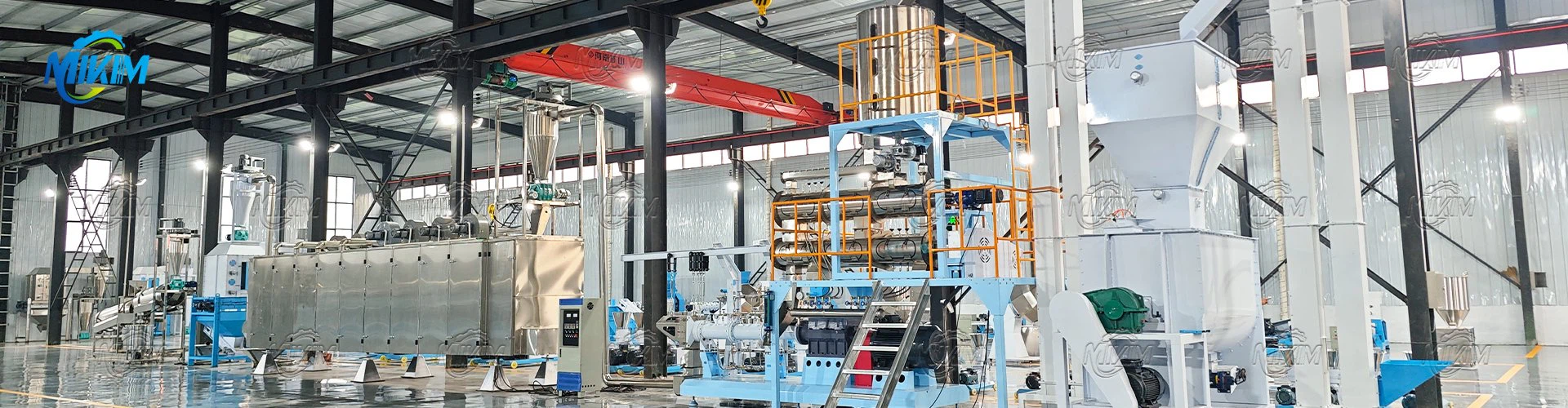

How Can a Floating Feed Production Line Improve Profitability?
Profitability in floating fish feed production is driven by two levers: the cost of raw materials and the efficiency of the process. This article explains four ways to improve profitability-raw material cost optimization, energy-efficient equipment selection, process efficiency upgrades and customized service-and closes with execution key points.
1. Raw Material Cost Optimization
1.1 Innovative Protein Substitution
Replacing 20%-30% of fishmeal with insect protein (black soldier fly) can reduce costs by 25%-30% (supplier-estimated typical values), but requires additional supplementation of methionine to balance amino acids. Fermented rapeseed meal can replace part of soybean meal, reducing costs by 15%-20%, but it must be detoxified by myrosinase before use.
1.2 Starch Source Upgrade
The combination of cassava starch and α-amylase replaces traditional flour, reducing costs by 10%-15% while improving starch gelatinization and enhancing particle cohesion.
1.3 Dynamic Procurement Strategy
Establish a raw material price fluctuation model, lock in prices in batches when soybean meal and fishmeal are low, and use futures hedging to reduce risk.
2. Machine Parameter Reference (DGP Series)
| Model | Main Power (kW) | Feeder Power (kW) | Cutter Power (kW) | Capacity (t/h) | Dimension (mm) | Weight (kg) |
|---|---|---|---|---|---|---|
| DGP40 | 4 | 0.4 | 0.4 | 0.04 - 0.05 | 1400 × 1030 × 1200 | 240 |
| DGP50 | 11 | 0.4 | 0.4 | 0.06 - 0.08 | 1400 × 1030 × 1200 | 320 |
| DGP60 | 15 | 0.4 | 0.4 | 0.12 - 0.15 | 1450 × 950 × 1430 | 480 |
| DGP70 | 18.5 | 0.4 | 0.4 | 0.18 - 0.25 | 1600 × 1400 × 1450 | 600 |
| DGP80 | 22 | 0.4 | 0.75 | 0.3 - 0.35 | 1850 × 1470 × 1500 | 800 |
| DGP90 | 30 | 1.1 | 1.5 | 0.4 - 0.45 | 1900 × 1500 × 1600 | 1200 |
3. Process Efficiency Upgrades
3.1 Water-Resistance Technology Breakthrough
A double-layer conditioner is used: the first layer is injected with steam for preheating, and the second layer is added with hot water (60 °C). The conditioning time is extended to 60 seconds so that the starch is fully gelatinized, and the water resistance of the pellets increases from 20 minutes to more than 35 minutes.
3.2 Post-Ripening Process
After the particles are ejected from the mold, they enter an insulation tank (maintained at 40 °C for 20 minutes) to promote starch recovery and reduce dispersion in water.
3.3 Energy Consumption Control
The pelletizer is modified with a permanent-magnet motor, reducing power consumption by 18%-22%; a waste-heat recovery system installed in the drying process reduces steam consumption by 30%.
4. Customized Service
Provide exclusive formulas for large-scale farms and bind long-term orders; develop regional formulas (such as cold-resistant feed for low-temperature fish species) to differentiate the product.
5. Execution Key Points
- Priority piloting: start with small-scale raw material substitution and monitor fish growth data before scaling.
- Data-driven operation: establish a production database and continuously optimize process parameters.
Our Factory

Packaging and Shipping
Our machines are first wrapped with stretch film, securely packed in wooden crates, and then loaded into containers for safe international shipping.

Certificate of Quality Compliance
