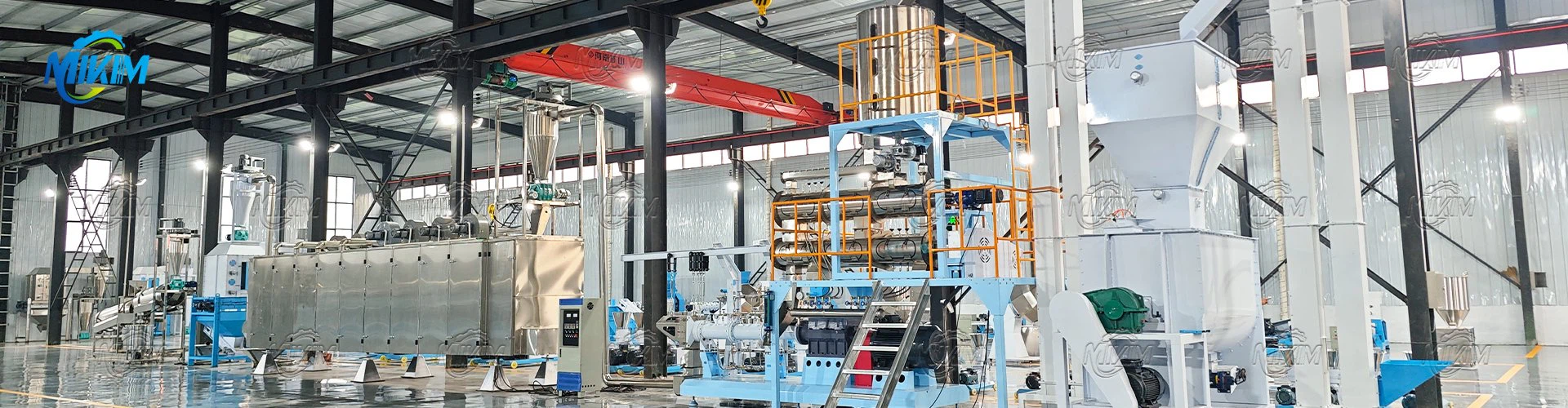
Floating aquatic feed pellet extruder clogging during continuous production is a major issue that disrupts operations, wastes raw materials, and decreases product yield. It can result in costly downtime, increased energy consumption, and damage to equipment, negatively impacting both production efficiency and profitability.
Details
I. Specific Phenomena of Blockage in Continuous Extruder Production
Phenomenon Description:
In continuous production, a blockage often manifests after 1-4 hours of normal operation:
- Slow Discharge: The discharge speed gradually decreases, sometimes even halting completely.
- Increased Chamber Pressure: The pressure in the machine chamber rises suddenly, often triggering overload protection and a shutdown.
- Abnormal Vibration & Noise: The machine vibrates excessively, and abnormal noises may be heard from the chamber.
- Material Backflow: Materials begin to backflow from the feed inlet, and steam leakage can be observed.
- Clogged Die & Feed Holes: Upon shutdown and disassembly, you'll find carbonized materials, agglomerated raw materials, and clogged die holes and feed holes.
- Screw Sticking: The screw and screw sleeve may become stuck, exacerbating the problem.
II. Core Causes of Extruder Blockage During Continuous Production
1. Raw Material Quality Fluctuations
- Cause: Changes in raw material batches, especially after adjustments or supplier changes, can lead to inconsistent moisture content, particle size, and impurities.
- Consequence: These variations lead to uneven gelatinization and poor flowability, causing material to agglomerate and clog the die and feed channels.
- Impact: This is responsible for 38% of blockages during continuous production.
2. Unstable Process Parameters
- Cause: Fluctuating steam pressure (below 0.3 MPa or above 0.5 MPa) and inconsistent feeding speed can lead to uneven material gelatinization.
- Consequence: Some material becomes over-gelatinized (sticky), while others remain under-gelatinized, leading to accumulation and clogging.
- Temperature Fluctuations: If the milling chamber temperature is inconsistent, areas can become too hot, resulting in material carbonization and blockages.
3. Equipment Component Wear or Malfunctions
- Cause: Over time, screws and screw sleeves wear out, reducing extrusion and shearing effectiveness. Lubrication system failures increase operating resistance, while issues with the cooling system lead to higher temperatures in the machine chamber.
- Consequence: Insufficient pressure and flow cause material accumulation. Wear on critical parts like screws and die heads exacerbates the problem by preventing the machine from pushing material forward effectively.
- Impact: Material gradually clogs the die orifice and feed holes, resulting in a total blockage if not addressed.
4. Inadequate Operation & Maintenance
- Cause: Lack of routine inspections and sudden adjustments to feed speed or screw speed can disrupt the flow, causing pressure imbalances.
- Consequence: Without proper maintenance, residual materials can accumulate and lead to blockages during extended production runs.
- Impact: Failure to perform timely cleaning and maintenance directly contributes to frequent clogs.
III. Solutions and Long-Term Maintenance Plans to Prevent Blockages in Continuous Extruder Production
Emergency Handling Steps (Immediate Action Required)
- Stop the Machine: Disconnect the power immediately to prevent further damage.
- Close the Steam Valve: Prevent steam leakage and burns from high-temperature materials.
- Wear Protective Gear: Ensure all operators wear high-temperature resistant gloves and protective masks to avoid burns.
- Disassemble Key Components: Clean the die head, distributor plate, and manifold. Remove any foreign objects, coke lumps, or stuck material.
- Do not force the screw-gradually clean it by heating and gelatinizing to prevent damage.
- Check Key Systems: Inspect the steam, lubrication, and cooling systems for faults. Repair them promptly to restore function.
- Reinstall Components: After cleaning, reassemble the machine, conduct a no-load test run, and then resume production gradually to prevent future issues.
Stable Control of Process Parameters
- Steam Pressure: Monitor steam pressure continuously and maintain it within the optimal range of 0.3-0.5 MPa. This ensures a stable and dry steam supply, preventing excess moisture that can affect gelatinization.
- Feeding & Screw Speed: Ensure the feeding speed is synchronized with the screw speed and milling chamber temperature to avoid imbalances that lead to material accumulation.
- Milling Chamber Temperature: Maintain a consistent temperature between 150-180°C. Adjust heating parameters promptly if temperature fluctuations occur, to prevent over- or under-gelatinization.
Equipment Maintenance and Inspection Optimization
- Routine Inspections: Set up a 30-minute inspection interval to check key factors such as die discharge, steam pressure, temperature, and current changes.
- Die & Feed Hole Cleaning: After every production cycle, clean the die holes and feed holes thoroughly to prevent clogging.
- Regular Equipment Checks: Inspect vulnerable parts such as screws, screw sleeves, and dies after every 8 hours of continuous production. Replace worn-out parts promptly.
- Lubrication System: Regularly add qualified lubricating oil to the lubrication system to reduce wear and ensure smooth operation.
- Cooling System Check: Ensure the cooling system is functioning well to prevent high temperatures in the milling chamber that lead to carbonization.
Long-Term Prevention and Control
- Raw Material Testing: Establish a raw material testing system to monitor moisture, particle size, and impurity content before processing. Reject any raw material that does not meet specifications to prevent clogging.
- Standardized Production Processes: Develop and strictly adhere to standardized production procedures. This includes uniform raw material quality, consistent parameter settings, and careful monitoring of process variables to prevent disruptions.
- Post-Cycle Cleaning: Ensure thorough cleaning of all materials in the machine chamber, die head, and manifold after each production run to prevent clumping and buildup.
- Scheduled Equipment Maintenance: Perform comprehensive equipment maintenance quarterly to address potential issues before they cause significant problems. This will help maintain optimal performance and reduce machine downtime.
Company Profile