
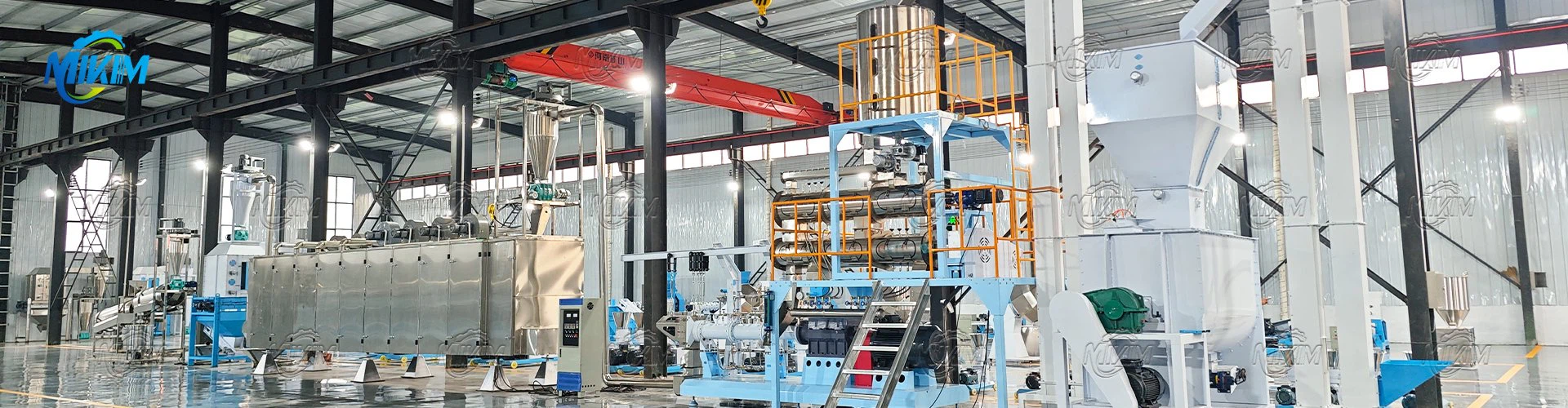
Extruded Aquatic Feed and Its Role in Modern Aquaculture
Extruded aquatic feed is produced from high-protein raw materials through extrusion technology, a route that raises feed utilization and cuts waste in fish and shrimp farming. Compared with a simple pressed pellet, an extruded pellet can be formulated to float, to sink slowly or to sink fast, so the farmer can watch feeding behaviour directly at the water surface and stop feeding at the right moment. That single advantage reduces overfeeding, one of the largest hidden costs in pond and cage farming.
The puffing production process itself is straightforward and easy to understand, and the machines involved are simple to operate and to maintain. Because extrusion cooking gelatinises starch and denatures protein, the pellet holds together in water for a predictable time, and the feed is more digestible than a raw mash of the same formula.
Raw Material Intake, Crushing and Batching
The line starts with raw material cleaning. Stones, sand and metal fragments must be removed before any grinding takes place, otherwise they damage hammers and dies further downstream. Cleaning is followed by coarse crushing, which reduces whole grains and oilseed cakes to a size that a batching scale can handle accurately.
Batching follows, and it is the stage that decides whether the finished feed actually meets its formula. Each component - protein meal, energy source, mineral and vitamin premix - is weighed in sequence. After batching, the material passes through an ultra-fine crusher and then a secondary mixer. Ultra-fine crushing matters for aquatic feed because the pellet must be compact and water-stable; finer particles pack into a denser, smoother pellet with less surface dust. The secondary mixer homogenises the batch so that every pellet carries the same nutrient profile.
Extrusion Section and Forming
At the heart of the line sits the extruder, driven by a main motor, fed by an independent feeder and fitted with a cutter at the die face. The feeder meters material into the barrel at a steady rate, the barrel uses mechanical shear together with added steam and water to cook the mash, and the die then shapes it. The cutter chops the extruded rope into pellets of the required length.
Two settings control most of the product outcome: the die opening and the cutter speed. The die opening sets the pellet diameter and, together with the formulation, the buoyancy behaviour; the cutter speed sets the pellet length. Because the two variables are adjusted independently, one machine can run floating feed, slow-sinking feed and sinking feed on the same day. On the DGP range the feeder and the cutter each have their own drive, which keeps feeding and cutting stable even when the load on the main motor changes.
Spraying, Cooling and Packaging
Freshly extruded pellets are hot, moist and soft, so they must be stabilised before storage. The sections that follow the extruder handle liquid addition (fat and oil spraying), cooling and final packaging. Spraying is carried out on the moving product stream so that the added liquid is distributed evenly instead of being absorbed by only part of the batch. The pellets are then cooled towards ambient temperature, which hardens the surface and limits mould growth in bags or silos, and finally packed to the required bag weight.
Because aquatic feed is usually stored in warm and humid conditions, the spraying and cooling stages are not optional extras. A line that bags warm pellets loses the benefit of the whole extrusion process within a few weeks of storage.
Line Layout and Extruder Models
Taking a line with an output of 3-6 tonnes per hour as a reference, the complete installation covers the following sections:
Raw material cleaning and coarse crushing equipment
Automatic batching and weighing system
Ultra-fine crusher and secondary mixer
Extruder with its feeder and cutter
Spraying, cooling and packaging section
Auxiliary steam supply from a 1 t boiler
The total installed power of such a line is about 450 kW, and the equipment occupies a floor area of roughly 30 x 24 m with a working height of about 30 m. The unit is built with a compact design and a rational material flow, which helps the plant meet environmental protection requirements, and the configuration can be adjusted to the customer's own formula, available floor space and utility supply.
The DGP series covers a wide capacity range, from small-farm scale up to small industrial output, and every model shares the same feeder-plus-cutter arrangement:
| Model | Main power | Feeder | Cutter | Capacity | Dimension (mm) | Weight |
|---|---|---|---|---|---|---|
| DGP40 | 4 kW | 0.4 kW | 0.4 kW | 0.04-0.05 t/h | 1400 x 1030 x 1200 | 240 kg |
| DGP50 | 11 kW | 0.4 kW | 0.4 kW | 0.06-0.08 t/h | 1400 x 1030 x 1200 | 320 kg |
| DGP60 | 15 kW | 0.4 kW | 0.4 kW | 0.12-0.15 t/h | 1450 x 950 x 1430 | 480 kg |
| DGP70 | 18.5 kW | 0.4 kW | 0.4 kW | 0.18-0.25 t/h | 1600 x 1400 x 1450 | 600 kg |
| DGP80 | 22 kW | 0.4 kW | 0.75 kW | 0.3-0.35 t/h | 1850 x 1470 x 1500 | 800 kg |
| DGP90 | 30 kW | 1.1 kW | 1.5 kW | 0.4-0.45 t/h | 1900 x 1500 x 1600 | 1200 kg |
| DGP100 | 37 kW | 1.1 kW | 1.5 kW | 0.45-0.5 t/h | 2000 x 1600 x 1600 | 1500 kg |
Capacity is quoted for a typical aquatic feed formulation. Actual output depends on the raw material blend, the pellet diameter and the amount of liquid added after extrusion, so the same machine may run above or below the table figure in a given plant.
Frequently Asked Questions
Q: What is the difference between extruded aquatic feed and ordinary pressed pellets?
Extruded feed is cooked inside the extruder barrel, so starch is gelatinised and the pellet is denser and more water-stable. A pressed pellet is simply compacted, and it breaks down faster in water with more fines in the pond.
Q: Why is ultra-fine crushing needed before extrusion?
Aquatic pellets must be smooth and water-stable. Finer particles pack more closely, which produces a denser pellet surface, less dust and better retention of the added oil.
Q: Can one extruder make floating and sinking feed?
Yes. The die opening and the cutter speed are set independently, so the buoyancy behaviour and the pellet length can be changed without replacing the machine.
Q: What does the 3-6 t/h line require in terms of utilities?
The complete line has a total installed power of about 450 kW and needs roughly a 30 x 24 m floor area with about 30 m of working height, plus steam from a 1 t boiler for conditioning.
Q: Which models suit a small farm instead of an industrial plant?
The smaller machines in the series, such as DGP40 to DGP60, have capacities from 0.04 t/h to 0.15 t/h and modest power demand, so they can serve a farm-scale operation without a heavy electrical upgrade.
Q: What is the most common cause of poor pellet quality?
Unstable feeding into the barrel and an incorrect die or cutter setting. Both show up as pellets of uneven length, soft surface or excessive dust rather than as a machine fault.