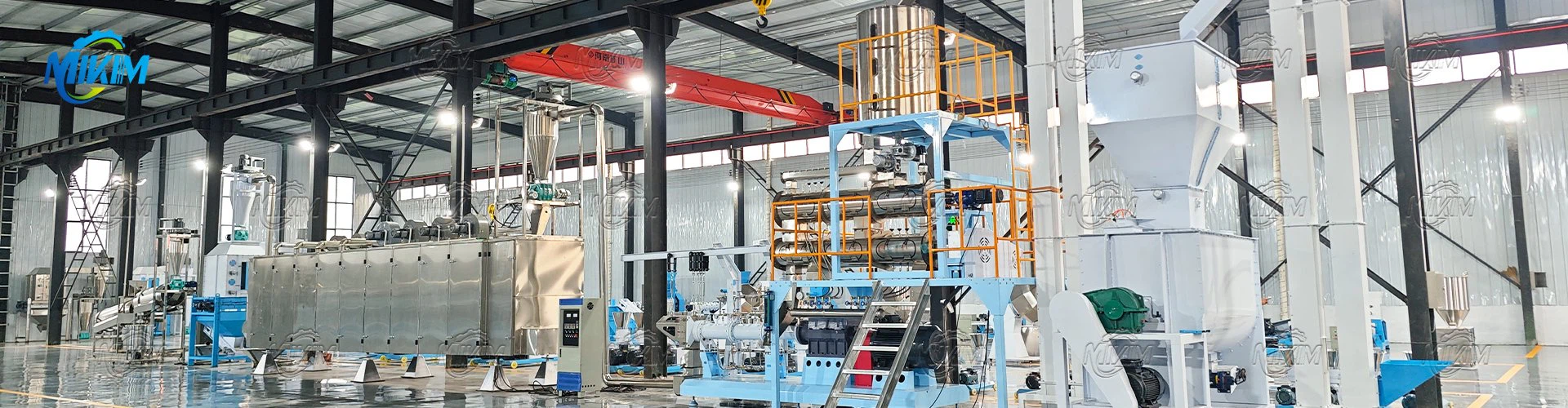

Yes, high-quality Twin screw floating fish feed making machines are capable of producing micro-pellets with diameters as small as 0.6mm to 0.8mm. However, this is not just a matter of changing a die plate. Successful sub-1.0mm production requires ultrafine raw material grinding (micronization), high-precision die engineering, and a high-speed synchronized cutting system. Twin-screw technology is preferred over single-screw because it maintains the extremely high and stable pressure necessary to force material through microscopic die holes without clogging.
1. The Technical Challenges of Sub-1.0mm Extrusion
Producing micro-pellets for fish fry and shrimp larvae is considered the "High-Precision" tier of aquafeed manufacturing.
A. The "Micronization" Requirement
The golden rule of micro-pellets: The largest particle in your raw material must be no larger than 1/3 of the die hole diameter.
- For a 0.6mm pellet: Raw materials must be ground to 200 microns (approx. 80 mesh) or finer.
- The Problem: Standard hammer mills cannot achieve this. You will need an Ultra-fine Pulverizer or a specialized sifting system to prevent instant die blockage.
B. Pressure & Rheology Control
Small die holes create immense backpressure.
- Twin screw floating fish feed pellet maker machine Advantage: The positive displacement action of twin screws ensures the dough moves forward even under extreme resistance.
- single screw fish feed processing machine Limitation: A single-screw machine often suffers from "back-leakage" when the holes are too small, leading to inconsistent pellet density.
2. Critical Machine Configurations for Micro-Feed
| Component | Specification for <1.0mm Pellets | Why It Matters |
| Die Plate | Thinner plate with laser-drilled holes | Reduces friction and prevents heat buildup in small holes |
| Cutter System | High-speed (up to 3000+ RPM) / Ultra-thin blades | Ensures clean cuts without deforming the tiny pellets |
| Screw Design | High-shear configuration | Ensures full starch gelatinization for water stability |
| Conditioner | Dual-axis differential steam conditioning | Ensures every tiny particle is hydrated and pre-cooked |
3. Why Micro-Pellets Require Twin-Screw Stability
In the world of fish fry (starter feed), uniformity is everything. If 10% of your pellets are 0.8mm and 10% are 1.2mm, the smaller fry will starve or the larger ones will grow unevenly.
- Uniform Expansion: Twin screw floating fish feed pellet mills provide a homogeneous "melt," meaning every micro-pellet expands at the exact same rate.
- Low Blockage Risk: The self-cleaning nature of intermeshing screws prevents the buildup of "dead spots" that could flake off and block the tiny die openings.
4. Checklist: Are You Ready for Micro-Pellet Production?
Before attempting to produce granules under 1.0mm, verify your setup:
- Do you have a Pulverizer? Standard grinding is insufficient.
- Is your steam quality stable? Fluctuations in steam will cause micro-pellets to clump or sink/float inconsistently.
- Is your dryer equipped for small particles? Standard belt dryers might let 0.6mm pellets fall through the mesh. You may need a vibrating fluidized bed dryer.
5. FAQ:
Q: How do I prevent my 0.8mm die from clogging?
A: Clogging is usually caused by fiber or large protein particles. You must use an Ultra-fine Pulverizer and a high-frequency vibrating screen to ensure all raw materials are 100% fine powder before they enter the extruder.
Q: Can I make floating fry feed at 0.6mm?
A: Yes. Floating behavior at this size depends on high starch gelatinization. Twin screw fish feed making machines provide the necessary shear to ensure micro-pellets have a porous internal structure even at such a small scale.
Q: Does producing smaller pellets reduce my hourly output?
A: Yes, significantly. Because the total surface area of the die holes is smaller and the pressure is higher, the capacity ( kg/h ) will drop compared to producing standard 3mm pellets. Expect a 30-50% reduction in throughput.
Q: Why are my micro-pellets irregular in length?
A: This is usually a cutter issue. For pellets under 1.0mm, the distance between the blade and the die face must be microscopic, and the cutter speed must be perfectly synchronized with the extrusion speed.
Q: Is shrimp larval feed made with this machine?
A: Yes. Twin screw fish feed pellet maker machines are the preferred choice for shrimp starter feed, as they can produce the high-protein, water-stable sinking micro-pellets required by shrimp hatcheries
Company Profile