
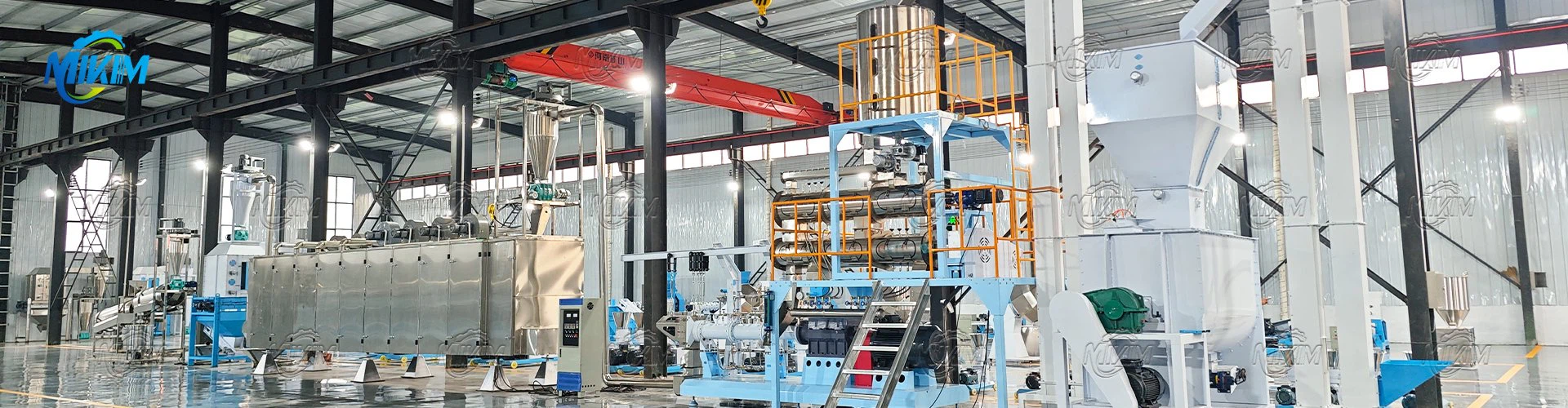
What Is a Small Fish Feed Extruder Machine?
A small fish feed extruder machine is a compact processing unit that cooks, expands, and shapes a moistened mixture of grains, protein meals, and additives into uniform pellets. Inside the barrel, high temperature and high pressure gelatinize the starch so that the pellets float or sink as designed and stay stable in water. Small models are usually sold as integrated units, covering crushing, mixing, puffing, and molding in one structure, so the operator does not need to assemble separate machines.
Benefit 1: Ease of Operation
The first benefit is simple operation that does not require specialized skills. The integrated design avoids complex assembly and debugging. The operator follows four core steps: raw material selection, formula mixing, parameter setting, and equipment startup. A basic touchscreen displays key parameters such as the puffing temperature and screw speed. Values such as preheating temperature and screw speed are preset to basic levels, and the user only makes small adjustments according to the recipe and the fish species.
Benefit 2: Automation Saves Labor
Feeding, mixing, puffing, and cutting are semi-automated and do not need full-time supervision. An automatic feeding hopper delivers the mixed raw material evenly, avoiding the output fluctuation caused by uneven manual feeding. A built-in cutter trims the pellets to a set length automatically. As a result, one or two part-time workers can run the line at key points such as adding raw materials and collecting finished pellets.
Benefit 3: Small Space and Flexibility
The whole machine occupies about 1-3 square meters and weighs only a few tens of kilograms, so it fits in family yards, storage rooms, or sheds without a dedicated factory building. If the farming scale is small, the machine can be moved on demand for production. Unlike large industrial fish feed lines, no complex site modification is required; a flat ground is enough for normal operation.
Benefit 4: Lower Entry Barrier for Home Farming
Because the machine is inexpensive to install and simple to maintain, it lowers the entry barrier for home-based fish farming and small workshops. The user can adjust the formula according to locally available raw materials and produce fresh feed on demand, which reduces storage loss and supports consistent feeding.
How It Compares with Large Industrial Lines
Large industrial lines offer higher throughput and fuller automation, but they need dedicated buildings, three-phase power, and professional maintenance. A small fish feed extruder machine trades some capacity for flexibility and low initial cost, which is the right trade-off for small farms producing feed for their own stock or for a limited local market.
FAQ
1. How much space does a small fish feed extruder machine need?
The integrated machine occupies roughly 1-3 square meters and can be set up on flat ground in a yard, shed, or storage room.
2. What pellet sizes can it produce?
Pellet length is adjusted by the built-in cutter, and pellet diameter depends on the die; common small-machine dies cover fry-size and adult-fish-size pellets.
3. Can it make both floating and sinking feed?
Yes. Floating feed requires proper starch gelatinization and moisture control; sinking feed is produced with lower expansion settings.
4. What raw materials are suitable?
Grain meals, protein meals such as soybean meal and fish meal, and mineral and vitamin premixes are common, provided they are ground to a uniform particle size and free of hard impurities.
5. Does the machine need full-time operators?
No. Feeding, mixing, puffing, and cutting are semi-automated; the operator mainly adds raw materials and collects finished pellets.
6. How is the machine cleaned?
After each production day, run the machine briefly to expel residual material, then clean the screw, barrel, and die head with warm water and dry them.