
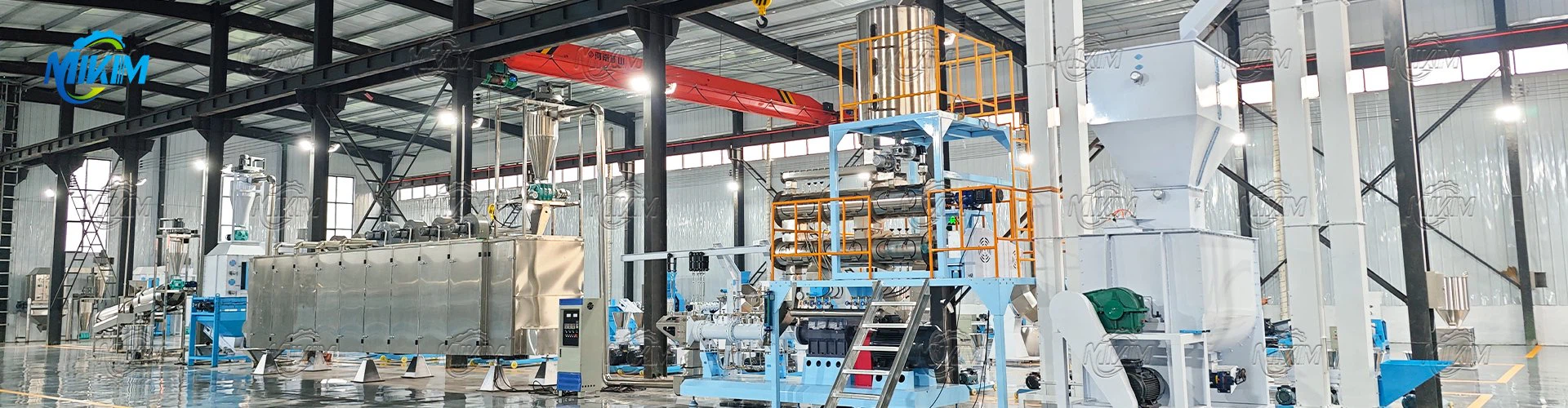

Can a floating fish food pellet making machine be used for other purposes? The answer is a definitive yes. While originally designed for aquatic pellets, the high-temperature, high-pressure extrusion technology at the heart of these machines perfectly aligns with the production requirements for high-quality pet food.
Below, the Mikim technical team provides a deep dive into how to adapt your fish feed equipment for dog and cat food production, including specific parameter adjustments and formula secrets.
Key Takeaways
- Versatility: With a simple die change and parameter tuning, one machine can produce fish, dog, and cat food.
- Digestibility: Extrusion increases starch gelatinization (>85%) and protein denaturation, making pet food highly digestible.
- Critical Parameters: Dog food requires 120–140°C; cat food requires 130–150°C due to higher protein content.
1. The Science: Why Extrusion Suits Pet Food
The core of pet food processing is improving palatability and digestibility. The extrusion environment of a fish feed pellet mill (120–150 °C, 3–5 MPa) triggers two vital chemical reactions:
- Starch Gelatinization: Breaks down complex carbohydrates into easily absorbable sugars.
- Protein Denaturation: Moderately alters protein structures to increase enzyme accessibility.
For instance, chicken-and-oat dog food processed through a Mikim extruder reaches a protein digestibility of 88%, significantly higher than non-extruded alternatives.
2. Technical Comparison: Fish vs. Dog vs. Cat Food
To help operators switch production lines efficiently, we have summarized the optimal mechanical parameters in the table below:
| Feed Type | Temperature (°C) | Pressure (MPa) | Screw Speed (rpm) | Die Size (mm) | Key Requirement |
| Floating Fish Feed | 120 - 130 | 3.0 - 4.0 | 280 - 320 | 1.0 - 10.0 | High Buoyancy |
| Adult Dog Food | 120 - 140 | 3.5 - 4.5 | 300 - 350 | 3.0 - 5.0 | Texture & Crunch |
| High-Protein Cat Food | 130 - 150 | 4.0 - 5.0 | 350 - 400 | 2.0 - 4.0 | Protein Denaturation |
3. Producing Dog Food: Parameter and Formula Adaptation
Dog food requires a balance of energy and fiber.
- Formula Logic: Typically 30–40% grains (corn, oats) and 40–50% meat (chicken, beef).
- Technical Tuning: Maintain a screw speed of 300–350 rpm. This provides the necessary shear force to create a porous, crunchy texture that helps clean a dog's teeth while chewing.
Moisture Tip: Raw material moisture should be kept between 18%–22% before entering the floating fish food extruder machine for optimal expansion.
4. Producing Cat Food: Meeting High Protein Demands
Cats are obligate carnivores, meaning their food requires higher protein (60–70%) and fat content.
- The Challenge: High protein makes the "expansion" harder to achieve.
- The Solution: Increase the temperature to 130–150 °C and pressure to 5 MPa. This extends the "residence time" in the extrusion chamber, ensuring that even dense fish meal or chicken meal is fully cooked.
- Results: Using these settings for salmon-based cat food can result in an absorption rate of 91%, meeting premium industry standards.
5. Advanced Tips for Professional Results (The Mikim Edge)
To transition from "amateur" to "commercial" quality, consider these two professional factors:
A. Single-Screw vs. Twin-Screw
While a single screw floating fish feed making machine (like our standard fish feed machines) is excellent for most feeds, if your cat food formula exceeds 12% fat content, we recommend a Twin screw floating fish food extruder machine. Twin-screw systems offer stronger self-cleaning capabilities and higher shear force for "sticky" high-meat formulas.
B. The Post-Coating Process
To further increase palatability, do not put all fats into the extruder. Use the extruder to create the "kibble," then use a Flavoring Roller to spray oils and natural attractants onto the surface of the warm pellets.
C. Preventing Cross-Contamination
When switching from fish feed (fishy odor) to dog food, always run a "flush" batch (usually 5-10kg of pure corn meal) through the machine to clean out residual odors and oils from the screw and die.
6. Case Study: A Dual-Purpose Success Story
A family-owned farm in Southeast Asia utilized a Mikim single screw floating fish food maker machine to manage both their Koi ponds and their Golden Retriever breeding facility.
- The Switch: By simply swapping a 4mm die (Koi) for a 3.5mm die (Dog) and increasing the screw speed by 10%, they produced high-quality dog food at a cost of only 8–10 yuan per kg.
- The Outcome: The farm reduced its annual feed expenditure by 35% while maintaining the health and coat shine of their dogs, proving the machine's ROI (Return on Investment).
FAQ
Q1: Can the same floating fish feed pellet making machine produce floating and sinking feed?
Yes. Buoyancy is controlled by adjusting the temperature and the moisture content. Higher temperatures and lower moisture usually produce floating pellets.
Q2: Do I need a different dryer for pet food?
No. Both fish feed and pet food must be dried to below 10% moisture to prevent mold. The same multi-layer dryer can be used for both.
Q3: Is it difficult to change the dies?
Not at all. Mikim machines feature a quick-change die head design, allowing you to switch from 2mm cat food to 5mm dog food in less than 15 minutes.
Q4. Can the same floating fish feed pellet extruder machine produce fish feed and dog food?
Yes. By changing the die head and adjusting temperature, screw speed, and die orifice diameter, the same single-screw extruder produces both fish feed and dog food.
Q5. What parameters are needed for dog food?
Typical parameters: temperature 120–140 °C, screw speed 300–350 rpm, die orifice 3–5 mm (adult dogs) or 1–2 mm (puppies), with a formula of 30–40% grains and 40–50% meat.
Q6. Why does cat food need higher temperature and pressure?
Cat food requires 60–70% protein; the higher temperature (130–150°C) and pressure (4–5 MPa) with longer residence time ensure sufficient protein denaturation and digestibility (up to 91%).
Q7. Is the production cost of homemade dog food lower?
In the case study, the production cost was about 8–10 yuan per kilogram-significantly lower than similar market products, which reduces breeding costs for family owners.
Our Factory

Packaging and Shipping
Our machines are first wrapped with stretch film, securely packed in wooden crates, and then loaded into containers for safe international shipping.

Certificate of Quality Compliance
