1 t/h Small Wood Pellet Making Production Line for Wood and Feed
A 1 t/h small wood pellet making production line can produce wood pellets and grain feed, but not through one die, one moisture target and one heat source, because the two materials bind by different reactions.
Product Details of1 t/h Small Wood Pellet Making Production Line for Wood and Feed
Tianjin Mikim Technique Co., Ltd. is one of the most experienced manufacturers and suppliers of 1 t/h Small Wood Pellet Making Production Line for Wood and Feed in China. If you're going to buy cheap 1 t/h Small Wood Pellet Making Production Line for Wood and Feed made in China, welcome to get more information from our factory. All our products are with high quality and low price.
Quick answer
This 1 t/h small wood pellet making production line carries two presses on one frame: a ring die wood press at 1-1.5 t/h on pine offcuts at 4-12 mm, and a ring die feed press at 1-2 t/h on grain at 1-12 mm. Both discharge into one 800-1000 kg/h cooling and screening unit, then one bagging scale. Drying runs on an airflow dryer: a 13 m duct on a 7.5 kW fan, heated by a hot gas furnace outside the electrical total. Connected load is 174.4 kW, and the 90 kW wood press is close to half of it. No die, no moisture target and no heat source is shared.
01
What 1 t/h means on a small wood pellet making line that also runs feed
One ton an hour describes one stream, not the sum of two.
Wood pellets at 4-12 mm from the ring die
The wood press is rated 1-1.5 t/h across a 4-12 mm range on dry, chipped pine. Fed green offcuts, it sits at the bottom of that band, because it is pushing water it cannot bind.
Feed pellets at 1-12 mm after crumbling
The feed press is rated 1-2 t/h over 1-12 mm, on the 6, 8, 10 and 12 mm dies in the standard set, with a 3-15 mm working range. No crumbler ships in this build: 1-12 mm comes from die choice, and a crumble pass joins the list with chick feed.
Why the two outputs cannot be reached in the same hour
Both presses discharge into one 800-1000 kg/h cooling and screening unit with one bagging scale behind it. That stage is wider than either press and narrower than both, so the hour belongs to one product.
02
Why one die and one dryer cannot serve wood and feed
Die, compression ratio and surface finish for wood
Wood binds on lignin, so the die must build pressure along a long hole against a small bore until the lignin softens and welds; the bore is polished, because a scored hole grips the pellet and lifts load. Wood enters dry, at 10-12%.
Steam conditioning and the moisture range feed needs
Feed binds on gelatinized starch, and starch gelatinizes under steam. The conditioner is a 1.1 kW shaft turning mash through injected steam, lifting moisture into the 12-20% band the die needs. Without steam the mash passes the hole soft and breaks up in the cooler.
The dryer target for wood, and why feed skips the dryer
The airflow dryer serves the wood path only, taking offcuts to 10-12% in a 13 m duct. Grain never enters it, because grain is bought at a moisture the feed press accepts, and gas at duct temperature would set the starch before conditioning.
Why one press with two dies fails both products
A die swap changes the hole, not the machine. The wood press runs no conditioner and a feeder sized for dry, low-density material; the feed press runs steam and a die cut for a short hole. A feed die in a wood press gives the bottom of the band and weak durability. Two products in one week need two presses.
03
Two ways to run both products: parallel lines or one line with a changeover
Parallel wood and feed streams on one frame
Two presses, two crushing stages, one shared downstream. The paths meet at the cooler, and neither product waits.
One press, two die sets, sequential batches
One press, one die at a time, a purge between products, a moisture reset upstream. Saving: one press and one foundation. Cost: a shutdown per switch ending in an unsellable batch.
What each route costs in floor space and lost hours
Parallel takes two footprints and 174.4 kW. A changeover build takes less of both and gives back the switching hours plus the first batch of each run. Three answers settle it:
- Shift overlap: when both products ship in the same week, every week, the first overlap decides it. - Switch frequency: twice a month is a schedule item; twice a week is lost production with a die change attached. - Pellet quality: a buyer testing durability on every lot cannot absorb a post-switch batch.
Equipment list for the wood side and the feed side
Two streams, one frame. Each item belongs to one stream or to both.
#
Stage
Equipment
Model
Drive kW
Serves
1
Wood crushing
Chipper-hammer unit
MH-600
18.5
Wood
2
Drying
Airflow dryer, 13x1.5x3.5 m
325
7.5
Wood
3
Conveying
Screw conveyor
KWX50YP
1.5
Wood
4
Wood pelleting
Ring die wood pellet mill
MKLH560
90
Wood
5
Grain grinding
Water drop hammer mill
SFSP56X36
22
Feed
6
Feed pelleting
Ring die feed pellet mill with conditioner
SZLH-250
22 + 0.75 + 1.1
Feed
7
Cooling and screening
Cooling and screening unit
LX-LS50
8
Both
8
Bagging
Automatic weighing and bagging
DCS-Z-W-50
3
Both
Connected load
174.4
Table 1: Equipment on the 1 t/h small wood pellet making production line, by stream.
Wood side: chipper-hammer unit, airflow dryer, screw conveyor, ring die press
Offcuts enter as they come off the saw; one unit cuts and breaks, removing a machine and a transfer point.
Model
Power
Capacity
Weight
Packing size mm
MH-420
7.5 kW
600-1000 kg/h
130 kg
1400x600x750
MH-500
15 kW
800-1500 kg/h
210 kg
1500x650x850
MH-600
18.5 kW
1000-2000 kg/h
320 kg
1500x700x1000
MH-700
37 kW
1800-3000 kg/h
400 kg
1600x800x1100
MH-800
45 kW
1000-2000 kg/h
550 kg
2000x1100x1300
MH-1000
75+7.5 kW
2000-3500 kg/h
550 kg
2000x1100x1300
Table 2: Chipper-hammer unit series, wood crushing stage.
Model
Power
Duct bends
Duct size
219
4 kW
two bends
7.5x1.5x3 m
325
7.5 kW
three bends
13x1.5x3.5 m
400
7.5 kW
four bends
17x1.5x3.5 m
Table 3: Airflow dryer series, wood drying stage.
The drying stage is a duct, not a rotating vessel. A furnace burns fuel at the inlet and the fan pulls that gas through 13 m of duct in three bends; the chips travel suspended in the gas, so the bends add residence time without adding floor length, and a cyclone drops the dry material out at the outlet while the gas goes on to the dust collector. The 7.5 kW in the table is the fan. Heat is the furnace's job, and the furnace with its fuel sits outside the connected load.
Model
Capacity
Main motor
Pellet dia.
Dimensions mm
Weight
MKLH560
1-1.5 t/h
90 kW
4-12 mm
2620x1640x1770
5.2 t
MKLH560A
1.5-2 t/h
132 kW
4-12 mm
2680x1560x1770
5.6 t
MKLH700
2-2.5 t/h
160 kW
4-12 mm
2560x1380x2020
7.2 t
MKLH860A
3-4 t/h
250 kW
4-12 mm
3150x1550x2240
9.5 t
Table 4: Ring die wood pellet mill series, wood pelleting stage.
Model
Power
Capacity
Length
Dimensions mm
KWX50YP
1.5 kW
0-1000 kg/h
2.5 m
2800x850x740
KWX75YP
3 kW
0-2000 kg/h
3 m
-
Table 5: Screw conveyor series, drying to pelleting transfer.
Feed side: grain hammer mill, ring die press with conditioner, cooling and screening
Grain runs through a water drop mill, never through the chipper-hammer unit. A hammer set worn on pine is the wrong tool for grain, and a mill opened for pine cleaning stops the feed campaign.
Model
Power
Spindle speed
Rotor dia.
Capacity
Dimensions mm
SFSP56X36
22 kW
2950 rpm
560 mm
3-4 t/h
1430x860x1000
SFSP56X40
37 kW
2950 rpm
560 mm
5-6 t/h
1630x860x1000
SFSP65X45
45 kW
2950 rpm
650 mm
7-8 t/h
1720x870x1320
SFSP65X60
55 kW
2950 rpm
650 mm
10-12 t/h
2000x960x1320
Table 6: Water drop hammer mill series, grain grinding stage.
Model
Capacity
Main motor
Feed motor
Conditioner
Dimensions m
Weight
SZLH-250
1-2 t/h
22 kW
0.75 kW
1.1 kW
1.7x0.65x1.75
715 kg
SZLH-320
2-4 t/h
37 kW
0.75 kW
2.2 kW
1.8x1.55x1.65
1400 kg
SZLH-350
2-6 t/h
55 kW
0.75 kW
2.2 kW
2.15x1.95x1.9
2000 kg
SZLH-420
4-12 t/h
110 kW
1.5 kW
4 kW
2.3x3.2x3.09
3200 kg
Table 7: Ring die feed pellet mill series with conditioner.
Shared: cooling screen, packing scale and control cabinet
Model
Power
Capacity
LX-L550
8 kW
400-600 kg/h
LX-LS50
8 kW
800-1000 kg/h
Table 8: Cooling and screening unit series, shared downstream stage.
One unit takes either product. The bagging scale covers 10-50 kg at 260-300 bags per hour on 3 kW, 0.1% static and 0.2% dynamic accuracy, 1200x1200x2400 mm, on 0.6-0.8 MPa air at 0.2 Nm3/min. Each press has its own overload set, because the two never peak together.
05
Where 174.4 kW of connected load sits, machine by machine
Eight drives, one total, and three of them decide the electrical design.
The wood press as the single largest load
90 kW is close to half the load and carries the full die load on its own, so it takes the largest cable and starter, and its own foundation block under 5.2 t of machine.
Crushers, dryer and conveyors
The airflow dryer runs one 7.5 kW fan on one starter, and the start order is the process order: the furnace comes up to temperature first, the fan follows and pulls hot gas through the duct, and the feed screw runs last, so wet chips never sit in a cold duct. The 18.5 kW and 22 kW crushers never grind together, which is how two streams share a cabinet without sharing a peak.
What the total does not include
174.4 kW covers the drives in Table 1. Dust fans, lighting, the air compressor behind the bagging scale, and the hot gas furnace with its fuel are site scope.
Where 174.4 kW goes
90 kW wood press, 23.85 kW feed press set, 22 kW grain hammer mill, 18.5 kW chipper-hammer unit, 7.5 kW dryer fan, 8 kW cooling screen, 3 kW bagging scale, 1.5 kW conveyor. The wood press alone is half the total, and the drying stage carries its water load in fuel rather than in current.
A ring die wood pellet mill at this rating decides incoming cable size, so it is confirmed before the building is wired.
06
Pine offcuts: moisture, chip size and what the crusher accepts
Green offcuts and how much water the dryer must remove
Offcut moisture follows where the pile sat: dry on top, wet at the edges and bottom where rain reaches. A drying run sized on a pile average comes up short on the wet half, and the failure shows at the press: material still carrying water slips under the roller. Water counts against dry matter, so the drying load climbs faster than tonnage.
Length, thickness and knots the chipper-hammer unit takes
Slab ends, edging strips and trim blocks enter one pass: a knife section takes the length down, a hammer section breaks what the knife leaves into chips the die accepts. Knots load the rotor, so a steady feed rates better than a slug of blocks.
Storing offcuts so moisture stays even
Cover the pile, split wet and dry batches, load across the face rather than the bottom. A covered store costs less than a longer drying duct.
Pine resin softens on the hot die face, works into the hole mouths and sets as the die cools, so the next start meets a partly blinded die. Scrape die and rollers after each run, check the gap, and keep a second die set for bench cleaning.
The pine path in four steps
offcuts enter the chipper-hammer unit at 1000-2000 kg/h, drop into a 13 m drying duct on a 7.5 kW fan with heat from the hot gas furnace, leave the cyclone at 10-12%, and reach the wood press through a 1.5 kW conveyor. The feed side never touches this path.
07
Changeover sequence from wood pellets to feed pellets
Emptying and purging the wood path
Stop the crusher first, then run the drying duct on hot gas alone until it clears: a duct that stops hot with pine dust inside is a fire item. Run the conveyor empty, open the chamber, blow down die face, rollers and feeder.
Die swap, roller setting and torque check
Pull the die with the lifting rig, fit the feed die and matching rollers, set the gap, torque the clamps. Turn the press by hand before the motor starts, and run a small feed through before conditioning.
First feed batch and what to discard
The first mash carries wood dust and loosened scale; it goes to waste, not into a bag. Steam goes on once the die is warm, because wet mash on a cold die slips.
Time budget for a two-product week
Put the switch in the plan as its own slot. The drying duct runs for wood at the start of a block and idles while feed is made, so the wood restart begins on a cold duct and the furnace has to climb back before the fan pulls gas.
Cooling, screening and bagging at two bulk densities
Cooling time for wood pellets against feed pellets
Wood pellets leave the die hot and dense, feed pellets warm and wetter. The same deck holds wood longer because a dense pellet gives up heat slowly, so one air setting does not serve both runs.
Fines, dust and the screening deck
The screen returns fines to the press that made them. Wood fines are dry and need extraction at deck and spout; feed fines carry fat and stick, so the deck is brushed each shift.
Bag weights and the packing scale range
One scale covers 10-50 kg at 260-300 bags per hour. An equal bag weight fills to a different level in each product, so the feed gate is set per product and marked.
09
Layout and container loading for a 1 t/h small wood pellet making line
Layout for a parallel arrangement
The 13 m drying duct sets building length: a section 1.5 m wide and 3.5 m high, with the hot gas furnace at the inlet end and the cyclone and fan at the outlet. Put the duct along one wall and the presses along the other, so the conveyor run stays short and the furnace stays away from the bag stack.
What ships as one lot
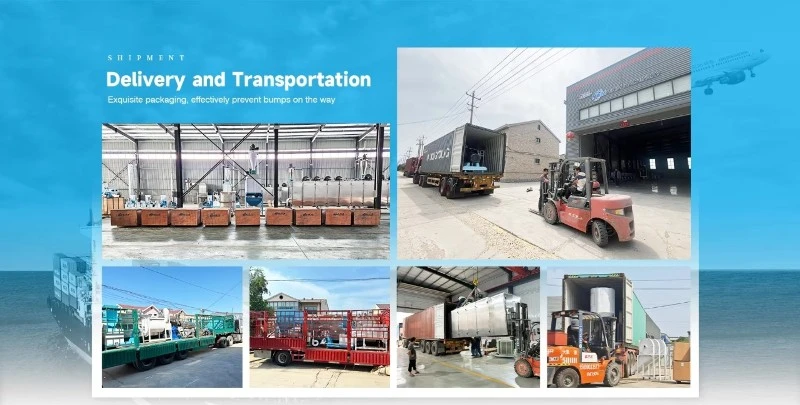
The wood press travels in one piece at 2620x1640x1770 mm and 5.2 t with lifting points; the chipper-hammer unit at 1500x700x1000 mm and 320 kg; the feed press at 1.7x0.65x1.75 m and 715 kg; the drying duct in sections joined on site.
Site preparation before arrival
Four items on the site drawing: an isolated foundation block for the wood press, 174.4 kW of incoming capacity with the cable route, a covered fuel store for the hot gas furnace, and a floor drain at the cyclone discharge.
10
How the FOB quote is split across the two product lines
Wood side items priced as a block
Crusher, airflow dryer duct with fan and cyclone, hot gas furnace, conveyor, wood press and die sets. This block changes with offcut volume.
Feed side items priced as a block
Hammer mill, feed press with conditioner, one die set. This block changes with the formula, because die thickness and hole size follow the product.
Shared items, spares and the drying fuel question
Cooling screen, bagging scale and cabinet are quoted once, with spares: one die set per press, roller sets, hammers, screens. Furnace fuel is bought locally against your offcut moisture, outside the FOB block.
11
Buyer questions on dual-purpose wood and feed lines
Questions on running both products
1
Can one 1 t/h line make both wood pellets and grain feed pellets?
Yes, in this build: 1-1.5 t/h at 4-12 mm on wood, 1-2 t/h at 1-12 mm on feed, and one 800-1000 kg/h cooling and screening unit behind both, one stream at a time.
2
Is the dryer used for the feed side or only for the wood side?
Wood only. The airflow dryer takes offcuts to 10-12% in a 13 m duct: furnace heat carries the chips in suspension, three bends hold them long enough to dry, and the cyclone drops them out. Grain never enters it, because the feed press takes mash at 12-20% after conditioning.
Questions on power and raw material
3
How much power does a 1 t/h wood and feed line draw, and which motor is the largest?
174.4 kW of connected load, with the 90 kW wood press close to half and the 23.85 kW feed press set second. Drives only; dust fans, lighting, the air compressor and furnace fuel are site scope.
4
What moisture and chip size does pine offcut need before the wood press?
One chipper-hammer pass at 1000-2000 kg/h produces chips the die accepts, and the airflow dryer brings them out at 10-12%. The chip size that matters is the one the die can grip, and it also decides whether a chip stays airborne in the duct.
5
Does the same cooling screen handle wood pellets and feed pellets?
Yes, the 800-1000 kg/h unit takes either product, one at a time. Air setting and deck cleaning differ, and equal bag weight fills to a different level.
Questions on changeover and shipping
6
How does the change from wood pellets to feed pellets work, and what has to be swapped?
Purge the wood path including the drying duct, swap die and rollers, reset the gap, discard the first feed batch, then condition once the die is warm.
7
How is a dual-purpose line shipped, and what is assembled on site?
Machine by machine. The 5.2 t wood press ships in one piece with lifting points, the drying duct in sections joined on site, and the crushers and feed press as complete units at the sizes in Tables 2 and 7.
Send your offcut volume and get a dual-line proposal: monthly tonnage and how wet it runs, the feed formula and its tonnage, shift pattern, plot dimensions, incoming capacity. Those inputs return a configuration, an electrical schedule by machine and a quote split into the three blocks above, through our contact page.